
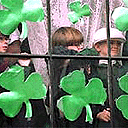
St Patrick's Day in New York is an excuse for all sorts of silliness. Latinos sell green tulips outside subway stations. African-Americans munch green doughnuts in McDonald's. Portuguese bakeries sell shamrock-shaped gingerbreads. Even 5th Avenue is given a green stripe for the day as Irish Americans parade along it after an emotional mass in St Patrick's Cathedral.
In fact, it's a day when the whole of New York seems to become "Irish" in a vaguely ersatz way. Old ladies invite you back to their homes to eat corned beef sandwiches and knock back a Jameson's or two; secretaries go to work in many shades of green.
Today on St Patrick's Day, New York lovingly embraces all things Irish. It was not always so; in fact, the Irish struggle against prejudice was bitterly fought.
The St Patrick's Day Parade is organised today by the Ancient Order of Hibernians, who formed a defensive Irish brotherhood in 1836 after the Catholic church of St Mary's, on Grand Street, was desecrated and burned. After the great famine of 1845, New York's population swelled with landless, impoverished Irish Catholics who arrived packed in like sardines on ships. Processed by the thousand at Ellis Island, they moved into New York City's most notorious slums, the 5 Points. Here, in grisly tenement blocks, families of up to 13 people shared a measly 250sq ft and lived in poverty.
In the 1840s-50s, job listings in newspapers often contained the initials NINA - No Irish Need Apply. Life was made difficult for Irish Catholics by both conflict with the impoverished African-Americans they displaced in the labour market, and from New York's Protestant elite. Initially, men could only find paid work as labourers. Irish sweat built the Brooklyn Bridge (killing 30 workers in the process), the subway system and Central Park.
And still they kept on coming. Two years after the potato famine, 40 "coffin ships" were arriving at Ellis Island every day. In 1860, Irish Catholics formed 25% of New York City's population. By 1900, the largest emigrant bank in the US (no WASP bank would take Irish money) was Irish owned. The police force, the fire service and City Hall all came to be dominated by the powerful Irish interests of the local Democratic political organisation, Tammany Hall, which used its clout to support Al Smith in his 1928 presidential bid. (Smith lost; and it wasn't until John F Kennedy's victory in 1960 that an Irish Catholic was installed in the White House.)
To this day, firemen and police officers walk in the St Patrick's Day Parade alongside marching bands representing each Irish county. The County Societies themselves run golf tournaments to raise money for their children's college fees.
The Irish networks that kept immigrants out of the poorhouse 100 years ago are still going strong, and are largely responsible for perpetuating a distinct Irish-American sense of identity still discernible in the St Patrick's Day parade today.
Way to go
British Airways (0845 7733377, www.britishairways.com) and Virgin Atlantic (01293 747747, www.virgin-atlantic.com) have several daily flights from London Heathrow and Gatwick to New York for £360 and £185 return, respectively. For accommodation, try the Gramercy Park Hotel, 2 Lexington Ave at 21st St (+1 212 475 4320, 800 221 4083; fax +1 212 505 0535), single $155, double $170; or the Cosmopolitan, 95 West Broadway at Chambers St (+1 212 566 1900, 888 895 9400; fax +1 212 566 6909), single $99, double $129.
Where to go
McSorley's Old Ale House
Address: 15 East 7th Street. Tel: +1 212 473 9148. Opening hours: 11am-1am (Mon-Sat), Sun 1pm-1am. Price: two mugs of ale cost $3.50. Lunch and dinner (basic pub grub) served.
McSorley's opened in 1854 with a woodburning stove in the middle of the floor which remains to this day. Located in the heart of Greenwich Village, it doesn't get better than this.
Flannery's Bar
Address: 205 West 14th Street. Tel: +1 212 229 2122. Opening hours: 8am-4am (Mon-Sun). Price: Two pints of Guinness cost $8. No food served.
Flannery's green wallpaper, wooden fittings, Killian's Red ale on tap and all Irish staff give this bar a distinctly Gaelic feel, not least on Monday and Wednesday nights when the walls resound to traditional Irish music.
Rocky Sullivans
Address: 129 Lexington Avenue (between 28th and 29th Streets). Tel: +1 212 7253871 (www.rockysullivans.com). Opening hours: Noon-4am (Mon-Sun). Price: Two pints of Guinness cost $10.
Bored with watery Guinness and blaring satellite TVs, Irish musician Chris Byrne opened Rocky Sullivans in 1996. His popular Wednesday night book readings have drawn top-flight Irish-American authors including Roddy Doyle and Frank McCourt.
Kinsale Tavern
Address: 1672 3rd Avenue (at 93rd Street). Tel: +1 212 348 4370. Opening hours: 8am-4am (Mon-Sun). Price: Two 20oz pints of Guinness cost $9.50. Lunch, dinner available. The fresh fish is recommended.
The owner Frank Skuse, from West Cork, serves a monster Irish breakfast of rashers and black pudding after a long night on the razzle, which you can wash down with a choice of Irish ales on tap, including Guinness, Murphy's, Caffrey's, and Harp lager.
The Irish Rover
Address: 37-18 28th St, Astoria, Queens. Tel: +1 718 278 9372. Opening hours: 8am-4am (Mon-Sat), 12pm-4am (Sun). Price: Two pints of Guinness cost $8.
Situated in the area of Woodside, Queens,which is an Irish American enclave. When Shane McGowan, the former Pogue, is in town, he's often to be found surrounded by the Rover's nostalgic prints of the Emerald Isle. Between May and September, the TVs hum with coverage of the Gaelic Games and on Saturday nights, live music bounces off the walls.
The Irish Arts Center
Address: 553 West 51st St Tel: +1 212 757 3318 (www.irishartscenter.org)
This is the place to learn the tin whistle and the bodhran, and brush up on your Gaelic. But it's not all shamrocks and green beer; it's a cultural hub for Irish Americans where up-and-coming actors and directors premiere cutting-edge drama in the 99-seat theatre, and give Dublin-based companies the chance to shine in the Big Apple. Established Irish art directors and writers give regular workshops: past speakers include Gabriel Byrne, Pat McCabe (of The Butcher Boy fame) and Jim Sheridan. Surprisingly perhaps, Latino kids from the neighbourhood (Hells Kitchen in midtown Manhattan) tend to fill the children's step-dancing class. The centre also screens films and documentaries, organises a monthly cabaret for young talent and exhibits Irish American artists.
The Tenement Museum
Address: 97 Orchard St Tel: +1 212 431 0233 (www.thirteen.org/tenement)
New York Walking Tours
Tel: +1 212 439 1090 (www.bigonion.com)
Irish Pubs Guide
www.execpc.com/~tjcasey
Irish Repertory Theatre
Address: 132 West 22nd St Tel: +1 212 727 2737 (www.irishrepertorytheatre.com)
St Patrick's Day special
• 'I was heading 60 miles out to sea, to a pirate's hangout' Sally Kindberg heads for the wild west of Ireland to visit a pirate queen's haunt 60 miles out to sea
• Cork tips Guy Mansell finds that the Republic's second city is competing with Dublin for the culture crown
• Shamrock rovers Joanna Israelsohn finds herself spoilt for choice when planning a trip to the Emerald Isle
• The 'fast show From war-torn province to hip weekend destination, Belfast has been quick to reinvent itself, says Katharine Viner
• The middle way Far from the tourist trail but only an hour from Dublin, Roly Smith explores the Irish Midlands and finds his perfect home in the hills
