
The man chasing me is brandishing a big stick. He's dressed in a suit made of animal skins and has a blackened face topped by a helmet adorned with goat horns. When he gets close enough he roars and throws a bag of ash over me. A little girl scrambles, crying, on to the flat roof of her home. She is frightened of the man with the big stick. I know how she feels.
In the Berber villages of the Toubkal region in Morocco's High Atlas mountains, this unorthodox game of tag is the aftermath of the Tafaska - the feast of the lamb - which commemorates Abraham's sacrifice of a sheep in place of his son and is held 60 days after Ramadan. Sheep and goats are slaughtered for feasting, and the skins are stitched into suits, worn for four pungent days.
Just 24 hours after leaving London, I am dashing about the terraced fields of apple trees with the village boys and men who are old enough to know better. Even my guide, Mohammed Elaamri, also a Berber, thinks it's all a little strange. Above us in the village of Aremd, every rooftop and street corner is filled with people swaying, jigging, dancing, chanting, clapping or banging a tambourine-style drum. By dusk, the goat-skinned men - there are up to eight of them each day - are knackered. The game ends with the muezzin's wailing call to prayer echoing around the surrounding mountains.
Morocco has all the advantages of being just 14km from Gibraltar, at the tip of southern Spain. It's close, but as different from a European break as you could wish for. And there's no visa documents or health precautions to worry about.
My flight arrived in Marrakech at about 11pm. The airport is only 4km from the medina - the peach-walled old town - and by 11.30pm I was in a different world. A succession of strong-smelling alleyways snaked through the city leading, unikely though it seemed, to the door of my hotel, Riad Les Cigognes.
Moorish architecture looks inwards; behind anonymous doors and walls is a hidden world of tiled courtyards with flourishing citrus trees, palms, bougainvillaea and fountains. I was staying in a riad or maison d'hte , a kind of upmarket B&B. Old properties in the medina and the neighbouring kasbah, the fortified town, are being bought and restored, providing beautiful, peaceful and intimate accommodation in the heart of the city. There are usually fewer than six rooms and rates are very affordable - between £25 and £70 for a double room with breakfast.
My plan was to spend two days hiking in the High Atlas mountains, then return to explore Marrakech for an evening and morning before the flight home on Sunday afternoon.
Topping out at over 4,000 metres, the Toubkal is the country's highest massif, although I was only trekking at around the 2,000m. The treeline peters out at the village of Imlil at around 1,500m, where there's a clutch of small hotels, cafés and shops selling everything from Mars bars to guttering.
Imlil is an hour and a half by road from Marrakech, the last 20 minutes on a swaying mountain dirt track clinging to the contours. The villagers have voted not to have it paved as they like their semi-isolation at the head of the valley and are worried about being inundated by Moroccan tourists in their cars.
With my pack strapped to a mule, we walked for 45 minutes over the pass to Aremd, Considering this is the closest village to the country's highest mountain, it is surprisingly free of tourist trappings. The Gte d'Omar in Aremd can accommodate 20 or so people, several to a room. The facilities are basic, but there is a shower - cold water is free, hot water costs 10 dirhams (70p). Fatima, Omar's wife, and her daughter-in-law bake fresh bread daily and cook delicious tajines - meat and vegetable stews cooked in earthenware pots with conical lids.
On my first day of walking we climbed to the tizi (mountain pass) that gave us a spectacular view into the neighbouring Tacheddirt valley. Walking at a steady pace that still left me breathless on the steepest parts, we saw few other tourists. It was quiet in early March, the beginning of the season in the High Atlas, but the sun was already strong, burning my face before I realised it. In the late afternoons, the temperature began to fall, and by the evening I was wearing two fleeces, jacket, thermal underwear, hat and gloves.
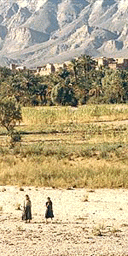
Descending through the sweet-smelling pines and gnarled junipers we saw the summit of Toubkal in the distance, a faint triangular point against the blue sky. Below were well-kept terraces of fruit trees covered in spring blossom. Boulders and scree covered the valley floor, the aftermath of dangerous flash floods that had been caused by summer storms.
Later, the first star of the evening, the Etoile de berger or shepherd's star, rose in the sky and, on cue, dark blobs on the mountainside began moving across and down the slopes. The flocks were coming home.
Returning to Marrakech after two days in the mountains was a culture shock - the sheer numbers of people, the rapidly changing smells, sounds and sights, but I discovered that the trick is to go with the flow. Be prepared to wander; if you follow the crowds, sooner or later you will end up in the huge square that is Djemaa El Fna.
On Saturday nights, the medina seems to draw everyone in the city. Get your bearings over a glass of fresh orange juice from the stalls ringing the edges of the square. Then it's time to check out the entertainment. There is something for everyone; fire eaters and snake charmers, musicians, magicians and monkey tamers, storytellers and scribes. Café de France has the best terrace panoramique .
Marrakech has four distinct parts - the fortified kasbah, the medina, the Jew ish mellah, and Gueliz, the new part of town built by the French early in the last century. There are many historical monuments but with just a half-day of exploration open to me, I picked out a few places to visit. Bahia Palace has ornate plasterwork and painted ceilings that have survived the city's dry desert climate. A dynasty of sultans and their many wives are buried in opulence in the 16th-century Saadian tombs, the walls decorated with marble and gilded cedar wood. The serene Majorelle Gardens, now owned by Yves Saint Laurent, offer a shady retreat if the bustle of the medina gets too much.
Finally, I made for the souks, where there are more than 2,800 shops selling Berber jewellery, slippers, leather goods and carpets that can be "DHL-ed to your home". I even passed a shop selling thrones. I saw carpets being woven and wool being dyed using pomegranate and saffron. I learned that the leather of goats and gazelles is much better quality than sheep or camels.
I spent the flight home bemoaning what I had not had the time to do, such as having a henna design painted on my hands, paying a visit to a hammam (public bath), or riding a camel. But, of course, it gives me the perfect excuse to make a return trip.
Way to go
Lisa Sykes travelled with Tribes (01728 685971) and flew to Marrakech with Royal Air Maroc (020-7439 4361). Tribes can tailor-make trips to Marrakech and the High Atlas Mountains. A four-night trip with two nights' B&B at a riad and two nights' full board in Aremd, with transport, a mountain guide and a city guide costs £645pp including flights. A long weekend in Marrakech, without the trekking, is cheaper. Royal Air Maroc flies direct to Marrakech three times a week from Stansted and daily via Casablanca from Heathrow. Return fares from £280 including taxes.
In Marrakech, Riad Les Cigognes, (00 212 44 384791) has doubles from 400 dirhams (£26), including breakfast. There are three double rooms plus a suite with two doubles and a lounge. Dinner is available for a minimum of four people. Other riads include: Riad Kaiss (440141), Riad El Arsat (387567), Dar Mouassine (445287), Dar Zina (385242), Dar Sara (385858).
When to go
March to May and late September to November are the best times to visit; avoid July and August, when Marrakech is very hot, and in the winter when the High Atlas are covered in snow.
Reading
Visit www.booktailor.com where you can put together your own customised guidebook for Marrakech and the mountains, for under £20, choosing the best bits from guidebook publishers and travel writers. Morocco National Tourist Office (020-7437 0073).
Ultimate weekends
Dream tickets
The Ice Hotel in Lapland, shopping in Dubai, or perhaps touring Britain in an Aston Martin DB6. Charlotte Atkins suggests something a little more adventurous for the weekend
Game on
What are you up to this weekend? Follow our examples and you could make your free time go a lot further. Charles Burgess swaps his civvies for a safari suit
All in the best possible taste
A 12-course feast prepared by a chef who has been awarded three Michelin stars followed by bed in a five-star hotel. It doesn't get much better, does it? Mike Kiely indulges himself in Lombardy
Comfort zone
Katharine Viner dons regulation robe and slippers, and destresses in style in the Chilterns
Horse power
Fancy some sunny days at the races? Former jockey Thomas Rees recommends a spectacular new course on the Costa del Sol
