
On the main drag in Fuengirola on the Costa del Sol - a sorry litany of cafés, bars, estate agents and shoe shops - there's a tired sign on the wall of an alley that announces The Sportsman's Bar. From within the dismal portals comes the drone of racecourse commentators, with all the news that you might want to know about the horses running at Wolverhampton, or Kelso, or Newton Abbot. It's a kind of souped-up betting shop on the Costa del Crime, with the Racing Channel on the television and a well-stocked bar for solace.
But it would be an unlucky punter who found himself lured there on a Sunday, since just a couple of miles up the road, in the foothills behind Mijas Costa, there is a spectacular new racecourse overlooking the sun-spangled sea, with all the promise of Brighton Rock and any amount of men in dark glasses muttering from the side of their mouths.
The Hipodromo Costa del Sol is the brainchild of Antonio Maldonado, for 18 years the first mayor of Mijas after the death of General Franco. A mind-boggling £24 million has been poured into the project, eventually to cover 250 acres of land with villas, hotels, shops and almost anything else that can be fitted on it. But the hub of the enterprise is the racecourse, to which all are invited for free every Sunday - even on an ordinary day 2,500 people turn up for the craic.
And a craic it is, since there's a distinct Irish brogue to many of the voices at the track, along with the English, so that, as in Ireland, there's none of the benighted snobbery that can sometimes plague a day at the races in Blighty. Not that there's an absence of competition at the track; there are plenty of cabals at the tables on the terrace. At first they seem formidable, but it's a false impression, since their members appear as comfortable with strangers as they do with their confederates.
The members' bar on the terrace, at the moment no larger than a tennis court, overlooks the broad promenade, with palm trees rustling in the breeze, that fronts the track, the winners enclosure and the paddock. Entrance to this eyrie is perhaps the one undemocratic idiosyncrasy of the track; it lies in the gift of the president of the Hipodromo, Señor Maldonado, though what policy of selection his office uses is not revealed. Owners, would-be owners, trainers and jockeys take their ease there, as well as sundry onlookers whose role it might be as well not to ask.
In due course, the grandstand proper will be built, a state-of-the-art edifice for 5,000 spectators with corporate and private boxes fit for Royal Ascot. But for the minute, the relaxed atmosphere of the terrace induces a languor unthreatened by the promised grandeur of the architect's plans.
Looking over the edge of the terrace at the horses in the paddock before the first race was a large man in an elegant double-breasted suit. He looked like Michael Caine before he assumes his threatening role. He looked promising. In fact he was affable and helpful, involved in construction in the Midlands. He knew his way about the formbook and gave the impression, which he did nothing to dispel when asked, that he might be able to accommodate a "commission". Damon Runyan would have called him a sportsman.
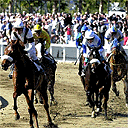
Diverted by a drunk at an inappropriate moment, I never got to know his selection for the race and, being non-plussed by the form in the racecard, I got it wrong. One man who had clearly not was Norman Jones, triumphantly accepting the winner's trophy, alongside his trainer, Peter Haley. Norman bounded up the steps to the terrace with his fake bronze statuette, apparently the very least of his gains on the race. He explained that he was the manager of the David Nicholls Racing Club in Spain, which forms syndicates of owners to race horses at the track. He explained a great deal more, but it was the kind of stuff a man needs to know before the race.
At one table on the terrace was John Reid, the international jockey for the big occasion, checking out the track while on a golfing holiday (complete with dark glasses); at another Robin Wakelam, a horse transport groom who last year shipped the British showjumping team to Sydney. With him was Lester McGarrity, the Irish ex-champion jockey of Belgium and now a horse dentist, who incidentally speaks seven languages (including horse).
Beaming at the alfresco delights was Frank Fallon, who owns the famed Red House pub outside Dublin on the Naas Road - his son has it now. "He's put me out to grass," said Frank, while admitting that he keeps his hand in on the Costa del Sol with his O'Brien's Bar in Fuengirola.
In fact we'd been there the night before to meet Eddie Creighton, the Irish trainer, to get the SP on the racecourse. He trains 50 horses in one of the 10 American barns built so far at the track. He came to Mijas 15 months ago with his wife, Catherine, and seven children, and a horsebox full of hope, after an honourable career as travelling head lad to Michael Kauntz and the late, great, Tom Costello in Ireland. Now he has a full team working for him (including offspring), with the classic-winning Irish jockey Warren O'Connor and Alan Mackay riding for the stable.
From Creighton's barn there is a walk up to the plateau of sea-sand, one-mile track, where various horses were exercising. Two days before the race meeting, there were few who were doing serious work (or gallops), since hopefully they were fit enough by then. Pipe-opening canters were the order of the day. The big four-year-old I was on needed no more then a hack once round the track and then another at an easy canter.
Alone, we wandered round to the far side of the track, with the sea glistening below us. It seemed like the brightest spring morning on the Sussex Downs, the air clean and lucid, the colt at one moment gazing out over the Mediterranean and then up to the snow-capped mountains above, his ears flicking like radar.
Señor Jose Joan Abrines is the managing director of the Hipodromo track. His CV reads interestingly for a man employed in a £24m racing venture on the Costa del Sol, including three years with the American Embassy press office in London and two years with the Central Office of Information at the Foreign Office in London.
Since the idea of a local council in Britain spending such huge sums on a racetrack seems a far-fetched social enterprise, it was as well to ask the justification for this jamboree. His answer was simple: "Because we can." All the money will be recouped by the development on the land, the largest project in southern Spain.
"We are Andalucians. We like horses," he admitted with a disarming smile. And the taxpayers? "Oh, they're very happy with the idea." Were they asked? Coy is an adequate expression of his response. The gist of it was that they would all be better off. And if they can develop the track in the manner of, for instance, Del Mar in California - "Where the turf meets the surf" - then he's right. It certainly looks the part.
Señor Abrines is both urbane and refreshingly frank about the perceived evils of illegal gambling and the wide boys that a new racetrack will attract. "The days of the East End villains on the Costa del Crime are dying out. They're all at least 70 years old and dying to go home," he said. "We've had approaches from English 'entrepreneurs', as they call themselves, but they never seem to want to put anything in. They just want to take it out."
It's a sad reflection on the local perception of the Englishman abroad, but then, they're not all like that. Hunting down the gold chain brigade so beloved of the tabloids isn't a rewarding game these days - they seem to be a disappearing species.
Way to go
Hipodromo Costa del Sol, Mijas Costa, Malaga (tel: 00 34 952 592700). Race days every Sunday, first race noon during spring and autumn, 11pm summer.
Where to stay
Fuengirola: (Tourist Office, 0034 952 467 457) - the nearest to the track is the Hotel Galicia with en-suite rooms from £12pp a night (0034 952 463301)
Mijas Pueblo: (Tourist Office, 0034 952 485900) recommended is Pension Mijas, a family-run village house with rooms from £12pp a night (00 34 952 485310). The four-star Hotel Mijas has luxury rooms with balconies (all with views), swimming pool and terraced restaurant from £75 per night for a king-sized double (0034 952 485210). Popular with owners and trainers is the four-star El Oceana Hotel and Beach Club at nearby La Cala. The hotel has a pool and private Jacuzzis situated on the terraces of guest rooms. From £75 to £140 a night (00 34 952 587550).
Flights
easyJet (0870 6000000) flies Luton to Malaga from £80 return, Go (0870 6076543) flies from Stansted, from £128 return.
Ultimate weekends
Dream tickets
The Ice Hotel in Lapland, shopping in Dubai, or perhaps touring Britain in an Aston Martin DB6. Charlotte Atkins suggests something a little more adventurous for the weekend
Game on
What are you up to this weekend? Follow our examples and you could make your free time go a lot further. Charles Burgess swaps his civvies for a safari suit
All in the best possible taste
A 12-course feast prepared by a chef who has been awarded three Michelin stars followed by bed in a five-star hotel. It doesn't get much better, does it? Mike Kiely indulges himself in Lombardy
Comfort zone
Katharine Viner dons regulation robe and slippers, and destresses in style in the Chilterns
High society
It's close, but about as different from Europe as you can get. Lisa Sykes walks through the High Atlas with Berbers and soaks up the atmosphere Marrakech's souks
