
In Christopher Buckley's satire The White House Mess, the president's staff want to keep the ambitious vice-president out of the way so they send him to Muscat, the capital of Oman, for a "cross-cultural conference".
It's still that sort of place. Half a century after the explorer Wilfred Thesiger first saw Oman, it still remains relatively and resolutely undiscovered. And Thesiger could hardly be accused of failing to plug it in his book Arabian Sands. Despite the fact that he chose to travel 1,000km by camel through the unforgiving desert of Rub-al-Khali, the Empty Quarter, Thesiger reckoned his five years with the Bedouin tribes in Oman were "the most important of his life".
It's pretty splendid still for, as well as sometimes magnificent desert, it's the land of frankincense, has terrific forts and ports, and wadis - oases of green and rock and water that spring on you unexpectedly. So, it doesn't need to be this obscure, but to a large degree it likes it that way.
Greater Muscat, the capital area, is three small towns strung along 35 miles of coast: there's Muscat itself, where Sultan Qaboos's palace, Al Alam, is, but not much else; Ruwi, with a lot of the hotels and almost all of the commerce; and Muttrah, with most of the tourist-pleasing bits. Government offices and new residential areas sprawl in between and alongside.
Ruwi, where we stayed the first night, is ugly, and we quickly escaped in a cab to Muttrah, strolled along the cornice at dusk and popped into the souq, where a mixture of frankincense-sellers and general shops, clothes stores and silver and gold merchants encourage but don't really hassle. When we went back there later in the week, there were more tourists around, and we haggled successfully, but business is conducted in an altogether lower key than, say, the market in Marrakesh.
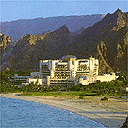
There are cruise holidays that pop into Muttrah, hit the souq, and get back on the boat. There are round-the-world jet tours that stay in Oman for a couple of nights but don't do much more than the souq and a stay at one of the big hotels across the city. Christopher Buckley's vice-president would have no doubt stayed at the Al-Bustani, a vast and eye-water ingly pricey hotel with a vast atrium and a floor reserved exclusively for the royal family. I preferred the look of the other premier-league hotel, the Hyatt Regency.
Sunbathing can be reliably planned: it had rained in Muscat in January and December, short showers, and these were the the first for three years. But the best of Oman seemed to be to be outside Muscat. To get around the country, you need to drive a lot. In Muscat, the dual carriageways are new and cared for, with flowerbeds by the side. But in 1970, when the Sultan took over, Oman only had six miles of road. To get far beyond Muscat, you need a four-wheel drive. And you really need a guide. That's why the holiday trade for Oman is still at the carefully-organised stage.
We went at a fair pace, 1,300 miles in four days, of which I'd reckon a good 40% was on bumpy, barely-planned roads where knowing the turn-off seemed to depend as much on feel and instinct as anything else. On these tracks there is barely any signposting and precious few other vehicles. But, especially to the south and east of Muscat, the rewards are great. The best souq experience was in Nizwa, partly because we headed there on a Friday, the best day to be there, for the goat and cattle market. It happens every week but the bustle and noise was thrilling.
Near Nizwa is Jabrin fort, a 17th-century castle, the first and most famous of several castles we visited. And then, into the mountains, towards the peak of Jebel Shams, and on to Oman's Grand Canyon, Jebel Akhdar. The rock is greyer and its area is much smaller, but it was not the only time in this week, with the contrasts of spectacular hills, desert and Vegas-style hotels, that I was reminded of the south-west of America.
Sometimes I bored of the sand and scrub. But on our travels - kind of Thesiger-Lite - there was a moment, an afternoon, that just took my breath away: stunning, authentic, a world away from home. Tony, our guide, drove off us off road, into the foothills of Wahiba Sands, an expanse of golden dunes. He knew a Bedouin family who had settled there, and decided we would go for lunch. Up and across - heaven knows how - we landed at their farm in the sand, where the women brought us plates, waited for us for us to finish, and then ate. That famous and true Bedouin hospitality. They lived and slept in rectangular, wooden tents, and kept goats that stayed in the shade under carts and vehicles.
We bashed along the coast to Ras al Jinz, at the north-eastern tip of the country, for a night-time appointment on the turtle beach. Again showing a method in their caution about tourism, the government restricts access to the beach at night-time. A guide asks you to wait and with luck finds a turtle that has made its way on to land to lay its eggs. We got the turtles, but not the eggs. It didn't matter to me. One of the guides was reacquainted with a turtle he'd marked before - proof that they return again and again to the same place.
The next day, we stopped at Wadi Shab, the best wadi we saw. In a beautiful valley, water teemed through the stone, feeding a lake and some spectacular date palms. There was a stupendous walk to be done there. Another time. The coastal town of Sur was pleasant, and the beaches around here looked terrific, too, especially at Tiwi, about the only place, outside Muscat, we saw a large party of holidaymakers.
Muscat is popular with Germans, but the tourist trade is emerging only slowly, encouraged by Sultan Qaboos. Getting a visa is still a hassle, the infrastructure is developing slowly, and the country is reluctant to turn its back on its traditional Arab life. It could be the new Dubai, golf courses and glitz, but it won't go that way quickly, if at all. There is a bit of oil, but not much.
About a quarter of the population of Oman is foreign nationals, high but nothing to compare with the 80% of so in Qatar and the United Arab Emirates. Oman men working for the government are required by law to wear traditional dishdashas , and many women wear abayahs . You can sink a cold beer in Muscat's business-class hotels, but you could pay £4 for it and alcohol is available in few hotels outside the capital and very few restaurants anywhere. The exchange rate works out at roughly £2 to one rial and Oman doesn't feel cheap. The food is fine, but not stunning, and you have to be prepared for plenty of Indian meals.
We had a day travelling west of Muscat, to forts at Rustaq, Al Hazm and Nakhl, and then hopped on an Oman Air plane to Salalah, in the very south-east corner of the country. It feels different, one remove from the more bustly atmosphere of the north. The land is much lusher and they do have a monsoon season, between June and September. The city itself is unprepossessing. Thesiger started off from here.
What it does have is the centre of Oman's frankincense trade, the trade that made it famous. A white, gloopy resin is taken from the trees dotted around Dhofar region in March and May, stored away from the damp monsoon mists, and sent to market in September. Legend has it that the three kings met up here on their way to Bethlehem.
The Haffa souk has good deals on the best local frankincense, called Hujari, and we stocked up on presents. I paid four rials for jars of frankincense, myrrh and sandalwood, and some charcoal and a pot to heat it on.
We travelled out of Salalah, one way to the archaeological site of the Queen of Sheba's palace and to good coastline around Mirbat, and the other way up in the mountains to Mughsail beach and to the tomb of the Prophet Job. They, like Salalah, are in the take-it-or-leave it category. Which is certainly not true of the country as a whole.
At the Dhofari museum in Salalah, I read another line of Thesiger's: "While the Bedu were prepared to tolerate me as a source of very welcome revenue, they never doubted my inferiority." In the nicest possible way, that statement still rings true still of most of Oman. It is a confident, traditional, unoppressively Arab country, the real deal.
Way to go
World Expeditions is this year launching a 14-day Journey Through Oman, from £1,495, land-only, starting from Muscat, or from £1,795 with flights from London. Contact 020-8870 2600, enquiries@worldexpeditions.co.uk. Will Woodward flew with Gulf Air, (reservations: 0870 7771717).
