
When I was 13 I bought my first and last harmonica, the classic Hohner Super Vamp, after my older brother played me Little Walter's 'Juke' on his Blues Volume 2 compilation. Finding myself musically illiterate, I quickly decided to leave it to the likes of 'Blind Lemon' Jefferson and other Delta bluesmen to express so perfectly my pubescent angst and yearnings - 'I'm broke and I'm hungry, ragged and dirty too. What I want to know sweet mama is can I go home with you?'
Now standing on the banks of the muddy Mississippi several decades later, I was finally about to enter heaven, or rather Greenville, home of the annual Delta Blues Festival.
For those used to the bunfight of British festivals such as Glastonbury, getting in was a breeze. You simply stroll up with your hampers and iceboxes or move in the kitchen sink in the pick-up truck. If you do happen to forget something, there's a horseshoe of stalls fringing the stages, selling everything from Buds to alligator kebabs.
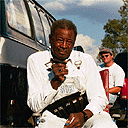
Scattered across the field, I picked out three stages. As I made a beeline for the one the wailing harmonica was coming from, I wondered whether it might belong to the next Blind Lemon Jefferson, Muddy Waters, Sonny Boy Williamson, Howlin' Wolf, Robert Johnstone, Son House or Jimmy Reed. All seven hailed from the Mississippi, as did Elvis Presley, Ike Turner, Bo Diddley and Tina Turner (who used to play Greenville's Flowing Fountain club for 50 cents). The guy playing the mouth harp on the Juke House stage turned out to be as old and frail as Methuselah but with a voice that could strip paint off walls.
Willie Foster, got his first mouth harp - also a Hohner - at the age of seven. Unlike me, however, he could play the thing. Willy howled like a coyote and when the instrument left his lips, a voice as dark and bottomless as that of his mentor and friend Muddy Waters, tumbled out.
It was the same voice he later used to demonstrate for me the difference between Chicago blues and Delta blues. First he minced his voice effetely into a twangy rubber band and sang faster R&B time: 'My baby gowwwwwn an' left me.'
Then the phrasing slowed, and a voice that belonged to the dead bellowed the same words again. One moved your feet, the other moved your soul.
Willie told me the first harmonica he'd bought cost 25 cents, 'and I had to save up cotton money two weeks to buy it'. When I asked who taught him to play blues, his face broke into deep smiling gulleys: 'A feelin' did... I had the hungry blues, the sick blues, the hard workin' blues an' the love blues. They all just tumbled out.'
After Willie's set, I worked my way through a thicker crowd encircling the main stage. The Jerry Kattawar Band were halfway through their set. Jerry, a third generation American of Lebanese origin who daylighted in a truck-rental business, could have been Jerry Lee Lewis himself, if his hair hadn't been as black as the rest of his outfit. Jerry hammered on his piano with his hands, his feet and his head, he stomped the floorboards, and leaped like a monkey on top of his piano before starting hammering some more. Jerry was taking us on a trip back to the early Fifties, when the white Mississipppi man got hold of the black man's blues to create rock'n'roll.
Watching Jerry, it became clearer why some Baptist choirs had refused the invitation to play the gospel tent that year. Ever since Robert Johnstone sold his soul to Satan in exchange for guitar mastery down at the nearby Crossroads, the blues and rock'n'roll had belonged to the devil.
The gospel tent was the only alcohol-free zone at the festival, and for good reason: everybody inside was already drunk on Jesus. The crowd swayed. The choir, dressed in identical T-shirts emblazoned with the single word, Christ, echoed the preacher who tirelessly worked everybody into a frenzy with his looping litany: 'They got some blues out there, what they need is Jeeesussss... They got some Budweiser out there, what they need is Jeeesussss.' Clearly, he too must have been in need of something because after 15 minutes he passed out.
Outside the tent, topless flesh grilled in the sun. One sizzling couple had fallen asleep lying on a pyre of maybe 30 Budweiser cans hugging the last two protectively to their chests. Skirting the field the concession stalls offered Polish sausages, red beans and rice, chitterlings (also known as chitlins) of hog intestines and even whole roasted pigs with crushed beer cans between their teeth. From this bacchanalian banquet, I chose 'ali-bobs' - kebab-sized chunks of alligator tail marinated in Cajun spices served on a skewer and tasting like tandoori chicken. Suzy and her brother, Clark, who wore several nasty zipper cuts across his face and neck, had driven 11 hours from South Georgia to sell their ali-bobs.
As the sun began waning, an elephants' graveyard of discarded animal bones littered the field. People sat on their cool boxes and beach chairs or strolled between camps, mixing easily. At 6pm it was decision time. Time to decide whether to stay for the headlining acts, the likes of Denise La Salle, or move downtown to a club where the local bands from the festival would already be setting up.
I drove slowly back into town, passing the occasional splash of privately owned Greek Revival pomp and a swath of shotgun shacks, where the majority of the impoverished black majority still lived. Greenville was home to bluesman Little Milton. It was also where Elvis regularly sent his private jet from his nearby home in Memphis to stock up on hot tamales at Doe's Eat Place (it's still there and serves two-kilo sirloins too).
Apart from these two claims to fame and the presence of the Missisippi River sneaking through its back door, Greenville was just another cotton town on the old blues 'chitlin' circuit (so named because musicians played for a plate of chitterlings at jukebox joints).
At the Flowing Fountain, Jerry Kattawar was again abusing his piano. Ninety-five per cent of the audience was black, aged between 21 and 121, and they came in all sizes. I could not remember ever being in a more relaxed club.
Jerry gave way to the O.V. Wright Band - led by another local boy, but one who preferred steamier Chicago-style blues. Couples older than my parents were engaged in what's commonly known as 'dirty dancing', where steps are of secondary importance to enthusiastic bumping and grinding. O.V. stirred the erotic cocktail, singing: 'Anybody here tonight with somebody else's somebody?' He repeated it three times. We could have been back in the gospel tent. Unlike the preacher, however, after several repeated questions designed to heighten the sexual frisson, his own delayed answer came: 'Well that's all right.'
Fact file
This year's festival (00 1 662 335 3523) is on 15 September. Admission is $20 (£14), payable on the gate.
For regional information visit www.thedelta.org. Perry's Flowing Fountain is at 816 Nelson St.
The nearest major airport is Memphis, three and a half hours' drive away. A return ticket from Gatwick with Delta through America Direct (0870 789 6688) costs £477 per person next month. All-inclusive car hire is from £32 a day.
For hotel information call the Greenville Convention and Visitors' Bureau on 00 1 662 334 2711. Room rates are between £42 and £70 a night.
