"You're here for a conference?" people asked us in Istanbul. Who would choose, they seemed to imply, to be in this hot, busy, sardine-tin of a city in the dog days? And didn't the English belong in beach resorts or business meetings?
After a while, we began to wonder if they had a point. To be sure, the city's splendours weren't lost on us: we admired the Aya Sofya, Emperor Justinian's 1500-year-old church; still standing, and still the grandest building in the city, despite various attempts that have been made to surpass it with increasingly breathtaking mosques.
We ate freshly caught sea bass down by the Bosphorous shore, blithely choosing to overlook the fact that our dinner had been hauled from one of the world's busiest sea lanes. We got bustled, barged and bullied in the covered bazaar, where my honest plea that I didn't actually want a backgammon board was universally interpreted as a particularly hard-hearted form of bargaining.
We were brutally assaulted by a masseur in the beautiful Cemberlitas baths, built by the architect Sinan, Istanbul's Christopher Wren, some 400 years ago. And we caroused in elegant Taksim, formerly the European embassy district, across the Golden Horn from the busy chaos of Old Stamboul.
But in the end, we couldn't hack the pace. So we took ourselves across the Marmara into Asia, to the endearing, almost impossibly sleepy town of Iznik.
Iznik, formerly Nicaea, has been capital of two empires, the Byzantine and Ottoman, and the scene of two of the great ecumenical councils of the Christian church. Yet Iznik today, still bound by its ancient walls, has no traffic lights (or traffic, apart from tractors and bicycles), and one roundabout. This roundabout (laid out by the town planners in 316BC) is evidently an object of civic pride: the only postcard for sale in Iznik is a time-delay photo of it taken at night, in the manner of Times Square or Piccadilly Circus. Tellingly, only one set of cars lights has been caught in the picture (and good money says it wasn't doing more than 10mph).
Although superficially similar to Istanbul, the longer you spend in Iznik, the greater the differences appear. In the centre of both towns there are examples of the venerable Byzantine church of Aya Sofya, scene of violent theological disputes leading to the schism of the Christian churches. But Iznik's church is a humble ruin, unvisited and attended only by a chatty old man who'll show you round and is happy to shoot the breeze with you. The total absence of a common language between you is no deterrent in this.
Both cities are surrounded by stout walls, but while Istanbul's have borne witness to countless tragedies - blinded emperors, hanged sultans and the fall of an empire - Iznik's march in fine step alongside a road troubled only by the kind of gaily painted tractors you're surprised to see outside of central Asia.
And while Istanbul looks out from a lofty prospect on the ferries and fishing boats of the Golden Horn, the cruise ships of the Bosphorous and the tankers of the Marmara, Iznik slumbers in a peaceful valley, with pedalos and row boats milling idly on the lake. The beauty of the situation is best appreciated on the walk out of town to the tomb of Abdulvahap, a companion of the prophet Mohammed who died nearby. The tomb itself wouldn't look out of place in an industrial wasteground, but the view of the lush plain of olive groves and orchards surrounding the walled city and its lake is a good excuse to pack a few cold Efes beers and some borek pie and stay for a picnic.
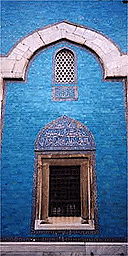
But the real value in escaping to Iznik was the chance to escape the tourist funnel in Istanbul, which leads you inexorably from monument to monument and tourist menu to carpet shop. Relentlessly friendly, the people of Iznik don't try to sell you anything you don't want, or dress anything up for your benefit. The local produce is (or rather was - in this as in everything, Iznik trades on its past) ceramics: Iznik tiles decorate most of the grander mosques of the early Ottoman domains. It was a relief to be able to amble round the workshops now producing handmade reproductions without being invited to drink tea or meet the owners' daughters.
Sit down in one of the restaurants near Aya Sofya, and you won't find English and German menus. In fact, you won't find a menu at all. We stood and looked bewildered (and presumably hungry) until we were offered a hearty Iskender kebab, cooked over wood. (Broadly, an Iskender is a doner kebab with tomato sauce and yoghurt - but then steak tartare is mincemeat with an egg in it.) We were, sad to say, wholly unequal to the task, and left wishing earnestly that we had been more hungry.
The bathhouse, too, was a revelation. Iznik's early Ottoman hamam is almost as beautiful as the Cemberlitas, and we assumed we knew what to expect. But our masseurs were far less squeamish about making sure we were clean under our towels (though without any impropriety), and had no compunctions about folding us up like rag dolls at the end of the massage. I left speechless: the sunburn I'd acquired during lazy afternoons by the lake had just been exfoliated with extreme vigour.
Sitting on the roof terrace of the Kaynarca hotel (whose proprietor, Ali, is one of the great unmentioned attractions of the city), listening to the silence of the streets, the quiet clatter of dice on a backgammon board and the sound of raki sloshing into our glasses, we realised that to relax in Turkey one has to leave Istanbul.
And so it was with not without regret that we took our leave of Iznik, planning our route back to the metropolis through the mountain city of Bursa; famed for its silk, its towelling, its beautiful mosques, and, most importantly, for being the birthplace of the mighty Iskender kebab. We stopped there for another one, of course.
Way to go
Seán Clarke travelled to Istanbul with British Airways, and stayed at the Hotel Ilkay in Istanbul and the Hotel Kaynarca in Iznik.
