
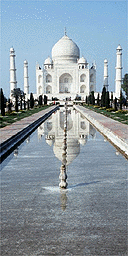
If you sweat your way up the Inca Trail to the mountain-top city of Machu Picchu this year, you will discover the cost of the trek has tripled. At the gates of the Taj Mahal, the admission fee for foreign tourists has skyrocketed by 6,000%. Holidaymakers in Majorca could face an additional tax of £1.25 per person per night. And in Florence you may soon have to fork out simply for strolling through Renaissance piazzas.
The heyday of the backpacker is over: nobody publishes guides celebrating the ingenuity of "Touring Europe on $5 a Day" anymore, while haggling with a rickshaw driver to save a few pence is definitely out. Being sensitive to the local economy and ecology is the new mantra.
It is not difficult to understand why. Every year we sightseers gather in larger and larger swarms. By 2010, the World Tourism Organisation estimates, there will be a billion tourist trips undertaken globally - compared with 663 million in 1999. The rise in air traffic volumes is even steeper, the economic pressure for new runways and terminals building all the time.
The problem is we congregate every summer in the most attractive heritage sites and wildlife reserves, generating lucrative business, educating ourselves about the world, choking native lifestyles, damaging buildings we have come to admire and spreading litter. Cities such as Venice, which hosted 11 million trippers last year, feel overwhelmed.
Increasingly, the solution of first resort is rationing by price, Galapagos Islands-style. Tourist numbers are limited to preserve a vulnerable habitat and expensive tickets are in effect the mechanism for restricting the destination to a profitable, upmarket clientele.
Peru's decision to hike the price of admission to the Machu Picchu national park - raising the cost of the permit from $17 to $50 for the four-day Inca Trail and access to the ruins - is a clear example of market pressures on what was for centuries abandoned stones and jungle vegetation. Independent trekkers can no longer go it alone. If they arrive at the park gates without a guide (and there must be one for every seven tourists), they are turned back to Cuzco. The new regulations follow an international outcry about rubbish spoiling the trail and fears the ancient site was not being protected.
Even in the developing world, such ticket prices are no longer exceptional. Poor countries with world-class ancient monuments are increasingly discovering foreign tourists as a ready source of revenue. Most of the money taken at Machu Picchu, it is promised, will be ploughed back in the form of improved services such as toilets and campsites.
Tim Murray Walker, marketing manager of the London-based travel agency Journey Latin America, understands the reasons. "With huge increases in visitor numbers, the strain on the local environment and services warranted the new regulations and price increase to cover . . . the upkeep of the monument.
"Peru wanted to restrict the number of people on the trail. It was like a constant caravan of backpackers." His company now offers 14-night "Peru for Walkers" tours at £1,718 per person, which includes flights, land transport, accommodation and full board on the Inca Trail.
But Murray Walker acknowledges: "You used to be able to get bucket-shop prices. It's a shame. It was backpackers who put [the trail] on the international map."
The best known example of prohibitive tolls is the Taj Mahal, the jewel in India's tourist brochures. Late last year, the Archaeological Survey of India (ASI) raised the entrance fee for foreigners from 15 rupees (22p) to 960 rupees (£14). Shortly before Christmas, Japanese tourists staged a sit-down protest. The ASI defended its price structure by pointing out that the Hermitage in St Petersburg charges non-Russians almost £7 - significantly more than the cost of tickets for locals. The additional revenue, the ASI added, would be invested in India's decaying monuments.
At one stage, guides outside the Taj Mahal reported up to 100 foreign students a day turning back in disappointment when they discovered the cost. "No one minds paying a bit more - say 100-200 rupees," said one young woman, "but $5, $10, even $20 is totally out of backpackers' budgets." In January, three tourists, from Sweden, France and South Korea, were arrested after climbing over the Taj Mahal's perimeter wall.
The practice of having a two-tier pricing structure, favouring national residents but discriminating against foreigners, is becoming more and more widespread. In the Jordanian desert city of Petra, for example, foreign visitors have to pay the equivalent of £20 for a day's ticket to the ruins; Jordanians are charged £1.
Introducing entrance fees is even more controversial if the architectural treasure is a living city where throngs of tourists become a problem of crowd control. Florence is actively considering levying 2,000 lire (64 p) from each visitor entering the city centre. In an open letter to the Corriere della Sera news-paper, the mayor Leonardo Domenici earlier this year suggested the supplement might be added to hotel or restaurant bills in Florence. "Cities and places of art must be open spaces, to be lived with no limitations," he declared.
"But it is fair that those who come to visit them contribute, even partially, to their upkeep. Cities . . . are submitted to increasing daily pressure. Wear and tear of monuments and works of art is no longer caused just by ravages of time."
In the Piazza della Signoria, a sign warns tourists to behave as though they are in a museum. Picnicking, littering, busking, trading and lying on the ground are all forbidden. A number of Florentine churches have begun charging for admission. The prices are clearly meant to preserve the heritage by keeping visitor numbers down.
There have been opponents to the scheme. "The city is for everyone," warned Professor Giovanni Carbonara, a director of the school of specialisation in restoration of monuments at the University of Rome La Sapienza. "If you make the historic town entry fee-based, it becomes a protected park, like a zoo." Money raised by the new tax, it is proposed, would be spent on security guards, restoring buildings, lighting and maintenance. The idea is still being debated.
The Balearic island of Majorca has an even more advanced scheme. Next year, if authorities in Madrid permit, a tourist tax of £1.25pp per night will be levied on hotels and apartments. Funds generated will be used to upgrade the island's infrastructure and, possibly, to destroy unsightly hotels constructed in the first wave of package tourism.
The policy could significantly alter the character of Majorca's tourist industry, forcing out the cheaper, sun and sangria market and transforming it into a more selective resort. For a familyof four, the new tax would add £65 to the bill for a fortnight's holiday. (Several years ago the Seychelles attempted to introduce a £75 environmental charge on visitors but gave up because of resistance from tour operators.)
The tourism industry is unsettled by Majorca's move. Hoteliers fear it will drive away a significant proportion of customers. The World Travel & Tourism Council accepts, in principle, that destinations can be degraded by pressure of visitors. "It may be necessary to reduce the carrying capacity and increase the yield in order to maintain the viability of an attraction," says Richard Miller, head of the organisation's research and economics department in the US.
But he adds: "If there's a need to put a price mechanism on, then the money must support the sites."
That is because what infuriates tour operators most is governments creaming off profits from the buoyant tourist industry. As air travel and tourism have boomed, so the price of visas and airport taxes have risen way ahead of inflation. The money is usually channelled away from tourism into national treasuries for general spending.
Charities promoting ethical and environmentally-sensitive tourism also doubt whether cash raised reaches those who most need it. Tourism Concern supports charging a "fair price" for heritage sites.
"If entry prices are too cheap local, communities will make no profit and have no incentive for conservation. It's a question of where the money is going," says Tricia Barnett, the organisation's director.
Even Rough Guide, whose handbookshave accompanied hundreds of thousands of students on their global wanderings, concedes the age of cut-price travel may be gone. "There's been a backlash against backpackers being so frugal," says Clare Southern, of Rough Guide. "You can't bargain everything down to the last penny. If you can afford to get to that country, you can afford to spend 10p or 50p. You can't be so frugal that it becomes offensive or insensitive to local poverty."
What other attractions around the world cost to visit
Cave paintings of the Dordogne: Perhaps the earliest move to protect heritage from the impact of tourism came in 1963, when André Malraux, the French Minister of Culture, decided to close Lascaux cave in the Dordogne. The cave contains a stupendous array of Paleolithic wall paintings, which were being damaged by excessive carbon dioxide created by the breath of thousands of visitors. Two galleries were reproduced, 200 metres away in Montignac. Now 266,000 people take guided tours to see replica paintings. Tours cost Ffr50 (about £5) for adults, Ffr20 for children 6 - 12.
Acropolis (Athens): Entrance fee to the main site Dr2,000 (about £3.50). Students half price, seniors Dr1,500. Plus Dr2,000 for entry to the museum. Free Sundays. Visited by 500,000 tourists a year.
Grand Canyon (Arizona): Entrance fee to the National Park is $20 (about £15) for a car and occupants. Individuals cycling, hiking or travelling by motorbike pay $10. Last year, on the busier South Rim 4.2m people rode the shuttle buses and just over 1.38m vehicles were admitted.
Machu Picchu (Peru, pictured): $10 (about £3.50). Half price with an international student identity card. Also half price for a second visit the following day if visitors retain their tickets. Fee for the Inca Trail and Machu Picchu has increased from $17 to $50 for adults and from $9 to $25 for students. Visitors figures average about 1,000 a day in June, July and August.
Stonehenge (Wiltshire): Adults pay £4.20, seniors and other concessions £3.20 and children under 16 £2.20 - and there is a family ticket (two adults and up to three children) for £10.60. Average of 800,000 visitors a year.
Alhambra (Granada, Spain): Entrance fee is Ptas1,000 (just less than £4). Visited by 2.2m last year.
Chichen Itza (Mexico): Admission to Mexico's most famous Mayan site is 85 pesos (about £6). On Sundays and Bank Holidays it is free but there is a 35 peso charge for the sound and light show. Visitor figures not known.
Valley of the Kings (Luxor, Egypt): Admission, including entry to three tombs, costs E£20 (£3.25). Individual tombs have separate admission fees: Tutankhamen's tomb costs E£40 (£6.50), Queen Nefertari's E£100 (£16), students half price. Visitor figures not known.
Pyramids and Sphinx (Cairo): E£40 (£6.50), students E£20 (£3.25). Visitor figures not known.
St. Mark's Basilica (Venice): Free but L3,000 (just under £1) to see the Palo d'Oro altarpiece and L4,000 for the Treasure. Discounts for students/seniors. More than 5m visitors a year.
Roger Bray
