
It's 9am on a cold, summer morning outside the House of Commons and confusion reigns as people frantically mill around outside parliament.
So what's new? Politicians are busy people, as they constantly remind us. But it's August, and with parliament in summer recess until October 15, the people outside are not MPs and spin doctors, but tourists, anxious to take a look at "the home of democracy", as one American (as only Americans can) told his son.
The Palace of Westminster, London's newest tourist attraction, only opened for business last week but has already seen more than 30,000 visitors pass through its doors.
Many more would have been on the tour if only a few signs had been placed outside the buildings directing eager tourists where to gather for tickets. However, this did allow for amusement as confused sightseers quizzed previously calm tourists to such an extent that soon no-one was confident they were in the right place.
Order was soon restored by Jan, our tour guide, who lined us up like sheep heading for a cull so that we could pass through security checks, before we embarked on the tour of parliament which traces the Queen's route when she makes her address at the start of each parliamentary session.
The first room that catches the eye is the Queen's robing room, a huge, beautifully decorated room where the Queen dons her ceremonial robes before the state opening of parliament. From here, the tour moves into the Royal Gallery, now largely a ceremonial room used for banquets when welcoming foreign heads of state.
On display in this hall are documents which date back to 1497 such as the bill of rights, the 1706 articles of the union, the death warrant of Charles I and a warrant for the arrest of Oliver Cromwell, dated January 29 1649. These were all taken from the Victoria Tower, which rises 100m into the sky and holds a vast array of public and political records on more than five and a half miles of shelving.
Both sides of the room are adorned with huge paintings of the death of Nelson and the meeting of Blucher and Wellington after the Battle of Waterloo on June 18 1815. A more contemporary painting in the room is a set of canvasses depicting a debate in the House of Lords, from which Baroness Thatcher's face fixes you with a steely stare.
Also on display is a miniature model of the Palace of Westminster as it was before most of the Palace was destroyed by fire in 1834.
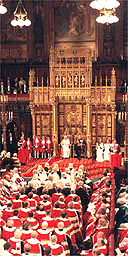
Entering the chamber of the House of Lords is one of the highlights of the tour. Although many people will be familiar with it from television, it is only close-up that the real splendour of the Queen's throne, restored in the 1980s, can be appreciated.
Visitors are then led past the woolsack, a reminder of how important the wool trade to colonial Britain, and finally allowed to sit - not on the famous red benches, but on the steps towards the back of the chamber where Jan, relays the current composition of the Lords with impressive ease.
Heading away from the Lords, it is interesting to note that general decor begins to fade as the tour gets closer to the House of Commons - a leftover from the days prior to the Parliament Acts of the early 19th century when the Lords wielded more power than the Commons.
Next is the central lobby, a hexagonal-shaped room at the heart of parliament which is a meeting point for the journalists, Lords, MPs and lobbyists who stalk the corridors of power. It is also home to one of the Palace's post office's, from which MPs mail around 500 letters to constituents each week - at the taxpayer's expense.
The central lobby stretches down to the Members' Lobby and beyond that the House of Commons. A bronze statue of Sir Winston Churchill overlooks the doorway to the chamber, his left foot has been rubbed smooth by Conservative MPs as a good luck charm before making a big speech.
Churchill's legacy remains in the fabric of the chamber as he took the decision to use the original archway, of which the bomb damage is clear to see, to the chamber when it was rebuilt after being destroyed in the second world war.
The most interesting part of the tour is the walk through the No Lobby, the small corridor that MPs must pass through within eight minutes of a vote to register their opposition to it. Lined with books, this much-maligned voting system is archaic, but kept because it gives members a reason to meet and lobby one another.
From here, we entered the Commons chamber, passing the Speaker's chair and being allowed to stand - but again, not sit - behind the green benches. Although it's hard to imagine what the atmosphere must be like at prime minister's questions when the chamber is packed to the rafters, the surprisingly small chamber, that cannot comfortably accommodate all its 659 members, hints at the intensity which must be felt.
Again, this is a throwback to Churchill's days. When the new chamber was built, the opportunity to expand it existed, but the original size was kept so as to ensure the intimacy of the place was not lost.
From the modern day home of debating, the tour than moves to St Stephen's Hall, which rests on the site of the St Stephen's chapel. This is the chapel where Henry VIII granted parliament a proper meeting place and ultimately led to the present House of Commons. It was the original chamber before being burnt down in the 19th century.
This hall also displays the effects of one of the great political movements of the post-industrial age - the Suffragette movement. A sculpture at the far end of the hall still shows the damage caused to it when Emily Davison chained herself to it in one of her more dramatic displays of political militancy.
The tour finishes off in Westminster Hall, a grand expanse dominated by its 13th century Hammerbeam wooden roof, which was the place for the trial of Guy Fawkes, the agitator who was caught red handed in the Palace of Westminster on November 4 1605 while trying to blow up parliament. This room was also the home of the law courts until the 19 century, and more recently was used to house Churchill and Gladstone when they lay in state.
Tour information
Tour groups of a maximum of 25 leave every few minutes from the Sovereign Entrance. Tickets for the one hour and 15 minute tour cost £3.50.
Opening times
August: Mon, Tues, Fri, Sat - 9.15am to 4.30pm.
Wed and Thurs - 1.15pm to 4.30pm.
September: Mon, Fri, Sat - 9.15am to 4.30pm
Tues, Wed, Thurs - 1.15pm to 4.30pm.
How to buy tickets
You can buy tickets from www.ticketmaster.co.uk or telephone: 020 7344 9966. Westminster Hall, within the Palace of Westminster, also has a ticket office which is open from 8.45am to 1pm daily, except Sundays and Bank Holidays.
How do I get there?
By rail: The nearest British rail stations are Charing Cross, Victoria and Embankment. Underground: Westminster (Circle, district and jubilee lines).
By bus: 3, 11, 12, 24, 53, 77a, 88, 109, 159 and the 211 all stop nearby.
Interactive guide
Find out more with our interactive guide to parliament
Useful links
Ticketmaster.co.uk
Parliament
