
My first visit to Switzerland, and not so much as a cow bell in sight. In fact, the only cows I saw all turned out to be from Scotland. Possibly this was because I was staying in the country's tiny, little known, Italian-speaking region, the very existence of which many of my friends claimed to doubt.
Well, I've been there and can vouch for it, but it is definitely a case of blink-and-you'll-miss-it: the Ticino region takes up only 6% of Switzerland's surface area. The majority of its tourist trade is internal - city dwellers from Zurich and Geneva who make the most of the chance to experience a slice of Italian cooking, culture and dolce vita without having to forsake the comforts of Swiss efficiency, or the country's enviable scenery. Italy made in Switzerland, as the guide books put it.
The Ticinese are proud of their beautiful corner of Switzerland, its history and its rich culture. The canton of Ticino encompasses Lake Lugano and the top third of Lake Maggiore. The lakeside towns of Lugano, Locarno and Ascona are its best known attractions, but the region is also home to medieval castles, vineyards and a skyline dominated by the Alps in the north - with the added benefit of more hours of sunlight per year than the rest of the country. The short flight from Zurich to Lugano was one of the most breathtaking I've ever been on.
My first stop was the Splendide Royal Hotel which overlooks the lake in Lugano. The eastern part of the town is called Lugano-Paradiso. How nice, remarked my companion, to be able to say "I live in heaven." Heaven, then, is a bustling town with a Mediterranean climate, full of smart shops, clean and tranquil streets and a beautiful lake flanked by mountains. Yup, that'd do it for me too.
Harvest festival celebrations took over much of the centre of town over the weekend I was there. The square outside the Church of St Maria degli Angioli (the Luini fresco inside, although heavily restored, is well worth a look) had become a temporary bandstand for a brass band, who played enthusiastic versions of Beach Boys and Boney M songs. Shoppers heading for nearby Versace and Yves Saint Laurent boutiques stopped to listen and enjoy the fun.
Lugano is one of the country's largest pedestrian areas: you can certainly while away many hours window shopping, salivating over the designer clothes, jewellery, and local produce. Check out the Gabbani food shop and its array of salamis and local cheeses. Many indigenous delicacies have either mushrooms or chestnuts as the central ingredient, both staples of the Ticino diet for hundreds of years. Chestnuts - 'the brown gold' - are made to serve a million and one culinary purposes: I tried bread sticks, marmalade, madeleine cakes and a sweet puree all made from this local staple. Fresh porcini risotto is also highly recommended, and a local walnut liqueur, noccino.
Merlot grapes have been grown in the canton for over 100 years, and now form the basis of 83% of all wine production. At the Delea vineyard above the Bellinzona, the canton's capital city, I tasted their white and their sparkling merlot. The setting undoubtedly helps - it was a beautiful clear day and the vineyard enjoys a spectacular view of the valley below and an isolated position.
What with the sun and wine, I'd have been very glad to book myself a room and spend the rest of the afternoon and evening there: the Deleas have eight newly and meticulously refurbished rooms available on a b&b basis. Still, if it's real real isolation you crave, you would do better to head still further up the mountain to the old village of Raza, accessible only by funicular. It has one restaurant and one hotel.
Bellinzona itself is a must-see. Home to three medieval castles, last year it was made a UNESCO world heritage site. 10 years ago, a lift was installed to take lazy tourists from the bottom edge of the town to the castle's ramparts, but don't miss the walk back down with its views of the town and sudden delights through arrow holes. Having made it to the castle, I sat in the main courtyard under a huge oak tree and fortified myself with a cappuccino before climbing to the top of the tower, where the view made me gasp out loud. The main castle, Castelgrande, housed a modern art exhibition earlier this year and was still sporting a (now rather tatty) huge red stripe, sash-like, all around its walls. (No, the sponsor wasn't the Jamaican lager. Seems like a missed opportunity to me.)
100 years ago, Turner was enchanted by Bellinzona. You can see his watercolours of Ticino and Bellinzona's castles in the Tate Britain. Other artists have fallen for the charm and tranquillity of this corner of Switzerland. James Joyce visited, and it was the long-time home of Herman Hesse: there's a small museum devoted to the Nobel Prize winner in Montagnola. Selections of his work are read in German and Italian every Sunday at 5pm. There is a vast array of small festivals throughout the summer months.
Perhaps the best known is Locarno's film festival in August. As well as attracting Hollywood's great and good, the festival boasts one of Europe's largest outdoor screens.
Contemporary architecture enjoys an unusually high profile thanks to one of the region's most famous sons, Mario Botta. Acclaimed internationally for his design of San Francisco's Modern Art Museum, the architect's work is all over Ticino - from the chairs in a museum's lecture hall to a brand new cable car station.
But it is Switzerland's natural beauty that draws most visitors. The Ticino region may not be able to lay claim to the huge mountains of its neighbours, but there's no shortage of beautiful and spectacular scenery. Hiking and nature trails criss-cross the nearby mountains and valleys, and cyclists are also well catered for, with 200km of paths across the canton. Like your action more thrilling? Try freefalling off the 220m-high concrete Verzasca dam, which features at the beginning of Goldeneye. You freefall for 80m before your parachute kicks in. I'm told this is a good thing.
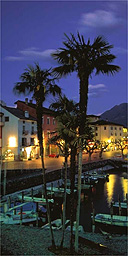
More down to earth fun can be had at the lakes, which are safe for swimming all year round (can't guarantee the temperature outside of summer), with windsurfing and sailing also readily available. Or take the lazy option and board one of the many boats which will take you on a gentle tour round the lakes. There are three golf courses, in Ascona, Losone and Magliaso, and you can even ski - there are 12 resorts with ski-runs for all levels. This is possibly the only place in the world where you will be able to ski past palm trees.
In Locarno, we drove past a crowd of people in a central square, watching youths scrawl graffiti on various placards. I gasped. I'd been wondering what happened to Switzerland's disaffected youth and why everywhere seemed so clean and well kept. Had the good burghers gathered to watch in horror as thugs defaced their city? No, my guide told me, this was in fact an officially sanctioned graffiti competition. Italian creativity combined with Swiss order and tranquillity: need I say more?
Way to go
Imogen Tilden travelled with the Swiss Travel Service and stayed at the five-star Splendide Royal Hotel, Lugano. A three-night package costs £552 and a seven-night package costs £905. Both prices are per person, and based on two people sharing a standard twin/double room on a b&b basis. The price includes scheduled flights with Crossair from London City airport to Zurich and return rail transfer from Zurich to Lugano. A half-price rail card is also included in the package. For further information and reservations call the Swiss Travel Service: 0870 727 5910. For further information on the Ticino call the Switzerland Travel Centre on 00 800 10030.
There are direct trains to Lugano from Germany, France, Belgium, Holland and Italy. Daily flights from Lugano airport connect with Zurich, Geneva and Rome. The San Bernardino motorway links Ticino to eastern Switzerland, Germany and Austria.
Useful links
Ticino tourism official site (includes accommodation information)
More about Ticino
The Herman Hesse museum
More about Mario Botta
