'Welcome," the perfume seller cried when I walked into his tiny shop in the souk in Damascus. And then, anxious that I might not have got the message, he opened his arms wide: "Ahlayn." Twice welcome - a traditional Syrian greeting.
A year ago, I came here for three months. Returning a month after the suicide bombings in the US, the hospitality was as warm as before. Syrians, though bemused by Britain's support for the bombing of Afghanistan, continue to offer a courteous welcome to their foreign guests.
As I left with my bottle of musk oil, I was presented with a tiny phial of rose water. In another shop, a glass of tea was brought to me on a small, silver tray. The old desert hospitality is still in evidence here as is the desert itself - desert scrub, really - which you first see as the plane comes in to land, banking steeply over red sand and flat-roofed houses.
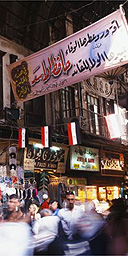
Damascus is only a five-hour flight from London, but its beating heart - the walled city with its seven gates - is a whole world away. Here, dark-skinned village women in long dresses of cerise, pink and orange squat by the kerbside selling apples, dates and walnuts. Tall men wearing checked keffiyehs and brown cloaks trimmed with black amble along the footpath. Women, shrouded and veiled in black, trail toddlers behind them. At the top of the crowded Hamidiyeh Souk, a man in tarboush (fez) and Turkish trousers sells tamarind juice spiced with rose water. Felafel stalls are everywhere and so too are the persuasive street vendors. If you don't want to buy, then don't. "No thanks" (" la, shukran" ), said firmly and with a smile but without lessening your pace should do the trick.
Damascus goes back a long way. The Romans built a huge temple to Jupiter here. With the fall of the empire, however, the locals took up residence within the temple walls and later a Christian church was built on the site of the inner sanctum. Then Islam arrived, and the stunning mosque, which the ruling Umayyad family built in place of the church, is now the third most important Islamic site after Medina and Mecca. Try to see it early in the morning when the sun gleams on the gold domes, on the 8th-century mosaics and on the dazzling white-tiled courtyard. Inside, people gather to pray and to chat. For the visitor, it's a great place to sit and rest. Women breastfeed their babies, small boys turn somersaults on the railings round the prayer area, children play skidding games on the loose carpets and the devout lower their foreheads in the direction of Mecca: in Islam, the sacred and the profane go hand in hand.
Close to the mosque is the tomb of Salahadin, the Kurdish sultan who knocked Richard the Lionheart off his crusading perch. Round the corner is a cavern where silk used to be dyed and which is now the Umayyad Palace Restaurant, run by a Palestinian and serving excellent traditional food.
The Syrian Arab Republic, to give it its full title, is a secular state and though Islam is the predominant religion, there are also a number of Christian churches in the old city including Armenian, Greek Orthodox and Latin Catholic, as well as a synagogue serving the estimated 4,000 Jewish people still living here.
But, make no mistake about it, although cellphones are on the increase and every street offers an internet office, although many men and women wear western dress and quite a few have four-wheel drives, Damascus (known locally as Cham) is an Arab city. One evening, I went with a friend to Al Ezz, a restaurant close to the Umayyad popular with Damascenes. The air was scented with apple from the narghilas (hubble-bubble pipes), which everyone was smoking. The women smoked, too, though many of them, with lots of blue eye shadow and kohl, had their hair concealed beneath a hijab .
Just after midnight, the drumming started and a dervish whirled into action. Arms raised heavenwards, the trademark white skirt fanning outwards, his movements became trancelike until finally the drums climaxed to approving shouts of "Allah!" It was the Umayyads who, fleeing to southern Spain, took with them their music and with it the cry of Allah which in Andalucia translated into "Ole!"
On another warm, jasmine-scented night, we went in search of wine and found Oxygen, an intriguing late-night restaurant in the Christian quarter, with DJ and dance floor and serving Italian food - as well as Jameson. Dinner, plus wine, was S£500 (£7).
Damascus was once the trading capital of the Arab world. Merchants stopped here on their way to India and China, buying and selling spices and carpets. A must-see is the 17th century Assad Pasha Khan - where the camel caravans used to pull in. Beside it is Damascus's most famous hammam, the Al Nouri. Here, you can luxuriate in the steam, have a massage, a glass of tea and loll about on marble slabs.
But be warned, it's men only. Women should wander over to Saruja, the old Turkish part of the city outside the walls, where they'll find El Ward Hammam open for female clients (noon-5pm Tuesdays and Wednesdays). The hammam is the place where fat is beautiful, so if you're that way inclined, let it roll. After a fierce scrub-down, followed by a massage, I came away walking on air. Cost: S£200.
I also found a small, one-star hotel in Saruja which offered a choice of lavatories - oriental and European - as well as tea and coffee on demand, endless and friendly advice on where to go and how to get there plus a shady, vine-covered courtyard with a fountain which, lit at night by coloured lanterns, was the perfect place to end the day. I arrived unexpectedly at 5am once, from Baghdad, eyes drooping with tiredness and fell asleep on a mattress up on the flat roof just as the morning star was rising - and the nearby minaret was starting its wake-up call.
Incidentally, if it's adventure you're after, head for the desert ruins of Tadmor - Palmyra to the classicists. A few hours' drive out of Damascus along a desert road, Tadmor was once the royal dwelling of the third-century renegade Queen Zenobia. Here, it's possible to have a short leisurely camel ride among the toppled Roman pillars or you can trek off for a few days, eating Bedouin food and sleeping in a tent.
Even more adventurous is to take a kamikaze walk across a Damascus street. Any street. The trick is to move off at a steady pace smack into six lanes of traffic. If you keep going you will, miraculously, emerge unscathed on the other side. It's like a synchronised dance: falter and you throw everyone else off course. Damascenes do it with style, foreigners screw it up for everyone else.
And what to bring back? Narghilas: the shop by the Hejaz Railway Station will do a package for about S£500. For someone's bottom drawer, get a genuine Damask tablecloth in the souk (S£1,000). For CD-Roms, try the square in Saruja where they start at S£100.
And remember, with things so cheap, generous tips and baksheesh won't do too much damage to the wallet.
Way to go
Getting there: Syrian Arab Airlines (020-7493 2851) flies London to Damascus three times a week for £310 return. KLM, BA and Austrian Airlines offer flights from £430. From the airport, catch the service bus to Baramke for S£20. Then a taxi to your destination, about S£30. A taxi all the way will cost S£500. There is an airport departure tax of S£200.
Where to stay: Adonis Travel, Damascus (+11 513 4859, adonistravel.com) offers six nights' B&B in a four-star hotel, double room, for £175pp. Al Rabie (one-star) Hotel (fax: +11 231 1875) in Saruja-Bahsa costs from S£250 a night.
Where to go: Adonis Travel also organises day excursions to Tadmor, with lunch and a guide from £70 for two people. Independent travellers should catch a minibus to the Harasta Bus Garage from where buses leave regularly for Tadmor, cost S£50. Camel trekking is organised by Zenobia Desert Camp at Tadmor (+31 912 407).
Further Information: from the Embassy of the Syrian Arab Republic, 8 Belgrave Square, SW1 (020-7245 9012), office open 9.30am-3.30pm. Visa applications cost £35. An Israeli stamp in your passport means you won't be given one. See also syriatourism.org.
Country code: 00963. Time difference: GMT +3hrs. Flight time: 5 hours. £1 = 74 Syrian pounds.
Mary Russell's next travel book, Journeys of a Lifetime, will be published in the spring by Simon and Schuster and Townhouse.
