
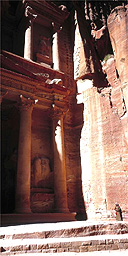
Elizabeth Seal. Don Seligmann. Keith Moseley. Eileen Brown. Wing Commander Rob Singleton. Moggy from Barrow. The Sugden family. I don't know where you live, but I know you're British, for you signed your names and gave your nationalities in the visitors' book in the museum high in a rose-red rockface at Petra where the curator, a handsome old Bedouin who reminded me of Spike Milligan, offers glasses of toothsome mint tea to dusty tourists.
You are among the very few British visitors to this dreamy archaeological site since September 11, and some of Jordan's few remaining tourists. While this is bad news for the Jordanian economy, from a selfish point of view, it means that you and I have had Petra pretty much to ourselves. And this, in an age of mass tourism where nearly every world-class heritage site from Petra to Angkor Wat crawls with tourists, is little short of a miracle. Albeit a dark miracle wrought by the destruction of those much younger monuments, the twin towers of the World Trade Centre.
Sandwiched - with an emphasis on the sand - between Israel, Syria, Iraq and Saudi Arabia, Jordan is, as yet, a remarkably peaceful country. A peacebroker among nations, this young kingdom (born 1946) is a safe and welcoming place. Come here and learn first hand about the countries we know as the Middle East. Certainly, there is an inescapable police presence throughout the Hashemite Kingdom, but you will probably feel thankful for this. Here is a country set between conflicts where you can rent a car, or camel, and set out on your own without fear.
As to the future, who knows what it will bring, although the bombing of Afghanistan can only inflame the spirit of peoples living here - the large majority are displaced Palestinians - who feel hard done by. No one I met, however, was anything less than saddened by the New York atrocity. Only students demonstrating peacefully enough at Amman university seemed to be anything like Osama bin Laden fans. The sanest views of all on the regional situation, I couldn't help thinking, were those of Bedouins (a small minority of Jordanians today), many of whom remain entirely sceptical of the notion of nation states and all their devious ways. Allah knows, history, the British and other imperial powers, have tricked them enough times.
The Bedouins who man (this is a country of men; out of Amman, the women are hidden away) the souvenir stands and cafés in front of the stunning rock-face monuments of Petra are far from being out of touch. Don't come to Jordan in search of some Lawrence of Arabia/David Lean epic experience. Some wear traditional costume, others sport Gucci jeans and Nike baseball caps. Mobile phones have replaced curved daggers as the must-have accessory even though games of draughts are played using pebbles and bottle-tops on boards scooped by hand from the desert sand. Nike, by the way, in the guise of a statue on the unforgettable facade of the Petra's famous "Treasury", is one of the very first sights you encounter on coming through the narrow defile that leads to the secret city. Goddess of Global Branding, she is mistaken by older tourists for the ancient goddess of Victory.
Having Petra almost entirely to yourself is like being a visitor to southern Jordan circa 1970. It is a great experience and highly recommended. If you get up early enough you can even get some good photos before the sun scalds the rocks. The well preserved Roman city of Jerash, north of Amman, with its fine theatres, colonnaded streets, oval plaza and nymphaeum offers a similar experience. The place is yours. And no one tells you off from clambering where you will at either Jerash or Petra.
Not that this is true everywhere in Jordan. The government has begun taking steps to restrict movement through some of the country's most delicate and endangered landscapes. Journeys from the new concrete village of Wadi Rum, gateway to the stunningly beautiful desert crossing the border between Jordan and Saudi Arabia, must now follow defined tracks to prevent erosion of the precious topsoil. The whole area, covering hundreds of square miles has recently been designated a Nature Reserve under the auspices of the RSCN (Royal Society for the Conservation of Nature). Not before time.
I go to see Lawrence's Spring (Ain Shalaaleh), where Faisal and Lawrence are said to have watered their camels before their famous attack on the Red Sea port of Aqaba. Ancient graffiti dedicated to the gods has been upstaged by the spray-on stuff of 2001AD; this says something along the lines of "Jordan for the Cup" and "Amjad loves Fatima". It is accompanied by an exhibition of contemporary land art featuring discarded Coke cans and cigarette packets. Conservation is finally becoming a priority in a country in which modernisation and the rise of Amman, the water-guzzling capital, threatens to destroy the delicate balance of life in the magnificent deserts that, with the exception of the fertile Jordan Valley, define the geography of the kingdom.
There is something very odd in arriving back in Amman, an unplanned city sprawling across seven hills, and settling into a five-star hotel after spending nights in the southern desert. The huge TV in the Grand Hyatt offered more channels than anywhere I've been this side of New York. Taking off my boots and pouring red sand from them into the litter bin, I found myself watching a ripping British documentary about Stanier steam locomotives of the former London Midland and Scottish Railway. Hoots from "Jubilees" and "Duchesses" were all but drowned out by the amplified muezzins calling the faithful to evening prayer.
At Amman station, headquarters of the legendary Hejaz Railway that once took pilgrims from Istanbul via Damascus and Amman to Mecca, repairs are being conducted on a British locomotive which one day will take tourists south past the international airport in wooden coaches and perhaps all the way through Wadi Rum to Aqaba. Ali Hassan Jadallah, the enthusiastic traffic manager showed me around station and shed. Here is a glossy black Belgium-built "Mikado" raising steam. There a German counterpart. At the back of the shed, three red Japanese "Pacifics" dating from the late 1950s. A haven for steam pilgrims, Amman station is eventually to become the hub of a rebuilt Hejaz railway. The railway's director, engineer Abul Feilat Abdel Razzaq tells me of a £2.5 billion plan to rebuild the railway from Mecca to Istanbul, creating a new passenger and freight link to Europe as well as a new high-speed line across the desert flats to Baghdad. Steam specials (you can hire these to order) will run alongside.
Currently there is only one, and sometimes two, passenger trains on the Hejaz Railway; diesel-powered, these take 10 hours to reach Damascus. It takes Jordanians less than three hours to drive. Mind you, you should see how they drive.
The revived railway will be a blessing for independent travellers as well as for the Jordanian economy, but it will be some while yet before you will be able to board a train direct from Waterloo to Mecca.
My journey south from Amman to float in the Dead Sea, to climb Mount Nebo to look over the Land of Milk, Honey and Israeli jet-fighters with the ghost of Moses, to Madaba, a small town where I eat one of the best meals in my life (grilled quails, fresh-baked bread and salads on the terrace of the Haret Jdoudna restaurant), on through Karak with its mighty sword-and-slipper castle and so down to Dana and the desert, was by Nissan Cherry.
Dana might mean a tin of bright pink luncheon meat in some countries; in Jordan it is the name of a magical village. Magical because what had been a rural community down on its luck until the late 1990s, has been chosen as an experiment in "green" living. It is beginning to work. The 19th-century stone village brought back to life by local people being encouraged to revive old crafts - the production of delicious "organic" food and of imaginative, yet simple silver jewellery - and to protect a stunning landscape from overdevelopment by providing a place to stay and guides for tourists who want to escape into a world of cave dwellings, scorpions, snakes, kestrels, healing plants, a prancing insect known as "the Horse of God", and awe-inspiring sunsets.
Talib, my guide, answered all my many questions with heartfelt knowledge. I had missed the last leopard by 12 years, but, if I would like to go on a night walk (yes, please) through Wadi Dana, I might yet see wolf, fox and hyena. The nearest we get is a half-munched goat's leg surrounded by the paw marks of a young wolf.
I stayed at the village guesthouse designed by the Ammani architect Ammar Khammash. It was by far the most romantic place I stopped in Jordan outside the desert. The views from the bedrooms here are a feast for the eyes. Dinner is whatever the cook decides to make. Breakfast was goat's milk yoghurt with olive oil, freshly baked bread and mint tea. There is no telly, a blessed relief in a country littered with satellite TV dishes.
Dana is "dry", by the way, which means that if you're the sort who enjoys a sundowner, remember to pack a discreet bottle. There are other creatures here fond of grape and grain. The village farmers complain about porcupines, which spend the night munching precious sweet grapes grown close to the dusty earth. I nodded sympathetically as I picked up a tell-tale quill; porcupines, what can you do with them, eh?
You can take your pick in Jordan between five-star urban and resort luxury and life in the porcupine-quilled valleys under desert stars. Whatever you choose, you might never experience what is normally a popular tourist destination quite like this again. Elizabeth Seal. Don Seligmann. Keith Moseley. Eileen Brown. Wing Commander Rob Singleton. Moggy from Barrow. The Sugden family. Tell me you don't feel the same.
Jordan's big five
Petra
One of the world's most inspiring archaeological sites. Essential viewing includes the famous Siq (the narrow defile leading to the Treasury), the Treasury, the Tomb of the Pharoah's Daughter, Grand Theatre and the street of Roman shops.
Wadi Rum
"Vast, echoing and God-like," said TE Lawrence. The desert of your Arabian dreams. Negotiate a trip into the desert and stay in a tent under the stars. Or, stay in permanent Bedouin tents at Captain's Desert Camp. I paid £30 for two nights inc dinner (00962-3-2016905; email: Captain@go.com.jo)
Jerash
Well preserved Roman city. Golden age in reign of Hadrian. Few signs (hooray). Quiet, informative museum tucked neatly away. No hotels. Few places worth eating in new town. Take a picnic.
Dana
Nature Reserve and craft-centred village; superb views and walks. Fascinating wildlife. Guesthouse £15-£ 30 (00962 03/368497; fax 368499).
Mount Nebo
Jordan lost East Jerusalem, Bethlehem and Hebron to Israel in 1967, but it retains many key Biblical sites, not least Mt Nebo, where Moses first looked out over the Promised Land. On a good day, mesmeric views of Dead Sea, Valley of Jordan and Jerusalem. Church with fine mosaics dates back to 394.
Jordanian Tourist Board (020 7371 6496 see-jordan.com)
Way to go
Getting there: Royal Jordanian Airlines (020-7878 6300) flies from Heathrow to Amman from £295 return.
Hotels: The Grand Hyatt Amman (00962 64651234) has double rooms at £55 for a until the end Nov, then £95; Movenpick Dead Sea Resort (00 962 5356 1111), from £130; in Petra, the Taybet Zaman from £120 a night (00 962 3 215 0111).
Country code: 00 962. Time difference: +2 hours. Flight time: 5 hours. £1 = 1.04 Jordan dinars.
For the latest advice on visiting any country, visit fco.gov.uk
