
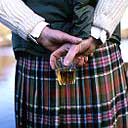
January in England is a miserable month: Christmas has been and gone, the weather is wretched and the only thing to look forward to is the return of Cadbury's Crème Eggs to the shops. What more reason do you need to head for Scotland? Up north, January means one thing: Burns night. Every year on January 25, the entire nation drinks, dances and partakes of haggis well into the small hours. So, on this auspicious day, we flew up to Glasgow and drove south to Robert Burns' home town of Alloway to crash the party.
As Scotland's most famous poet, the celebration of Robert Burns' birthday is a national institution. Born the son of a nurseryman in 1759, Burns seemed destined to follow in his father's footsteps and earn his living from the land. However, his numerous ventures into agriculture all proved unsuccessful, and in 1786 he finally resolved to emigrate. In order to raise money for the passage, he decided to publish a volume of his poems.
Emigration was immediately out of the question. His poetry was lauded throughout Scotland, thanks in part to his use of the Scots dialect in poems such as the narrative 'Tam O'Shanter' and 'My Luve's like a Red, Red Rose' (the Scottish answer to Shakespeare's 'Shall I compare thee...'). But it was that badly sung bastion of the New Year's Eve party, 'Auld Lang Syne', which secured his international reputation.
At the Burns Museum in Alloway, the curator John Manson informed the visiting party of schoolchildren that, aside from Happy Birthday, Auld Lang Syne is the world's most sung song. At first I paid no attention to the talk and wandered round peering at the artefacts and manuscripts from Burns' life, but when I noticed that everyone raised their hand in response to the question "Whom did Robert Burns' father marry?" I realised I had more to learn than the eight- and nine-year-olds, and decided I'd better tag along.
We left the museum and crossed the courtyard to the cottage where Burns was born, which has been preserved just as it was when the poet lived there. Inside, it was dark enough to make walking over the uneven floor tricky, and the place smelt pervasively of hay and damp stone ("It stinks," whispered one of the children, undaunted by the atmosphere). We were met at the door by an actor in full Burns regalia - the children giggled and I sympathised - who led us into the first room of the cottage which had been filled with benches. We sat down and waited for the show to begin.
'Rabbie' talked to us about Burns' life in the cottage, where he lived from earliest childhood, in a voice borrowed directly from Dad's Army's Private Frazer. Acting merits aside, the talk was informative and a good starting point for those, like me, who knew nothing about Burns' life. After a tour of the rest of the cottage, I walked down the road into Alloway in search of the other hub of the village's Burns industry - a sort of Burns visitor centre which goes by the name of The Tam O'Shanter Experience. There's something vaguely off-putting about any tourist attraction with the word 'experience' in its title, but my fears were allayed by the arrival of the avuncular John, who took me for lunch (Scottish salmon, of course) and gave me a guided tour of the village.
I'd wisely swotted up before my visit by reading Burns' masterpiece Tam O'Shanter, and for anyone who has read it, walking through Alloway is like stepping into the story. We poked around the bramble-filled ruins of the Auld Kirk, where the witches and warlocks of the poem danced, and John pointed out the window through which Tam peeped and the stone on which the devil was said to have sat. Moving on, we followed the road that Tam and his horse Maggie took down to the river Doon, and strode right up to the keystone of the Brig O'Doon where the witch pulled out Maggie's tail. Poor horse. It's a very steep bridge.
Later that evening I returned to the Tam O'Shanter Experience, having starved myself for the afternoon in preparation for my first Burns Supper. And this was no ordinary Burns night gathering - the centre was packed with local luminaries and Burns aficionados. Tickets were sold out months in advance.
My initial concerns about being the youngest person in the hall by some years - as well as the only woman in the place wearing trousers - soon paled into insignificance when the ceremonies began. The opening address and Selkirk Grace thankfully involved minimal participation, but I was left floundering during the piping of the haggis. The company stood and clapped slowly until the haggis, accompanied by a piper, was placed safely on the main table, whereupon Burns' poem To a Haggis was recited over it. Having never before had occasion to sample this famous dish, I was surprised - and relieved - to find that it tasted significantly better than it looked.
After the meal came the speeches. The Toast to the Lassies (Burns, apparently, was something of a ladies' man) and the Lassies' Response were witty and well-delivered (the rhyming of Fanny Craddock with haddock in the Toast to the Lassies was one of the high points of my visit). But the Immortal Memory - the central speech of the evening, given with the intention of outlining the greatness and relevance of the poet today - was the most moving section of the Supper. Although drinking and dancing are both major parts of the evening, it is the recognition of the durability of the poetry that Burns wrote over 200 years ago that turns January 25 into a special celebration. Either way, it certainly beats the January sales as a means of reconciling yourself with the new year.
· Sarah Crown travelled to the Burns night as a guest of the Scottish tourist board, staying at the Savoy Park hotel.
To listen to a Burns supper, click here
