
Laurie Lee did it in winter, weighed down by a 20lb pack containing, among other objects, several books, his violin and a saucepan. That's what I reminded myself of as I put one leaden leg in front of another on the final steep ascent over the Pyrenees from France into Spain.
It was a mild June day, but we had to pick our way through a bed of slush while a sudden sharp wind tried to blow us back down the mountainside. Lee had no other way of reaching his republican comrades fighting the Spanish Civil War, but we had forgone the road route and walked for eight hours, just for fun. And, even less like Lee, we were equipped with a map, detailed walking notes and, for me, a pair of light walking poles, without which I would never have made it before nightfall.
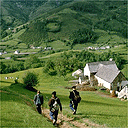
We were sampling a section of a week's self-guided walking holiday in the Mediterranean Pyrenees, part of a winding trail through Catalunya continuing to La Garrotxa and, eventually, east to the sea, which, if done in one stretch, would take a month.
It had been, despite my gasps and groans towards the end, a most delightful day, making steady, untaxing progress up the Eyne Valley in the Cerdagne. First through woods dotted with delicate orchids, gentians and wild angelica, then into meadows bursting with anemones, ranunculi and a carpet of rare, yellow, Pyrenean lilies.
In brilliant sunshine, we ate our picnic - coarse paté, salty Pyrenean cheese, bread and fruit - beside a rushing river. Then the hard part began. Bags lighter after the picnic, but stomachs heavier, we followed the path to the summit of the Col de Nuria, alone but for the distant shrieks of marmots, sightings of skittish mouflons, and the vultures circling ominously overhead.
The sure-footed Pyrenean chamois kept well-hidden, as my ungainly form scrabbled noisily up the last rocky patch to the grassy plateau. As a dedicated non-walker in normal life, the feeling of elation as I stepped over the border between France and Spain was tremendous. To my slight disappointment, there wasn't even a rubber stamp on a chain for me to record my triumph, let alone rejoicing border guards, but the sense of achievement, as I lay there panting at 2,683 metres (8,000ft), was enormous.
No sooner had I caught my breath than the really, really hard part began. We had to pick our way down a wall of horrible, shifting, grey scree where, without the trusty poles, I would have doubtless slid down the fast route, shredding myself on the sharp stones. With my mind on a cold beer and a hot bath, I plodded on to the hotel in the former monastery at the isolated shrine of Nuria.
The sight we beheld as we came round the final bend was extraordinary. I felt as if I had escaped to Colditz. After all I had endured, I was heading for a grim, grey edifice with high walls and tiny windows, surrounded by dark, pine-covered hills.
As we clumped, sweaty and red-faced, up to the entrance, a trio of high-heeled Spanish day-trippers, there to visit the shrine and, perhaps, take a pedalo out on the small man-made lake, looked at us in astonishment. They had arrived by the rack railway from the other side. Despite its forbidding exterior, the welcome in the 65-room hotel wing was warm, the room comfortable and the relief of getting my boots off indescribable. It was here, when the Second Spanish Republic was proclaimed in 1931, that the first draft of the Catalan statute of self-government was drawn up and, in the civil war, the building was used as a hospital.
Nuria, still inaccessible by road, has been a holy place since St Giles lived there as a hermit in 700. Now the neo-gothic sanctuary houses an unusual twelfth-century painted statuette of the Madonna and Child. I joined a short queue to put my head into a replica of St Giles's cooking pot while ringing a bell; this, the notice explained in four languages, would dispel headaches, calm tempests and increase fertility.
Next morning, with aching hips and screaming calves, I hobbled the few metres to the rack railway. Within half-an-hour, the two-carriage train which clings to the cliffs had picked up elderly couples with shopping baskets at Queralbs and whisked us to the bottom of the valley at Ribes de Freser, (though there is a spectacular day's walking trail down the gorge as well).
Our route and overnight stops had been carefully worked out by Inntravel, which uses local people to make sure that the trail is maintained and the way clearly marked with painted stripes on rocks and trees. Each morning, a picnic is ready and the luggage is moved on to the next hotel. Because you aren't travelling in a group, rest days can be built into itineraries as you wish.
At breakfast in the Grevol hotel in Llanars, we met a couple who were still enjoying their holiday even though the man had slipped and dislocated his shoulder. They were just going to have a quiet day and travel on later with the luggage. Bringing a mobile phone can be very useful, provided you can get a signal, to summon help - or a taxi in case of a sudden downpour. Hotels are only a few kilometres apart by road. Increasingly popular is hiring a guide, which is possible on some routes for about £50 a day. It saves having to study the notes and he'll show you interesting plants and wildlife, too.
From the Pyrenees to La Garrotxa, the landscape becomes less rugged. An ancient mule track led us down through holm oak, beech and ash trees past a long-abandoned watermill and ruined farmhouses. As the rain started, we arrived at the golden stone village of Beget whose year-round population has shrunk since the Sixties from 500 to only 50. Now the houses clustered around the eleventh-century church have been done up as holiday homes for well-to-do Barcelonans.
Here, the Hostal El Forn has only four rooms, so it would be unwise to stroll up on the off-chance. The narrow dining- room, which has lovely views, specialises in delicious local dishes, such as rabbit with figs, snails, and white beans with sausage.
The hotels are chosen not only for their location but also charm and good food. Hotel Cal Sastre at medieval Santa Pau used to house the proprietor's grandfather's tailor shop and is decorated with old sewing-machines and rather macabre shop mannequins. Our breakfasts were lavish. While Spanish guests nibbled on pastries, we gorged on tortilla, cheeses, olives, anchovies, dry ham and slices of sausage.
How sensible to serve tapas first thing, we thought, helping ourselves to more. Walking is hungry work after all, and better to have it twice than miss it altogether just because we'd got lost and failed to show in the bar at the usual hour.
Factfile
Caroline Hendrie sampled a range of four independent week-long walking holidays in the Catalan Pyrenees from Inntravel (01653 629001). The walking weeks are available separately, can be linked together or sold as a whole month of walking.
Lead-in prices for one week range from £580 to £783 depending upon the walk selected. Prices are per person sharing and include return scheduled flights London-Toulouse or Barcelona and transfers, seven nights' half-board, picnic lunches, walking maps and notes and luggage transportation to the next hotel on the route. Two weeks' walking (including the Cerdagne and Catalan Pyrenees) are from £1,406 each (as above) and include the transfer between the two walks.
The four interlinking walks are the Grand Cerdagne in the Mediterranean Pyrenees; the Catalan Pyrenees through the heart of Catalunya; the Pyrenees to La Garrotxa - a transition from a mountain to a Mediterranean landscape; and, new for 2002, continue from the mountains to the coast at Cadaques.
