
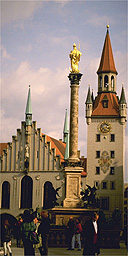
Even when there isn't a car in sight, Bavarians wait patiently for the green man before crossing the road. It seems odd at first, but long before your weekend is over you find yourself doing the same. No one parks on the wrong side of the road. This is, as you would expect, a very orderly place, the richest city in Europe's richest country, the home of BMW and Siemens. Everything works.
Even the disorderly behaviour is regimented. In the vast Hofbrauhaus bierkeller, raucous jollity is turned on instantly. Arthritic old men in ancient lederhosen bring litre steins of foaming lager. Blonde, pigtailed waitresses wearing dirndlscome with plates of sausage, sauerkraut and enormous dumplings. And 4,000 people eat pretzels and sing along to the band's umpteenth oompah version of Que Sera Sera.
The Hofbrauhaus is at Am Platzl 9. You will find fewer tourists at the Löwenbräukeller , Nymphenburgerstrasse 2, and the Augustiner Bräustuben , Landsbergerstrasse 19. The best beer gardens are the Seehaus in the Englischer Garten, and the small, somewhat eccentric Braunauer Hof , Frauenstrasse 42.
Think small
The city has all the trappings of a major metropolis with its vast palaces, grand municipal buildings and monumental statues of classical warriors striking Wagnerian poses. But unexpectedly, it also has two of the most beautiful small buildings anywhere in the world.
Sendlingerstrasse is a typical Munich street of mostly postwar five- and six-storey buildings painted in muddy pastel colours with uniform large, square windows. The Asamkirche is easily recognisable from a distance, the statues above the door jutting out into the street, but nothing prepares you for the interior. It was built in the 1730s by two architect brothers called Egid Quirin and Cosmas Damian Asam. Egid was also a sculptor and Cosmas a painter, and they built the church as their private chapel undisturbed by the demands of patrons, town planners or deadlines.
Almost impossible to film or photograph, it is dark, sinister and wildly baroque, full of optical illusions, the decoration covering every square inch of every surface area. The lighting is peculiar, with patches of brightness without any obvious source, the perspectives slightly odd so that as you walk along the aisle everything changes subliminally and, seen out of the corner of your eye, the statues appear to move. It could be something imagined by the fantasy writer HP Lovecraft, a phosphorescent temple of Y'ha-nthlei with strange leprous corals and grotesque brachiate efflorescences.
I was once, I'm ashamed to say, frightened by a potato. I opened a kitchen cupboard to find that in the darkness it had grown roots filling every available space. You get the same kind of shock walking into the Asamkirche.
Asamkirche , Sendlingerstrasse 32. Free.
See forever
The Amalienburg in the grounds of the Nymphenburg palace to the north-east of the city was built as a hunting lodge, also in the 1730s. It has one large room, two smaller ones, a single day bed, a Delft-tiled kitchen, an indoor kennel for the dogs, one lavatory and no fireplaces. The domed central room is full of silver-gilt mirrors and crystal chandeliers, the walls painted the pale green-blue of infinity that you see when you stand between two parallel mirrors. On a winter day in the snow, it was cold, deserted and magical.
Amalienburg , Schlosspark Nymphenburg. Open October- March, Tuesday-Sunday 9am-12-30pm, 1.30pm-4pm. DM3/€1.50.
Get technical
The Deutsches Museum on an island in the Isar must be the biggest collection of technology in the world, some 10,000 exhibits; to see it all, you would have to walk at least 10 miles and put aside a whole weekend.
You may prefer to skip the displays of machine-tool and tunnel-boring equipment and head for the musical instruments on the first floor or for the small but spectacular collection of motorcars in the basement. It has the first ever car, the 1885 Benz, a 1921 teardrop Rumpler, two of the most spectacular Mercedes- Benz racers - the shark-like W154 and the overdesigned W196 - and, best of all, a 1936 C-type Auto Union, as fantastic and impractical as any of Ludwig II's sledges in the Nymphenburg Palace.
It weighed little more than a Mini, but carried a massive supercharged 16-cylinder engine behind the driver, with narrow tyres and a swing-axle rear suspension. It could do 195mph at 3mpg and had a vicious unpredictable oversteer. Only one driver, Bernd Rosemeyer, came close to mastering it, and he ended up dead at the wheel, the victim of an unexpected crosswind. They don't make cars like that any more, certainly not in Munich.
Deutsches Museum , Museumsinsel 1 nr Isator. Open daily 9am-5pm. DM12/€6.
Be decadent as well as modern
A mile north of the Deutsches Museum, the 19th-century painter and sculptor Franz von Stuck built his own house in the jugendstil style of Munich art nouveau. Here, he turned his back on the modern industrial world and hid himself away to paint wonderfully lurid pictures of sirens and satyrs, full of dark colours and heavy-handed eroticism, the kind of painting that people didn't take very seriously in the 20th century.
You might assume that Stuck and his kind were an irrelevant cul-de-sac in the history of art. But not so. His pupils included the painters Wassily Kandinsky and Paul Klee, the graphic artist Alfred Kubin and the obscure but influential architectural sculptor Hermann Finsterlin, and the Villa Stuck and jugendstil led directly to abstract art and, by a more roundabout route, to German expressionism, the Bauhaus and modern architecture.
Villa Stuck , Princeregentstrasse 60. Mostly shut for refurbishment until 2004. A few rooms are open Tuesday-Sunday 10am-6pm with an exhibition of jugendstil jewellery. DM8/€4. Admission to the basement exhibition of Stuck's paintings and sculptures is free.
Go abstract
Kandinsky's journey towards abstraction and greatness was a slow one, and he didn't produce a major work until he was 42, which is rather heartening for the rest of us. One evening, he went back to his studio and saw a painting he didn't recognise propped against the wall in the sunlight, and it seemed to represent everything that he had been trying to do without realising. It was one of his own pictures lying on its side.
The best collection of his work is in the Lenbachhaus. You walk round the early galleries with your ear against your shoulder and, seen from that angle, it's surprising how modern his early work was. But even in his great Paris paintings of the late 1930s and 40s, you can still recognise a few jugendstil tendrils.
I went to Schwabing to find the house where he lived with the painter Gabriele Münther at 36 Ainmillerstrasse, and Klee's house at 32, but unfortunately the RAF had got there first.
Lenbachhaus , Luisenstrasse 33 nr Königsplatz. Open Tuesday-Sunday 10am-6pm. DM12/€6.
Get cold
As you may have noticed on any European beach south of the Arctic Circle, the Germans are not shy about public nakedness. You might have thought that the more conservative Bavarians would be different, but you would again be wrong. On anything approaching a summer's day, you will find dozens of naked bodies lying on the grass in the Englischer Garten or bathing in the shrivellingly cold Eisbach stream.
Somewhere near here on September 3 1939, the English socialite Unity Mitford tried to blow out her brains but missed. No plaque marks the spot.
Celebrate degeneracy
The massive Haus der Kunst beside the Englischer Garten was built in 1937 in the neo-neo-classical style popular at the time. It was originally a showcase for Nazi art but also contained a small exhibition of "degenerate" art where works by Picasso, Magritte, Mondrian and Matisse were held up to ridicule. A smirking führer was photographed standing next to Max Ernst's La Belle Jardinière just before it was taken out and publicly burnt. After the war, the Nazi art was left in store and the degenerate art took pride of place. Now, the Haus der Kunst hosts major international exhibitions.
Haus der Kunst , Princeregentstrasse 1. Open daily 10am-10pm. Prices vary. Free Sundays and national holidays.
Enjoy the inefficiency
The degenerate art was due to be installed in the Bauhaus-revival Pinakothek der Moderne which should have opened last year but whose opening date has now been put back to 2004, and even this is uncertain. Far from finding this an embarrassment, the Bavarians are delighted to have a rare opportunity to disprove their national stereotype. "The only thing certain about it is the address," they say joyfully.
The best of the Haus der Kunst exhibits have found temporary home in the Neue Pinakothek, which contains many galleries of rather baffling 19th-century German art punctuated with works such as Van Gogh's Sunflowers and Manet's Breakfast in the Studio that are so famous it comes as a shock to realise that they have a real existence beyond books and calendars.
Neue Pinakothek , Barerstrasse 29. Wednesday-Monday 10am-5pm, Thursday 10am-9pm. DM10/€5, free Sundays and national holidays.
Get stuffed
If you have burnt off enough calories walking around the museums, you may feel in need of a good meal, and, as you might have guessed from the size of most of the inhabitants, food is something that Bavarians take seriously. They eat hearty high-cholesterol fare with relish, and if there is any part of a pig that is inedible, they have not discovered it.
Expect enormous platefuls of schwein and fleisch (no euphemisms here). You may want to try schlachtplatter (slaughter plate). Useful words to know include inerein (offal), lunge (lung) and hirm (brain). Typical Bavarian food can be found in the Hundskugel, the Haxxbauer and the Ratskeller, but the ultimate is probably Zum Dürrnbräu, just down the road from the Hofbrauhaus.
Luckily, not all Munich restaurants are traditional. The Seehaus in the Englischer Garten serves quality modern food, low-fat but still recognisably Bavarian, and the city has several good vegetarian cafés, notably Buxs and Prince Myschkin.
Hundskugel , Hotterstrasse 18, approx DM22/€11 for a main course; Haxxbauer , Münzstrasse 6, DM22/€11; Ratskeller , Marienplatz 8, DM25/€12.50; Zum Dürrnbräu , Dürrnbräugasse 2, DM23/€11.50; Seehaus , Kleinhesseloher See, Englischer Garten, DM30/€15; Buxs , Frauenstrasse 9, DM20/€10; Prince Myschkin , Hackenstrasse 2, DM20/€10.
Way to go
Getting there: Lufthansa (0845 7737747, lufthansa.com) flies London City to Munich from £128.80 return tax inc. Getting around:
Trains S1 and S8 run from the airport to the city centre for DM16/€8. The Munich Welcome Card, available from the tourist offices in Hauptbahnhof and Marienplatz and in many hotels, costs DM12/€6 for a day, DM30/€15 for three, and gives unlimited travel in central Munich and up to 50% discount on tours, bicycle hire and museums.
Where to stay:
Travelscene (020-8424 9648) offers two nights' B&B at the two-star Europaeischer Hof from £194pp including flights. The five-star Kempinski Hotel Vier Jahreszeiten (+21250) has rooms from €160 a night.
Further information from the German National Tourist Office (020-7317 0908, brochure line: 09001 600100).
Area code: 0044 89.
Flight time from London: 2hrs.
Time difference: GMT+1hr.
£1= DM3.09 = €1.62.
