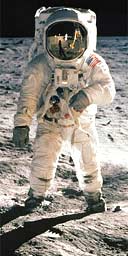
It's a truly unfortunate incident. Ten minutes into my first walk in space, I accidentally drop my right boot. Immediately, the pressure inside my two million dollar space suit drops from over four pounds per square inch to zero, I explosively decompress, expand hugely and, within 30 seconds, am unrecognisable as a human being. My blood starts bubbling, my eyes explode, I'm raked by radiation and micro-meteorites and, as I face the sun, I boil to death. I want my mum.
In fact, if was I in outer space rather than 20ft off the ground at Nasa's Marshall Flight Centre in Huntsville, Alabama, it would be a spectacular death. Instead, it's just another failed mission, one more experience of life aboard the shuttle - and its potential pitfalls - at Space Camp.
An intensive three-day training programme for final frontier fanatics, it offers a flavour of an astronaut's life, along with a heady whiff of the pressures of mission control.
On the first morning, I'm one of 60 unfeasibly excited adults registering for a brief taste of the cosmos. With solid, all-American names like Kent and Cleve, our group includes a Boeing engineer, an ex-pilot, a serious amateur rocket guru and Carrie, who wants to join the 15 trainee astronauts selected every other year from 50,000 applicants - and become the first Irish woman in orbit.
First sight of our living quarters suggests: "Huntsville, we have a problem". We will be sleeping in Habitat 1. Not an early Conran shop, but a hybrid of Wormwood Scrubs and Red Dwarf. Bathrooms are waste management; taps, H20 dispensers; and the air-con, a life support system. We are, however, spared the straps which fix astronauts to the loo - flatulence would send a person flying through the air in a gravity-free environment.
As the centre regularly runs courses for schoolchildren, our eight-man dormitories have bunkbeds with plastic-covered mattresses. Rules state there's to be no drinking or smoking, gates will close at 11pm, do not play with your food unless you plan to eat it, no girls are allowed on the second floor, no boys on the fourth - EVER! - and there's to be no hand-holding, hugging, kissing, or, strangely, carrying each other around. Celibacy and incontinence control were clearly part of Buzz Aldrin's training.
Space exploration means a lot of time in the classroom: I sit through lectures on gravity, safety, clay owls (attached to the side of the shuttle to scare off woodpeckers, who once delayed a launch by pecking 300 holes in the fuel tank) and Nasa security (a bullet-proof layer on either side of the rocket boosters protect against anyone taking a pot shot while the shuttle's fuel tank is being transported to the launch by rail - train drivers prefer their locomotives not to travel at 8,000 mph). There's a final talk on jet propulsion before, rather prematurely, I fear, I'm sent on my first mission.
As well as adjusting to the claustrophobia of my space suit, I must gain an immediate grasp of acronyms - forget them and you might as well drop your boot. My suit is actually an EVM (extra vehicular mobility unit), my trousers an LTA (lower torso assembly), my helmet an EVVA (extra vehicular visor assembly). Trussed up like an MM (Michelin man), I feel a RP (right prat).
Working with full-scale replicas of Nasa equipment, I have to crawl through an air lock, mount a remote control and perform vital engineering repairs. Well, that's the theory. Suspended a precarious distance above the ground, with two fellow amateur-astronauts floating beneath me on chairs mimicking the frictionless environment of space, we set about building a huge, 3D triangle. It's not easy. Like rejects from The Krypton Factor, we can't make the two arms of the structure lock together. Despite wearing ice packs around my stomach, I'm soon sweating like David Mellor in a steam room. And then my boot falls off, and I bubble to death.
Displaying remarkable powers of recovery, my corpse spends a night in Habitat 1 before rising next day to fly a fully equipped shuttle simulator, complete with the shakes, rumbles and alarming sensations of take-off. It's followed by more lectures, jaw-dropping Nasa footage on a 67ft wraparound Imax screen, fairly dire canteen food, and then exposure to the physical effects of space travel.
For starters, I'm shot 160ft into the air in two and a half seconds, travelling at 45mph an hour. It subjects me to 4Gs, more than an astronaut during a shuttle launch. At the top of the "space shot", I lift out of my seat to float for a heart-pumping, gravity-free two seconds above the dizzying drop, before I'm forced back into a rapid descent. It's a frankly appalling sensation.
Back on vaguely solid ground, a spring-assisted harness lets us try walking on the moon, where gravity's a mere one-sixth that of the earth. I take huge bouncing bunny hops and side steps, while talking in a deep voice about giant leaps for mankind. The terminally vain might note that a tight harness and lack of gravity play hell with a soggy midriff.
And we're not finished yet. We end with a grim machine known as the multi-axis trainer. The three-ring gyroscope spins rapidly in different directions, disorientating you as if your craft had gone into tumbling freefall, as happened to Neil Armstrong's Gemini 8. Imagine a downhill skier crashing head-over-heels and you get the picture. The good news is that because your stomach doesn't move, you won't be sick - in theory.
To start with it's not too bad, but when the operator is side-tracked I'm left spinning for two minutes 20 seconds, a minute longer than most, and emerge with a bouffant hairdo and what, if I'm not mistaken, is almost certainly nausea. It could be worse - astronaut Alan Shepard once stayed spinning for nine hours.
It's not the best preparation for our final day, on which we get the chance to taste the world of mission control. I'm put in charge of scientific operations, a controversial appointment for a man who can't programme a video. Nasa, or rather the American public, pays the multi-million dollar price when I land the shuttle in Senegal, West Africa - a rarely-used, last resort landing site.
And that just leaves time for letting off homemade rockets, the closest we've actually come to flying, before a talk and graduation ceremony - this is America, remember - by living, breathing astronaut, Bob Springer, who, after just six months' training, became one of the shuttle's health experts.
"I went to the John Wayne school of medicine," he says casually. "I was pretty wobbly at aiming the needle, but I got a lot of target practice with Carl Meade who was suffering severe motion sickness. We just taped him to the wall for two days."
It doesn't sound that hi-tech, but three fascinating days at Space Camp are final proof that I'm clearly not made of The Right Stuff. An astronaut's life? I'll take the air miles and the holiday snaps, but my body just isn't up to it - particularly if I lose my boots. Sorry, my BSTs.
Way to go
Space Camp runs two adult courses. Weekends for $499, and the Adult Advanced Space Academy, a five-day programme including computer design and scuba diving in the underwater astronaut training facility, for $899. For details, visit www.spacecamp.com.
Fly to Huntsville with American Airlines from £360 return (inc tax). Tel: 0845 606 0461
