
It's hot below deck - around gas mark 5 I'd guess - and I'm in the loo. Or the heads as they, I mean we, say on boats. Even if there's just one of them, it's still the heads. Always plural, like the doldrums. We have two. I'm not using them, I'm cleaning them - both of them, because today's my day to clean the heads.
That's bad enough in itself but a few things aren't improving the situation, apart from the heat. For one, I can't open the hatch to let some air in as this isn't the doldrums and a wave might come in, too. Then there's the ball of hair I've just pulled from the plug in the floor - I'm not convinced this is all head hair either. And urggghh, the last heads user didn't do the required minimum of 20 pumps and has left a little memento in the bowl. Nice thought. Thanks. I immediately imagine this to be the doing of the person who's been annoying me most on this particular day, day six. And, to cap it all, as we're bucking around like a fairground ride, I'm getting all mixed up with my angles; so when I pour bleach in the direction I imagine to be downwards, it turns out to be more like sideways and I totally miss the bowl. Help! Mayday!? This is supposed to be my holiday. Get me off this thing!
But we're over 1,000 miles from the nearest land and there's no off this thing for at least a week.
Anyway, a few hours later the situation has improved dramatically. It's night-time now, and much cooler. I'm on deck, steering. A half-moon has just risen from the sea, giving a silver sheen to the big black waves. It's bright, but not bright enough to drown out the shooting stars, inverted Roman candles hurled down from heaven. There's a good breeze and we're bowling along, the ocean hissing and fizzing as we carve out our furrow west. It's a wonderful thing to drive a big powerful sailboat fast through the night. A lone dolphin comes to play with us, leaping out of the silver sea beside the boat. That's more like it.
It's like that, sailing across the Atlantic. There are highs, and there are lows. Sailing is a high, cleaning heads is a low. Dolphins, flying fish, the whale that comes to entertain us, they're all highs. Being dragged out of bed to do something energetic with a sail is a low. And Lachlan, your recycled porridge teatime snacks are about as low as you can go.
The boat is CGU, named, romantically, after the insurance company that sponsors it. She (can a boat called CGU really be a she?) is a 67ft steel cutter, owned by well-known sailing person Chay Blyth and his company Challenge. We're taking part in the Arc, an annual event that sees over 200 yachts set off from Las Palmas in the Canaries for St Lucia in the Caribbean. ARC stands for Atlantic Rally for Cruisers but 40 or so boats - CGU included - are racing. Even so, as transatlantic crossings go, it's the easy option - it's south enough to be gloriously warm, the easterly trade winds are perfect, and if you do get into trouble, there's likely to be another boat not too far away.
There are 14 of us on board. Three are professional sailors: JB (the skipper who looks like a 1970s TV detective), his first mate and wife Michelle, who is frequently disappointed by the shortcomings of the rest of us, and Tim, the affable second mate. The rest of us are, in the skipper's own words, a bunch of amateurs. We're in construction, we're an antiques dealer, a plumber turned photography student, an electrician, an insurer, a reinsurer, a general manager, a computer trainer and the Guardian. We're in our 20s, 30s and 40s, and possibly our 50s, just. We're reading Zadie Smith, a book about the weather, Martina Cole, Yachting World, Ian McEwan, Jake Arnott, Harry Potter, Loaded, Maxim, and FHM. Three knew each other beforehand; otherwise we're strangers. One of us is Australian (Lachlan, the porridge recycler), another Finnish; the rest of us are Brits. Three are women, the rest aren't. There are three divorcees, and four of us - not me - find love at sea. Or in the sail locker to be more accurate. And by "find love" I mean cop off.
Yes, of course it's like Big Brother, a bunch of strangers cut off from the world, unable to get away. But there are differences. I don't know the dimensions of the Big Brother house and garden, but it's certainly bigger than CGU. The farthest we can get from someone is 67ft - or 87ft if you go up the mast. We don't lose people at regular intervals, though there are times when I would be happy to see certain people voted off. We have no Big Brother to talk to when things aren't going right, just the sea. And the daily task remains the same: sail this yacht across this big ocean.
The fact we're at sea means that, however much this is the Atlantic crossing for sissies, there's still a certain amount of risk involved. Some people deal with this better than others - there are the ones who remain calm when the sea doesn't. And there are the ones who shout and look for people to blame when things go wrong. The Big Brother psychologist would be kept very busy.
Leaving Las Palmas is exciting - 200 boats setting off downwind, coloured spinnakers flying, a huge flock of exotic creatures migrating west for the winter. But the following morning we've lost them all, and we're alone in our circular world, in the middle of a giant disk of wobbly blue, under a huge dome of paler blue. We never see any of the other yachts again, until St Lucia. We see a couple of other boats, and one plane I think. Otherwise, there is the horizon to look at.
Life at sea is punctuated not by night and day, but by watches - five hours on, five hours off. It's a primitive world where sleep and food are the main concerns. The highlight of each day is happy hour, between four and five in the afternoon when both watches are on deck together for a chat from the skipper and a cup of rum punch. It's the time for moans, news of other boats' progress from radio reports, the time for the reciting of poems that have been written on the board in the galley. Sometimes happy hour is happy, other times less so.
It's now day 8 and I'm on watch with Rami, one of my favourite crewmates. We've pretty much done all our personal information-swapping. I know about his job running computing courses back home in Finland's second city, the name of which I don't remember. I know about his ex-wife, and his kids, and about his fondness for Van Gogh. I know about his boat and about his sailing friends. I know a little Finnish history, and he's told me three times that Finland has a 1,400km border with Russia, obviously a matter of some concern. Rami is the Einstein of the crew and has tried - unsuccessfully - to explain relativity to me. Now we're left to discussing what's around us. Things like flying fish.
When an Atlantic flying fish launches itself from the sea into the air, there is the tiniest chance that instead of plopping back into its watery home it will land with a thud and a bloody nose on the deck of a boat instead. The tiniest chance, and for most people that is enough. But not for Rami; he wants to calculate that probability. So, using some fairly sweeping assumptions about the size of the Atlantic, the number of boats out there which are low enough for a flying fish to land on, the collective area of their decks etc, Rami surmises that a flying fish would be extremely unlucky to land on a boat: 1 in 700,000bn is the figure he comes up with. There must be a lot of flying fish out there, because we've had four on board already.
We catch three proper fish as well - two dorado and a wahoo. The biggest is more than 3ft long; all are big enough to feed 14. It doesn't get much better than fresh dorado, filleted and fried in olive oil. And if you think your local Japanese does good sashimi, then you're wrong. The way to do it is to catch the fish, kill it, slice it up then and there, chill it and eat within a couple of hours of it being alive. Fortunately JB is a foodie and produces wasabi and soy sauce. Sashimi makes happy hour very happy.
We eat well throughout. Even though the fresh stuff runs out after a week, we're still producing fancy stir fries, curries, stews, pizzas and elaborate pasta sauces all the way across. And we bake fresh bread every day. CGU is not a ship's-biscuits-and-a-lime-to-suck-on kind of boat. But cooking at sea can be a hazardous business: nearly every one of us arrives in St Lucia with a minor injury of some description, all of them sustained not on deck but in the galley.
Drama is infrequent and minor when it comes. Hurricane Olga makes an appearance on the weather fax, but she's a long way off, and then dissipates near Cuba. We have a couple of gusty nights, but nothing too scary. Then the heavier of our two spinnakers rips in a gust. I'm at the wheel at the time so quickly get christened The Shredder. It takes two people 24 hours of constant sewing to put it back together, and then lasts another day before going again. The second time it can't be rescued from the sea, and now it hangs as curtains in Davy Jones's locker.
We have no birthdays so we celebrate Finland's independence day for Rami. He hoists the Finnish flag and makes a speech, in which he reminds us that Finland has a 1,400km border with Russia. Then we share a bottle of Finlandia vodka. Richard, the punning electrician from Banbury, tries to teach us all the Charleston.
Birds are exciting - petrels and shearwaters absurdly far from land, boobies and beautiful long-tailed tropic birds closer to the Caribbean. Our one whale - either a minke or a pilot depending on whose side you take - is a big drama. She swims along with us for a couple of hours, sometimes behind, sometimes coming up alongside us, before peeling off like a fighter plane, pleased to have some company.
Otherwise, nothing much changes, except the ocean itself, which is never the same. Usually it's friendly enough, then it will hint at the temper you know it has but would rather not see. At times, there is 6,000m - 6km - of it beneath our keel. And it gets colder and darker the deeper down you go.
We have music on board, a CD player down below but with speakers in the cockpit, so when the wind gets up a bit we can blast the Ride of the Valkyries out to the waves. Actually, Wagner is reserved for when the huge billowing yellow lightweight spinnaker goes up - to add to the drama. And very effective it is, too.
Otherwise, the music policy, like everything else, has its highs and lows. Too much 1970s guitar music for my liking, though Pink Floyd works well at night. My attempts to get an airing for Massive Attack and Beck are shouted down. But Enya is tolerated. Enya! Who is she and what does she want? Imagine that scene I described earlier - the one with the dolphin and the moonlight. Now imagine how Enya could totally wreck it.
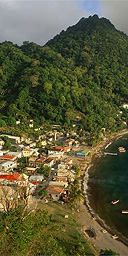
St Lucia becomes more than just a Caribbean island; it is the end of the rainbow, the release date, freedom. It is the land of ice and cold drinks, of whole nights of sleep, of space and choice and views. The first sight of land isn't actually St Lucia - it's Martinique - but it's very exciting all the same. At last an interruption to that line. When we finally round the northern end of St Lucia and cross the finish line, it's around midnight, but the marina bar's still open and they have rum and ice.
It takes us 13 days to get across, a day longer than the fastest boat, but much quicker than we expected. We've flown across, covering more than 200 miles a day and finishing fifth on corrected time: not bad for a bunch of amateurs. Who knows what would have happened without The Shredder on board...
For the next few days, boats keep coming in, their crews spilling ashore into the marina bar to swap stories. The waves get higher and the fish get bigger as the rum goes down. Blotto yachties aren't a pretty sight - far scarier than anything we found in the Atlantic. One night the party moves to the local village's street party or "jump up". It's as if Cowes Week had moved to Notting Hill for carnival - a terrifying hybrid. Luckily St Lucia is big enough, and friendly enough, to absorb this annual invasion. And it's easy to find a place to escape the sailors.
My favourite spot is the fort on top of Pigeon Island, at St Lucia's northern tip. From here, you can look down on the last stragglers crossing the line below. Or you can look back east towards Las Palmas, 2,600 miles away across the Atlantic, and feel quite smug about what you've done.
Way to go
Getting there: ARC 2002 starts on November 25 from Las Palmas in Gran Canaria. The voyage to St Lucia will take 18-21 days. To sail on a Challenge Business yacht costs £2,250pp including berth, food and drink on-board, all fleet-related costs, yacht insurance, safety equipment and oilskin hire. Flights are extra but can be arranged. Details from Challenge Adventure Sailing (The Box Office, Box Lane, Minchinhampton, Gloucestershire GL6 9HA UK, tel: 01453 836333), which also offers sailing trips of varying length and for all levels of expertise, from around the Solent, to round the world.
BWIA West Indies Airways (020 8577 1100) has direct flights to St Lucia on Tuesdays and Sundays from £417 plus tax return.
Further information: St Lucia Tourist Board 0870 900 7697.
More sailing options
Sunsail
(023 9222 2224)
Everything from bareboat and crewed yacht charters to flotilla sailing to watersports beach clubs. Learn-to-sail courses can be taken in Britain, the Canaries and Thailand. A two-day course at Port Solent costs from £125.
Sailing Holidays
(020 8459 8787)
Bases in the Ionian Islands and the Dalmatian Islands. A two-week Ionian flotilla cruise from Moutos on the Greek mainland and taking in Paxos, Cephalonia, Ithaca and Lefkas, costs from £435 (based on four sharing a yacht) including flights.
Top Yachts
(01243 520950)
Specialises in sailing in Turkish waters. Charter a crewed gulet from £345 per day for up to eight people (allow £15 to £20 per head per day for food). Flights cost from £280pp return. Guests are the crew aboard the Eve of St Mawes, a new but traditionally built pilot cutter which sails in off the Isles of Scilly, Brittany, South Devon and Cornwall. A three-day taster on April 6 from St Mawes costs £190. Phone 01326 270027, classic-sailing.co.uk.
Four Winds Sailing
(01635 43800)
Courses and holidays for first-timers to seasoned sailors from its base at Buckler's Hard Marina, near Beaulieu, Hampshire. Itineraries cover the Channel Islands, Brittany, and North French coast. A seven-day Normandy cruise costs from £495.
