
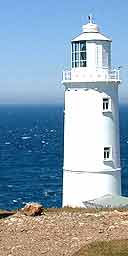
If your holiday-letting agency informed you that earplugs were supplied at your holiday cottage, it would normally set alarm bells ringing. But when you're staying at one of the working lighthouses featured in Rural Retreats' brochure, it soon becomes apparent why you may need them.
It was only 1pm when I arrived at Pendeen lighthouse, near St Just in Cornwall, but the fog was already drawing in. Every 20 seconds a high-pitched bleeping broke the eerie silence to warn passing ships they were entering inhospitable waters. I had come to see some of the first former lighthouse keepers' cottages at working lighthouses in England and Wales to be refurbished and let as holiday homes.
Nearly 100 years ago, lighthouses were manned by three keepers doing eight-hour-shifts. Today, all 72 lighthouses operated by Trinity House in England and Wales are fully automated and no longer require on-site keepers. But Trinity has come up with a new use for the guardians' now-defunct cottages by converting them into upmarket holiday accommodation. Three are now open in Cornwall and south Devon and a further 11 locations are expected to be ready within the next 18 months throughout England and Wales.
But are holidaymakers prepared for the realities of staying at a working lighthouse? After all, if the weather is bad, they may have to put up with the sound of a foghorn going off 24 hours a day for the duration of their stay. (Fortunately the light beam is not an issue as it is blocked out over the land arc, so guests won't feel like they are living in a laser show). David Brewer, from Trinity House, believes the sound of the foghorn is all part of the fun of staying in a lighthouse. 'It may be an irritant to some people, but I'm sure most guests will regard it as all part of the experience,' he says.
Fortunately, the punters seem to concur. David Legge, from Reading, stayed last spring at a former Trinity lighthouse, now under private ownership, at St Ann's Head, Pembrokeshire. 'You do get used to them, so much so that it's quite difficult to sleep without them when you get home! The noise would help to send me off.'
Most of the lighthouses were automated about 10 years ago and the foghorn and beam of light come on automatically when the weather draws in.
'The weather changes so quickly. You'd hear the foghorn go off on a blisteringly hot day and then a few minutes later you could see the fog coming in,' adds Legge. And he would definitely go back. 'The best thing about the place is the location. The scenery is absolutely stunning and you see so much wildlife. One day we saw a seal and her cubs.'
Although the lighthouses are exciting for kids, with many operating tours of their history and how they work, be warned - some of the locations are dangerous and Rural Retreats advises against taking young children. For instance, Start Point in Devon has some unfenced 100ft drops that could prove lethal.
By their very nature, lighthouses are situated in dramatic and often very remote loca tions. If you like stormy weather, this is the place to be. Fortunately, you will be able to watch the dramatic weather from the comfort of your refurbished luxury cottage (the former lighthouse keepers weren't so fortunate and lived in primitive conditions).
Most of the original features have been retained but the cottages have been tastefully decorated in neutral shades and furnished in a contemporary style. The well-equipped kitchens have all-white crockery, trendy chrome kettles and toasters and quarry-tiled floors. The all-white bathrooms have separate showers - or power showers - over the bath along with chrome towel rails and more quarry tiling. If you ever tire of looking at the stunning views, you can sink into comfy modern sofas and watch the TV or read a book in the cosy lounges.
Trevose Head, Cornwall
(suitable for older children and some units suitable for wheelchair users)
Location: Near the picturesque fishing village of Padstow, home of chef Rick Stein and his seafood restaurant (book well ahead to secure a table), bistro and cafe. The Eden Project is a 30-minute drive away. Surf fanatics can head for Harlyn Bay on the road to Padstow.
Children will love the nearby Lifeboat Station (open Monday to Friday between 10am and 3pm). No lighthouse tours operate from here so guests are guaranteed absolute privacy. Trinity says private tours for guests can be arranged on request.
Accommodation: It's hard to beat the views from these four single-storey cottages. Perched near the cliff edge, with a 75ft drop to the sea, all you can see is water and the odd fishing boat making its way back to Padstow. At Nimbus and Pelorus cottages, the kitchen, dining-room and lounges have sea views, with the bedrooms at the back of the property.
At Verity and Brook it's pretty much the opposite - most of the bedrooms have sea views. There's a grassy, fenced area at the front of the cottages overlooking the cliff edge, but this isn't recommended for guests' use - sea spray and the odd wave have been known to scale the rocks.
Prices: £810 for a week between 12 July and 5 September. Each cottage has a welcome hamper, which includes a bottle of wine, milk, tea, orange juice, eggs, preserves and biscuits or cake. Two of the cottages, Brook and Nimbus, allow dogs and smokers.
Note: Verity is particularly suitable for wheelchair users because there are no steps once inside the property.
Pendeen, near St Just, Cornwall
(most suitable for children - fenced gardens at the back - and wheelchair users)
Location: Disused tin mines line the deserted coast south of this lighthouse, which is just six miles from Land's End. Sandy beaches at Whitesand Bay and Gwynver are close by. The Geevor Tin Mine museum (01736 788662) is in Pendeen itself, with guided tours throughout the summer and winter months. St Ives, home to the Tate Gallery, a lovely sandy beach and numerous Cornish pasty shops, is a 20-minute drive away.
Accommodation: Out of the first three lighthouse keepers' cottages to open, this is the most suitable for young children; two of the three one-storey cottages - Vestal and Argus - have a separate fenced garden at the back where children can play. Vestal also allows dogs and smokers. A large expanse of grass to the front of the property is surrounded by a 4ft-high wall but children will need to be supervised at all times.
Each cottage has its own garage, worth using if you don't want to spend half your holiday cleaning the salty sea spray from your car windscreen. The single-storey units are set back a fair distance from the cliff edge and the best views of the rugged coastline are available from the end-cottage, Argus. An interconnecting door between Argus and Solebay means larger parties can take over both.
Prices: £810 for a week between 12 July and 5 September for Solebay, which sleeps four, Argus (sleeps three), and Vestal (sleeps four, dogs and smokers allowed).
Note: The single-storey cottages are suitable for wheelchair users. There are steps into the property but once inside it is all on one level.
Start Point, near Kingsbridge, Devon
(scheduled to open in June, unsuitable for children or wheelchair users)
Location: Drive four miles along narrow country lanes to reach this lighthouse, which lies on dramatic headland above Start Bay in the South Hams, between Dartmouth and Salcombe. The sandy beaches of East Portlemouth, Slapton and Blackpool Sands are within a 20-minute drive.
Walkers can follow the South West Coast Path, which runs past the property. Bring your binoculars - seals, dolphins and sharks have all been spotted from here.
Accommodation: My favourite cottage is Beacon, which is perched on the cliff edge and offers spectacular views. On summer evenings you can have barbecues on the timber-decked platform that adjoins the house. Sleeps six people. No dogs or smokers.
The three-bedroom Landward Cottage is smaller and adjoins the lighthouse. It has its own separate gravelled outside space with barbecue that overlooks the sea. Sleeps five. Dogs and smokers allowed.
Prices: Beacon starts from £1,039 for a week between 12 July and 5 September.
Note: The steep drops and unfenced areas mean the cottages are not suitable for children. If you want absolute peace and quiet this may not be the place for you.
The lighthouse is open to visitors between Easter and October from 10am to 5pm. Trinity House says that it will manage the visitor flow to cause minimum disruption to its guests.
Factfile
The lighthouse keepers' cottages can be rented through Rural Retreats (01386 701177). Short breaks and week-long stays are available. Two-centre holidays are also possible.
The next two properties scheduled to open this summer are at Cromer in Norfolk and North Foreland in Kent.
Most of the others will come on line by spring 2003 at St Anthony, near Falmouth; Bull Point, near Ilfracombe; St Catherine's, Isle of Wight; Whitby lighthouse; Alderney, Channel Islands; Anvil Point, Swanage; Lizard, Lizard Point; Nash, South Wales and Strumble Head, Pembrokeshire.
