
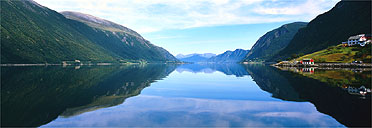
It might have been when we stood breathless after a mile-long scrabble over scree at the foot of an immense blue glacier and were offered crampons for our children to climb the ice. Or it might have been as we descended precipitous slopes on ponies above the snowline. And it might just have been one of those times when we gazed down into the impenetrable blue depths of a fjord. Quite when the defining moment was, I don't know, but we realised that Norway is a place of awesome, primeval physical extremes. In fact, everything you've ever heard about the Vikings and Norse gods slots into place. It's a land that breeds heroes, where men and women take on the unconquerable, silent mountains, the ice and those deep, deep waters. It's not for those who dream of languishing on a hot beach with a book.
The Norway we encountered was exhilarating and challenging. If it wasn't restful in the accepted holiday sense, it nonetheless sent us home feeling physically better and profoundly moved by the grandeur of the place.
You ought to go by sea. I can't now imagine approaching that fractured land mass by anything other than a boat from the north of England. Fjord Line's HMS Jupiter may not have been a Viking longboat - it was a slightly battered but very solid car ferry with a fantastic line in smorgasbord and some wacky children's entertainment (unfortunately all in Norwegian) in between the bingo sessions - but the 22-hour crossing of the North Sea from Newcastle felt like a homage to the past and preparation for the adventure ahead. And anyway, our girls, aged six and nine, thought the boat was fantastic, from the narrow cabin bunks to the endless corridors and stairs, and the salt-filled wind whipping your face on deck. We arrived on the one hot and sunny day of our trip, cruising up the Norwegian coast littered with tiny islands, and manoeuvred into beautiful Bergen, where open-air cafes line the harbour.
Bergen is the gateway to the fjords. Like the desert or the ocean, everyone should see them once in their life. You can almost hallucinate if you look down long enough at the still and perfect reflection of the enormous crags that rise from the edge, knowing the waters are as deep as the mountains are high. We wound around the Sognefjord by car on empty roads, through so many tunnels we lost count, crossing on one of the small ferries that seem to be more frequent and casually used than the underground in London, and felt completely dwarfed by rock and water.
We stayed a couple of nights in the log cabins of the Vesterland holiday park near Sogndal, some 200km from Bergen. These are very well-equipped pinewood cabins, but don't expect entertainment laid on, in spite of the name. A couple of swings was the lot, but what more do you need, with glaciers to climb?
You can drive for mile upon mile of empty winding road in Norway. Just when we thought we must have gone wrong somewhere, we rounded a bend and were confronted with the extraordinary sight of the Nigard glacier rolling towards us through a cleft of mountains. Pictures don't prepare you for the colour - bright turquoise - or the sheer power of the thing. In centuries past, it has inexorably, if slowly, flattened homes. In the mid-18th century, there was a mini Ice Age here and the glacier grew by 1.7 miles in 25 years. The tourist centre museum will tell you this, and also that the English brought the Black Death to Norway by boat where it killed a third of the population.
We thought at one point that the Norwegians might be getting their own back on the way to the glacier. You have to drive to an ice-cold lakeside, cross by small boat, and then somehow pick a footing across treacherous scree, ice and rocks that are lethally slippery from cascading streams to reach the foot of the glacier. It's not for the frail or anyone in less than stout boots. Although we and our footwear were tough, we fell several times.
When you finally reach the vast, overhanging mass of blue ice, you've only just begun. Everyone stops to eat their sandwiches and then the guides rope a party together, crampons strapped to their feet for the "family tour" - a walk up the glacier which is pock-marked with holes, forming surreal shapes, columns and arches out of the ice. We were unprepared. Nobody nannies you in Norway. We had no food, not realising the hike would take so long, and were fearful of seeing our youngest slide down a crevasse. With lingering backward looks, we left.
Something similar happened when we were staying by the lakeside in Voss, a popular tourist resort. We thought it might be fun for the children to go riding and were directed to a place called Engjaland, a few miles up the stunning Vik-Voss mountain road. That's where Tony Hutchinson, originally from Dorset but 25 years in Norway after army service, and his Norwegian wife Aud live in magnificent remoteness and keep a stable of hardy mountain ponies. What we thought might be a slow amble through the fields turned - for me, who had never ridden before - into the experience of a lifetime. The children were led up the path by a couple of stablehands while Tony, wearing a cowboy hat and riding the sort of big, fiery and unpredictable horse he says he likes, took the adults up steep mountainsides, through grass and bog, along vertiginous paths where the horses' hoofs skittered on stones and up above the snow line.
We were on the white roof of the world, gazing for miles with nothing else human visible, and then, alarmingly, coming steeply down again. We met the children and Aud at the couple's cabin in the mountains for brown cheese and home-made bread, and felt brave, exhilarated and content. The couple run treks lasting anything from two hours to a week, camping in wigwams, and offer bed and breakfast in their farmhouse.
There are quieter things to do - plenty of wonderful old stave churches to see and some good museums - but the real Norway is not for the fainthearted. Nor is it for those who like to drink. The astronomical cost of alcohol, loaded with tax in what from all accounts is a rather unsuccessful attempt to stop binge drinking, is a constant source of complaint among Norwegians themselves.
On the ferry, you are urged to take all your booze with you. The on-board duty-free shop must make a mint. We found restaurant prices were very expensive too, and supermarket food cost a bit more than in the UK. But if adventure is what you want, Norway is worth every krone.
Getting there
Fjord Line (0191-296 1313, fjordline.co.uk) offers seven nights' self-catering in August at Vesterland from £349 per adult and £289 for children under 16. The price includes return ferry crossings from Newcastle-Bergen with a car and cabin accommodation, and internal ferries to and from Vesterland.
Activities
Tony and Aud Hutchinson (+5651 9166, engjaland.no) offer riding trips, Nkr250 for two hours, Nkr1,800 for two days including meals and accommodation.
Further information
The Norwegian Tourist Board, 5th Floor, Charles House, 5 Lower Regent Street, London SW1Y 4LR (0906 302 2003, email: great britain@ntr.no, visitnorway.com/en/). Country code: 0047.
Ferry time: 22hrs.
Time difference: +1hr. £1 = 11.16 kroner.
The following correction appeared in the Guardian's Corrections and Clarifications column, Wednesday June 26, 2002
We referred to a car ferry belonging to the Fjord Line as HMS Jupiter. The abbreviation HMS stands for Her Majesty's Ship and is used only by the Royal Navy. For merchant vessels the convention now is to use the name only. This is the way in which they are described in Lloyd's List. Occasionally, on older ships, MV (motor vessel), SS (sailing ship), or PS (paddle steamer) may still be seen.
