
'But the best is puffin stuffed with fruitcake," said the waitress, placing slices of roast guillemot next to the roast potatoes. "That really is delicious, but we only serve it at home. It's not something you find in hotels."
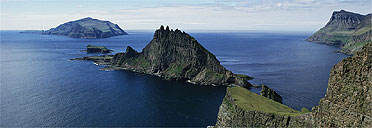
Puffin stuffed with fruitcake? Roast guillemot? I had heard that the Faroe Islands were a good destination for bird-spotting, but I didn't realise my first encounter would be on the dining table. However, I was more entranced by the living varieties - fulmars gracefully wheeling in the pale sky above the north Atlantic, while others nested on the ledges of the 300m high cliffs of Vestmanna; puffins, paddling and flapping madly across the sea and out of the path of our high-speed inflatable dinghy. Knowing what the Faroese do to them, no wonder the little birds looked alarmed.
But it's not just birds that make their way from the ocean to the dinner table on the Faroes, which lie 186 miles northwest of the Shetlands. The Gulf Stream, which keeps the islands pleasantly mild, means that the waters teem with cod, salmon, shellfish and whales.
A square of pilot whale blubber on a wafer of dried cod is a chewy, if ethically dubious, picnic favourite of the Faroese in the summer, when many of the islands' inhabitants are out in the fields making hay. Even those with office jobs who live in the capital, Torshavn, own a few of the country's 80,000 sheep, which feast on the supplies of hay in the winter months.
When it comes to whale, the Faroese are aware that the fact that they occasionally hunt and butcher these animals doesn't go down well with most tourists. "We only round them up if they happen to come nearby. We don't go out of our way to hunt them," a local told me.
There has been an upsurge in interest in the islands since direct flights started from the UK, four a week in fact from Stansted, although only for the duration of the Faroese summer holidays (June-August). This makes the islands, theoretically, an option for a weekend break. But you wouldn't want to go for just two nights. The place is too beautiful, too rugged, boasting an abundance of good walks, boat-trips, bike-rides and country-drives. Then there's the weather: mid summer, you'll have more or less 24-hour daylight, but that doesn't mean sunshine. When my Stansted-Faroes flight landed, the rain clung to the airplane windows, obscuring the view. It was cold and dismal. Yet a day or two later, I was sunbathing on the prow of a schooner as we sailed through inter-island channels and fished for cod from the deck.
To join up with the schooner, we had travelled by road from Torshavn to the village of Kirkjubour - with its shell of a partly built 12th-century cathedral and what is claimed to be the oldest prefabricated house in the world: a 900-year-old log shack with black-tarred walls and a typical Faroese turfed roof, originally delivered on a Viking ship. Inside, it's now a museum where you can sit on a whale-vertebra stool and admire the whale-belly container and sheep-bladder balloons.
There's also a long pole with a spike on the end. Impress your guide by guessing correctly that these implements are used to poke and twirl into the wool of a lost sheep and hoist it back to safety from a cliff ledge - as if the sheep were a tasty morsel in a fondue of wild weather and sharp descents.
The cliffs are incredibly sheer in places and with unexpected ravines. Combine the terrain with the unpredictable weather and frequent sea-mists, and you'll see why the sheep often come a cropper. Cliff walking in the Faroes is definitely not for the fainthearted. The paths are not clearly marked either. The best thing - if you're not on an organised tour - is to hire a guide.
After the museum with its sheep-twirling stick, we boarded the gracious schooner and, there not being any wind, we motored across to the small island of Koltur. On the way, between cod-fishing, we boarded rigid inflatables and bounced at speed towards the inlets and steep cliffs of Hestur island where serried ranks of kittiwakes squawked from narrow ledges and thousands more noisily filled the sky.
The driver daringly took the boat into narrow channels in the cliffs, surging through on the waves. We ended up in a large cavern where lantern-lit jazz concerts are held: the musicians in one boat and the audience bobbing about in others. It must be magical, although there's no chance of leaving during the interval if you don't like the music.
The tiny island of Koltur is home to just two people, who tend to their flock and have a couple of rooms in their farmhouse, offering bed and breakfast. It is a blissful place. The hills are rugged and green, cropped short by the sheep. There's a tiny sandy cove where the cold water is as clear and blue as the Aegean, and the friendly sheepdog plays happily on the white sand. It can be like heaven. Weather permitting, of course.
Getting there
Arctic Experience (01737 214255, arctic-experience.co.uk) offers a selection of packages, such as the independent eight-day island hopping itinerary. From £607pp with flights from Stansted or £597 from Aberdeen (June 24-August 19).
Arctic Experience also offers return ferry tickets from Aberdeen or the Shetland Islands starting from £501 for four people plus car.
Explore Worldwide (01252 760000, exploreworldwide.com) has a nine-day walking holiday from £885pp.
Further information
The Danish Tourist Board, 55 Sloane Street, London. SW1X 9SY (020-7259 5959, visitdenmark.com)
faroeislands.com
tourist.fo
Country code: 00 298.
Time difference: none.
Flight time: 2hrs.
£1 = 11.28 Danish kroner.
