
A pike appears first. Then a shoal of perch swims past, and closer inspection of the window reveals tiny tadpole-like algae, all within inches of my bed.
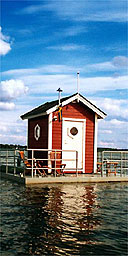
The room, with glass-panelled walls, is hardly big enough to swing a squid but it contains twin beds and a bedside table. It also lies 6m below the surface of Lake Mälaren in Västerås, Sweden.
Staying here is a reversal of the goldfish bowl: a bit like taking part in an underwater version of Big Brother where the fishy viewers can observe you 24 hours a day without having to lift a fin. I shine a torch on the pike and it swims to the next glass panel - there really is no escape.
The Utter Inn, the quirky accommodation for the night chosen by my friend and me, weighs 25 tonnes and has a solar-panelled roof; heating and electricity is generated from a car battery. Because the ice-breaker boat clears the way in winter, technically it is open all year.
The Utter Inn is the brainchild of Mikael Genberg, a local artist and sculptor who has chosen to focus on "making art for the public".
The Woodpecker, his first "hotel" creation, takes the form of a tree house in Västerås Park and accommodates one person 13m above the ground in a 350-year-old oak tree.
Food is delivered via a pulley, and there is also a miniature library, useful for passing the time if you feel compelled to spend the whole 24 hours away from other people.
While a night at the Utter Inn doesn't involve the ropes and harnesses needed to access the Woodpecker tree house, it is not the ideal place to stay if you are remotely claustrophobic. "My work makes people question their perception about what is safe and secure, and when you experience fear, it sharpens your senses," explains Genberg. It certainly does - especially when you are 6m underwater.
That evening, we had sat in deck chairs on the pontoon, eating a takeaway meal delivered from the mainland by boat and polishing off a bottle of chablis. Two Polish seamen in a speed-boat had hovered for a while, no doubt attracted by the sight of a red garden shed bobbing on the water, but apart from this, and an all-male crew on a Sigma shouting something in Swedish, we were left alone to catch the magnificent sunset. Even craft heading for the nearby marina created just enough waves to gently rock the pontoon, so what happened later that night was a tad unexpected.
Cocooned snugly beneath duvets in a comfortable bed, it's hard to know what to expect when you are 6m underwater, but I hadn't anticipated being woken at 3am to find myself in the midst of what seemed like a minor earthquake as our room rocked sideways like a seesaw. Convinced we were about to drown I scrambled up the aluminium ladder to the floor above water and pushed my brow against one of the portholes. Utter darkness.
I ventured outside on to the swaying platform but saw no sign of a vessel, or any other form of life for that matter, that could have caused such a commotion. Only the damp floor and some cutlery and candles sprawled across the room confirmed that I had not experienced my first underwater nightmare.
The next day, Genberg tells us it was probably the wake from the early morning ferry on its way to one of the islands on the lake.
After being marooned on our small pontoon of an island for 18 hours, it seemed sensible to check out Ridön, a proper island and a relaxing 40-minute journey in a catamaran from Västerås. Ridön has rolling hills, forests, small-scale farming and fishing. And with only four inhabitants, all things are indeed small scale.
One of the locals, Ingela Gorjeby runs a riding centre on the island. She meets us at the jetty and transports us in a trailer behind her motor-powered quad bike, a bizarrely modern version of the horse and cart that looks out of place on this quiet island, which in winter receives a visit from the ice-breaker boat just once every two weeks.
We make a slight detour to see the newly renovated youth hostel, coated in the traditional copper-based red paint to preserve the wood, and pass some of the 25 summer houses owned by the mainlanders.
Since 1978, the island has been preserved as a nature reserve, one of more than 40 such places in Västmanland. At one time, the area boasted so many oak trees that a shipyard was set up here, but nowadays Ridön is renowned for its Icelandic riding school.
Less than 30km from Västerås, beside another nature reserve, is Engsö Manor. This attracts many visitors looking for a supernatural experience, as there are regular sightings of ghosts and recently four ghostbusting teams from the United States have been monitoring the building.
The stone manor house is no longer lived in but even to a sceptic, the building seems exceedingly eerie. At the end of each step of the wide stone staircase are three white circles, thought to be painted in egg yolk in the 18th century to highlight the stairs in the dark, and also to keep out the gnomes, or "small people".
Superstition has a big role to play in the everyday life of the area. For example, one of the best-known items on display at the manor house is the gold chain won, according to legend, by Count Sparre during a game of Nordic backgammon with the devil. Reputedly, Engsö catches fire every time this chain leaves the premises.
For his next trick, Genberg is going underground, and is currently looking at caves around Västerås where, 60m beneath the Earth's surface, he is planning to create a twin-bedded hotel room. If the project is successful, guests will have the sound of bats for company and the opportunity to eat breakfast on an underground terrace.
If you can stomach it and don't suffer from either a fear of heights or mild claustrophobia, this could be just the adrenalin kick that you have been looking for. One thing is certain - it will undoubtedly sharpen your senses.
Getting there
Ryanair (08701 569 569, ryanair.com) flies daily from Stansted to Västerås.
Return fares (minus taxes) £22.98 for midweek flights, £37.98 for weekend flights.
Buses from the airport to the city centre cost about £1; a taxi costs about £9.
Where to stay:
The Utter Inn, Lake Malaren (tel: +21 13 96 00) costs £50 per person, including an evening meal - delivered by boat - and picnic-style breakfast.
Stadshotellet Västerås, Stora Torget (tel: +21 102 800, elite.se/vasteras) costs from £50 per night for a double room.
Where to go:
Engsö Manor, which is famed for its ghosts and located on the nature reserve of Angso Island, is an hour by road from Västerås, and islands, including Ridön, are easily accessed by means of frequent ferries that run from Västerås harbour.
Further information:
Swedish Travel & Tourism Council Information line (Freephone: 00800 3080 3080, email:info@swetourism.org.uk, visit-sweden.com).
VästeråsTourist Office, Stora Gatan 40, Västerås (email: info@vastmanland.se, vastmanland.se).
Country code: 00 46.
Time difference: GMT + 1 hour.
Flight time: 2 hours.
£1 = 13.90 Swedish kronor.
