
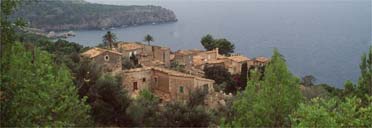
I am swimming through deliciously cold saltwater in the heavy heat of a Mallorcan summer afternoon, but I am not holidaying at one of the island's busy seaside resorts. Above me, the foothills of the Tramuntana mountains poke out from behind a terraced flower garden, below lies a valley full of sun-soaked farmland.
Most delightful of all, for a city girl who finds herself lolling about in an unchlorinated pool in the middle of the Mallorcan countryside, is the total and utter peace. There are cicadas whirring in the bushes, of course, but the sound of a passing car is extremely rare. In fact, the only man-made noise you can rely on is the occasional clink of ice in a glass.
So where are all the dive-bombing nine-year-old boys? And where is the obligatory wailing baby (the one that's been cradled in the seat behind you for the whole flight out from Britain and then turns out to be staying in the next room)? Where, finally, are those unappealing toddlers that strangers on holiday seem to specialise in producing? The answer is that they are banished, emphatically, from staying at this hotel and they are not even allowed to come in for lunch.
'I had a family come here the other day who had driven over because they had heard about the restaurant,' said John Hughes, proprietor of the Can Furiós Petit Hotel in the tiny hamlet of Binibona. 'They asked if they could have lunch and I had to say, "No. We do not allow children." The mother was quite angry.'
It may sound a harsh rule, but Hughes sticks to his guns. He argues that if you want to make children happy on holiday you have to have lots for them to do and a special menu, too. He is not prepared to see half portions of chips and pizza served in his pride and joy, the hotel's sophisticated Sa Tafoneta restaurant. Besides, there are plenty of places elsewhere in Mallorca that can cater to a two-year-old's fussy tastes.
The strict 'adults only' policy seemed to go down well with the hotel's other guests. One couple, who both work, were taking a week away from the company of children to rest before going away again with their young son; a trip they seemed to know in advance would be a 'holiday' in name only.
Another older couple with grown-up children were obviously not quite nostalgic enough about the early years of parenthood to want to get splashed in the pool. They were on their second visit of the year to Can Furiós and planned to come back once more in the autumn. 'We used to go to La Residencia, at Deià, and we have looked at Read's in Santa Maria too, but this place is much more relaxed,' they said. In truth, due to Can Furiós's size (there are only seven rooms and Hughes doesn't want to extend the premises), it will never seriously compete with these neighbouring luxury hotels, but it is still part of the upmarket 'north of the island' scene.
This, after all, was the first area to thrust off the image of Mallorca as the centre of the fly-'em-in-and-pile-'em-high school of tourism. The first charter flight freighted with British tourists slid into Palma airport more than 50 years ago and now there are 10 million tourists a year.
Today, 90 per cent of Mallorca's income comes from tourism, so the islanders have had to think quickly about safeguarding its future in the face of recent low-cost competition from resorts in Croatia and Egypt.
In response to the threat, the island has consciously headed for the high ground, with a new focus on luxury holidays, culture and fine food. A law now prevents all new construction and many of the most offensive beachside blocks in Palma have been pulled down.
A controversial ecotourism tax which was introduced earlier this summer will be channelled into heritage and renovation projects and into the establishment of national parks. The tax, which works out at between €0.25 and €2 (17p-£1.33) a night for those over the age of 12, depending on the standard of accommodation, is strongly opposed by many hoteliers. At some resorts, proprietors have even taken to handing out compensatory beer vouchers.
The result is that there are now two very distinct Mallorcas, which sometimes come into contact with each other.
In the sleepy village of Moscari, I met one Canadian refugee from the built-up coastline who had run for the tranquillity of the north. He had arrived on a direct flight from Canada at the height of World Cup fever without guessing what he would find. He made the mistake of wearing his German football shirt for his first stroll around Magaluf. Could have been nasty.
Can Furiós is a hideaway from Mallorca's brash side, an old Moorish house which was rebuilt stone by stone by Hughes around a pair of surviving look-out towers. Binibona is only half an hour from Palma, but the rather expensive airport limo service (£50 each way) organised by the hotel might be worth considering, even if you plan to hire a car once you arrive - the hotel would be near impossible to find for the first time in the dark.
The rooms are beautifully restored in local stone and antique wood. The three separate suites in the garden are furnished in great style, with canopied four-posters and large private terraces.
And yet this luxury comes at about £100 a night less than you would pay at some of the well-known establishments nearby - establishments, don't forget, that also come with the possibly unwelcome added extra of children. Can Furiós might mean 'mad house' in Mallorcan, but the atmosphere is closer to that of a sybaritic retreat.
Factfile
Rooms at the Hotel Can Furi ó s (00 34 971 515751) cost from £58, suites from £97.
Flights are available on no-frills airlines: EasyJet from Liverpool, Luton and Gatwick from £70 return; Go has fares for £83 from Stansted and £78 from Bristol.
More information is available from the Spanish Tourist Office (020 7486 8077) and the Mallorca Tourist Office (00 34 971 724090).
