
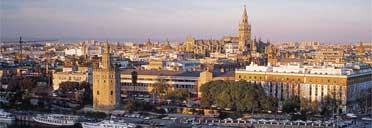
If you spent hours last week hunched up in a hot, uncleaned commuter carriage somewhere in Britain, you might not feel receptive to the idea of a holiday with a train as your transport, your hotel, your bar, lounge, cafe, restaurant and even your dance floor.
But the polished wood carriage interiors and sparkling etched-glass windows of the Al Andalus Express have more in common with the great train journeys of the past, such as the Orient Express, than UK commuter trains. This train will take you on a six-day tour of the historic Andalucian towns of Seville, Cordoba, Granada and Jerez, meandering through hills of olive and citrus trees and the stonier foothills of the Sierra Nevada. From the moment you board the reconstructed 1930s carriages at Seville you are in a time warp where service, luxury and courtesy replace stress, hurry and frustration.
Our group joined Al Andalus at the slick Seville station and slipped between waiting bullet-nosed high-speed trains to board an anachronistic assembly of Pullman-style cream and brown carriages. All are restored, or completely refitted, from trains that have known past glamour in Spain, Britain or France, from a time when diners wore lace and bow ties, and Monsieur Poirot was on the alert for jewel thieves.
There are 12 cars, most with a well-documented history: one of the sleeping cars once regularly carried an unspecified King of England between Calais and the Cote d'Azur. In addition, there are two restaurant cars, a lounge and games room; bar and dance-floor; five sleeping carriages; two shower cars and a staff carriage.
Spain is good at trains. On its high-speed services, passengers are given refunds if the train arrives more than 10 minutes late. Al Andalus Express offers no such promises, despite its name, but ambles gently through cultivated and wild olive and cork-oak landscapes.
We were 62 (though Al Andalus can accommodate 80 comfortably) as the train pulled out of Seville for Cordoba, cleverly timed to coincide with our first meal, an Andalusian Sunday lunch of enormous proportions. To be served first-rate food (an aubergine starter, followed by duck and local chocolate cake) with the appropriate local wines while travelling through the undulating landscape of Andalusia must surely rank as one of life's grade-one pleasures. So let's get one criticism quickly out of the way. Several of the participants were disappointed to find that the week's itinerary too often involved travelling by coach while the train shunted - empty - to a suitable pick-up point. Maybe this was essential and the rail tracks were not laid to suit twenty-first-century sightseers but, to those who had chosen a train journey because they love being in trains, it was a disappointment that so much travel was by road.
At Cordoba we concentrated on the more cerebral aspects of the Al Andalus experience - the first of several guided tours of the great Andalusian spectacles. The tour guides hired for each of these trips were excellent, experts in the extraordinary meeting of cultures - Jewish, Islamic and Christian - that characterises this region. Cordoba, with its Jewish old quarter and huge Mezquita, was the right place to start. The great mosque of Abd al Rahman was the work of many centuries, started in the eighth century until partly destroyed in the sixteenth century. In 1532, triumphalist Christians built their cathedral in the middle of the hypnotic rows of Islamic arches and pillars that had been a place of pilgrimage to the faithful. I hoped there were no Muslims there to see a young Spanish couple using the holy prayer niche as a photo opportunity for a most irreligious display.
Dinner in the Jewish quarter afterwards set the standard for the week, with plate after plate of traditional Andalusian dishes: fish, calamari, chorizo, lamb, and, naturally, Cava and local vino tinto. Those who over-indulged a little on the alcohol might have been the wisest after all, ensuring themselves an undisturbed night's sleep. Sunday was the one time the train was in motion through the night as it headed for Granada.
The standard class cabins were small - no bigger than second-class overnight sleeper accommodation between Glasgow or Penzance and London. The bunk beds and limited storage space proved difficult for some. But I admired the reaction of the retired hospital consultant with a bad leg and his chic seventysomething wife who told me they had giggling fits every time he made his nightly ascent of the ladder to roll into the top bunk. Sprightlier teacher friends said that it was difficult, with luggage and clothes hanging everywhere, to do anything but remain horizontal - sitting, reading and even talking was difficult. But they decided from the outset that the lounge car would be their library and sitting-room, and cheerfully put up with sleeping in what was essentially a wardrobe.
Despite space and storage difficulties, all the travellers presented themselves at the special-event evenings and gala dinner looking remarkably coiffed and uncrumpled. And, for those for whom things became too claustrophobic, there were always the spacious shower cars (large white robes and slippers were provided in every compartment).
If you want more space you can pay for Superior class (two compartments joined together), or for spacious Club class (two single beds convert by day to a sofa, chair and table) with panoramic window, good storage and en suite shower and toilet. But the costs double in some cases. As one woman put it, they had retiled the kitchen with the saving she and her husband made by forgoing superior accommodation.
We breakfasted aboard the train every day. That first morning, outside Granada, the choice seemed astonishing - from fruit, yoghurt and juices to the full English fry-up.
Fortified, we took the coach to the massive Alhambra complex of gardens and royal palaces. The mesmerising repetition of arches, cloisters, fountains and vistas of light and water, can barely be appreciated in one day. Be prepared to be shuffled through at a pace that the staff hope will ensure maximum access for thousands of visitors each day. But even among the shoving and shouting and regimenting I managed to find corners of peace from which to marvel at this thirteenth-century representation of paradise on earth, built to the order of the rulers of the Nasrid dynasty just as its political power began to wane.
The guides were excellent and on this, my third visit, I learnt for the first time that the elaborately vaulted ceiling of the Sala de los Abencerrajes was inspired by Pythagoras's theorem. Here, Boabdil's father murdered 16 princes of the Abencerraj family to protect his daughter. But the rule of the caliphs was virtually over and in 1492, the year Columbus 'sailed the ocean blue' Boabdil himself was forced to flee Granada when the city fell to the Catholic monarchs, Ferdinand and Isabella. Boabdil famously wept as he left the Alhambra and its beautiful gardens. His mother Ayesha is reputed to have unkindly reproached him: 'You may well weep like a woman for what you could not defend like a man.'
Boabdil also gives a version of his name to the splendid La Bobadilla hotel, some 70km from Granada. It was an inspired piece of itinerary planning to have this luxury rest day after two days of heavy sightseeing. Recharged, the group was ready for a couple more days of marching round the hill towns of Antequera and Ronda. We dined several times more in handpicked paradors and visited the sherry cellars of Jerez.
Our final celebratory gala dinner was, once more, in the Al Andalus Express, parked at Seville station. The after-dinner singing and dancing that kept most of us up until the small hours no doubt entertained a few passers-by and station staff. We imagined ourselves to be still in some Andalusian castle in some quite different century.
Factfile
Barbara Gunnell travelled with Mundi Color Holidays (020 7828 6021). Its Al Andalus Express holiday costs from £2,184 per person based on two sharing standard accommodation. The price includes scheduled flights from Heathrow to Seville, transfers, a night in Seville and five nights on board the train. All meals and regional wines with main meals are included, as is sightseeing with local guides and the full-time services of train staff.
