
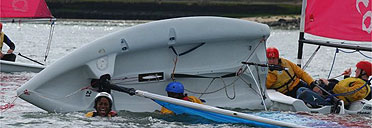
Within an hour, a complete beginner can have a tiny Pico dinghy zipping across the water at a good lick (there's probably a nautical term for that, but I'll be spliced at the mainbrace if I know what it is). And within an hour and five seconds, that same beginner will invariably capsize that Pico - again.
But it's not entirely the incompetence of a complete beginner that causes such minor disasters at sea, for these craft are remarkably sensitive, and one wrong twitch of the tiller will have the boom cracking you across the skull (don't worry, you'll be wearing a helmet) before sending you over the side for another dip in the briny.
All this and much more I discovered in a morning during an intensive one-day course in dinghy sailing at the world-renowned UK Sailing Academy, at Cowes on the Isle of Wight. The "world-renowned" bit is no idle boast, either - Olympic gold medallists Shirley Robertson and Ben Ainslie, and record-breaking round-the-world yachtswoman Ellen MacArthur are regular users of the academy's facilities, so it's a pretty safe assumption that you're trimming your sail where the very best have trimmed before.
Indeed, you would do well to keep in mind that such luminaries as these were once beginners, too, and no doubt had their first taste of life before the mainmast in similarly inept style, because learning to sail a little Pico when multi-hulled, multi-million-pound craft are cutting through the water all around you can be a rather humbling experience. Fortunately, you're not too recognisable when sporting wetsuit, buoyancy aid and helmet.
But before you slip into this little number, you first have to take a lesson on land concerning the various bits and pieces that make up your dinghy - things like the sail, mast, boom, daggerboard and tiller. This, thankfully, is about all there is to it apart from the relatively minor intricacies of the sheets (ropes to landlubbers) and a couple of cleats, knots and that sort of thing.
Picos are very simple craft, designed to make learning to sail an easy and fun experience, and once our instructor, Steve, had taken us - slowly - from the front to back (I know, bow to stern), we were each able to rig up our own individual craft in about five minutes with the minimum amount of assistance.
From there, it was into the wetsuits and on to the water. And this is where I'd recommend travelling in disguise. Kids think it's great to be towed out of the harbour to a safe learner's spot by motor boat, like a line of ducklings, but once the sin of pride and the necessity of appearing cool take over your life, around the age of 11, this really is not the way to travel. Nothing makes you feel more like you're at the bottom rung of the nautical ladder - especially as toffs in big boats look down on you from their poop deck with a condescending smile.
And it's perhaps just as well that all pretence at retaining a modicum of sang-froid has been disposed of by the time you reach the sheltered waters on which you will learn, because, mark my words, the only cool you'll be feeling for the next hour or two is that from the English Channel dribbling down the inside of your wetsuit after you've capsized your dinghy yet again.
One of the big advantages enjoyed by the instructors at UK Sailing Academy is that pretty much whatever the wind is doing, and from wherever it's blowing, there's somewhere they can take beginners that will provide suitable conditions. So even though the wind offshore was gusting Force 5 or more, we were able to find a relatively sheltered stretch of shallow water to the north-east of Cowes that was ideal - not too windy, the water shallow enough to stand up in.
With our second instructor of the day, Matt, yelling instructions at me from the shore, all was well until I got too far out to hear him. This was also the point where it was advisable to turn around and head back to land if I wasn't to run the risk of cutting up the Isle of Wight ferry. Which is where things get tricky and why you wear a helmet, because turning a dinghy around involves some complicated acrobatics that require you to duck beneath the boom swinging towards you, scuttle across to the other side of the dinghy as it veers around, change hands controlling the tiller and the sail and, above all, try to stay in the boat. An expert like Matt makes it look as easy as falling overboard; a novice like myself actually does fall overboard.
Fortunately, righting a Pico is an easy task, and once I was back in, at least the thing was facing in the right direction. But even the job of going in a straight line back to the beach isn't that easy. You'd think that holding a tiller straight would be a relatively simple task, but Picos, as I said, are twitchy little craft, and you only need to get the tiller a little off course and you're heading at a rate of knots for Southampton or Tristan da Cunha. Of course, there's no chance you'll ever get to either destination because once the Pico, rather than the sailor, takes control, its only aim is to get you back in the water as soon as possible.
And so, for the rest of the day we sailed out to sea, turned around, and sailed back to shore. Sometimes, just to make a change from this routine, we tacked along the shoreline. At times, Matt would follow us in a small motorboat, shouting both instructions and encouragement in equal measure, and occasionally he would take over to show us how to do things properly.
Like so many sports that seem impossible on the first attempt, things do fall into place eventually, and you do start to gain a modicum of control over your dinghy - so much so that by the end of the day you really can more or less take it where you want to go, rather than the other way round.
It may not be done with quite the style and verve of Matt - or even the 10 year olds who were sailing close by - but remember that at the start of the day you were a confirmed landlubber, whereas now you really can feel the thrill of a good breeze in your sail and the excitement of the water whipping by beneath the keel of your craft.
Not quite Ellen MacArthur, perhaps, but tacking along the right lines.
·Skandia Life Cowes Week (Skandia Life Cowes Week) runs until August 10.
Where you can learn to sail in the UK
There are several hundred yacht clubs throughout the UK where you can learn to sail a dinghy. Visit the Royal Yachting Association's website (rya.org.uk) for details of a centre near you. The following are all affiliated to the RYA and can get you out on the water and tacking with the best of them.
Caledonian Discovery, The Slipway, Corpach, Fort William PH33 7NB (01397 772167, fingal-cruising.co.uk). Ballyholme Yacht Club, Seacliff Rd, Bangor, Co Down, Northern Ireland (028 9127 1467, ballyholme.com). Hollingworth Lake Water Activity Centre, Boathouse, Lake Bank, Littleborough OL15 0QD (01706 370499, rochdale.gov.uk). Blakeney Point Sailing School, Church Farm House, Glandford, Holt, Norfolk NR25 7JR (01263 740704, blakeneypointsailing.co.uk). West Wales Windsurfing and Sailing, Dale, nr Haverfordwest, Pembrokeshire SA62 3RB (01646 636642, surfdale.co.uk). Brixham Yacht Club, Overgang Road, Brixham, Devon TQ5 8AR (01803 853332, brixhamyachtclub.com).
Way to go
Getting there:
Red Funnel (0870 4448890) offers weekend sailing courses at the UK Sailing Academy from £284pp, including two full days' tuition on Saturday and Sunday, plus two nights' half-board accommodation and return ferry crossing from Southampton to Cowes.
