
It was on our second day that we saw it - a nose and some whiskers, a flattish tail. It seemed to be surfing the waves that buffeted the canal sides as each boat puttered past. "Beaver," shouted someone. "Otter", roared another. By the time we'd fumbled the binoculars out of their case, it had dived beneath the surface and we were, anyway, out of range and distracted by the stone hulk of an approaching lock. We had several more sightings - just enough to be sure that it wasn't an otter (too furry), or a beaver (there aren't any), or even a common or garden water rat (too big, wrong tail), but never close enough to have any idea what sort of animal it actually was that seemed so curious about the tourists on the Nivernais canal.
It was only when our week was over and we returned to base that the mystery was solved: it was a coypu. So what exactly are South American rodents doing in the canal waters of France? The most obvious answer is burrowing away at the painstakingly constructed 200-year-old banks. Imported for their fur, coypu have gone native in central France, where they are providing a picturesque but ironic footnote to the history of the canal, since their arrival is the result of an industrialisation that has otherwise largely passed these bucolic pastures by.
The Nivernais - unspoiled to the extent that on some stretches it's quite hard to find a restaurant that is open within walking distance - snakes through the wine pastures of Burgundy, joining the Seine to the Loire via the Yonne. Its construction started in the late 18th century with the aim of floating firewood to Paris. It is 180km long, took 60 years to complete and, by the time it opened, the industrial barges were simply too big for many of its 110 locks. So, though it was used to carry wood well into the 20th century, there wasn't much call for industrial development along its banks. So sparse was the traffic that in the 1960s and 70s, the lock-keepers - inhabitants of dozens of tiny cottages along its length - were pensioned off and many of the cottages either sold off or left to decay.
In one stretch - known locally as the "happy valley" - the cottages were signed over to students and artists, creating a waterside commune that still exists today alongside the flight of 16 locks in the 3km stretch that joins the two halves of the canal. Imagine a giant spiral staircase, with treads made of water, and you have some idea of this strange stretch of rising damp.
Our own journey took us north from Vermonton, where our English-run boat-hire firm - France Afloat - has its base, to the spectacular medieval town of Auxerre. By the time you have spent two days rumbling along at four miles an hour, past fields filled with wild flowers, mooring up to cycle off in search of a boulangerie in some quiet canalside town, your whole metabolism begins to slow.
We arrived there on one of the weekends when the cathedral and abbeys of Auxerre are lit up at night, and it is an astonishing experience to sit on your boat in the middle of a Mervyn Peake illustration, while all around you a modern university town gets on with the buzz of life. One bank in Auxerre offers free mooring but no water or electricity; on the other side, for about £5 a night, you can hitch yourself up to all mod cons and go off for a night on the town, leaving your boat tucked up in a little harbour five minutes from the town centre.
The relationship between the canal and the surrounding countryside is more tenuous on the Nivernais than along some of the bigger waterways of France. You get to provide ballboy services for the kids having a kickabout around the edges of local boules grounds (a perilous one, this, involving brooms and buckets, and a desperate attempt at insouciance on behalf of our captain. If you're travelling with children, it's an advantage that playgrounds tend to be strung along the canal banks. It's also easy to find tennis courts and football pitches, for the most part well tended, and for much of the day deserted.
There's little sense of an economy geared to water bourne tourism - none of those dreaded restaurants with prix fixe menus in English, and the only giftshop we sighted was in a corner of the harbourmaster's booth at Auxerre. The canals and rivers weave in and out of each other, so - though it's initially shocking to find that all the waste from the boats is pumped straight into the water - the circulation keeps it clean enough to provide swimming areas along stretches of the river.
The surrounding countryside is a fabulously pretty, low-key mix of the apparently natural and the clearly cultivated - of small villages hugging the tips of hills and ramshackle mills with large lumps of statuary strewn around them. You round a corner of neat baby vines to find a huge outcrop of rock, flecked with starlings and falcons. You cycle off up a country road and, 15 sweaty minutes later, find yourself eating ice cream on the sheer edge of a hill town with a posse of local bikers.
When you want to stop, you look for the nearest bollard, or just launch yourself at a stable-looking verge, hoping to find a foothold beneath the mat of wild flowers. On our first day out of Auxerre, we moored at a plain slatted landing stage beneath a hill carved out to provide stone for the buildings of Paris, and now occupied by five million bottles of the local wine, Cremant de Bourgogne.
The next day we hitched up with a rather magnificent 72-year-old peniche, or barge, that had been converted into a mobile gîte by its owners (and crew), Chris and Fran Bennett - a graphic designer and ex-teacher who had decided to customise the good life. Their four-bedroom boat, Chouette, was built in 1930 to carry wheat and gravel. It has been restored and kitted out to provide a halfway house between the luxurious hotel boats that are largely the preserve of rich American tourists, and the hire-drive end of the market beloved of English families.
A week on the Chouette, for a group of six, will set you back nearly £4,000 in high season, but for that you travel in the sort of luxury seldom seen outside period films: have all your food and drink provided with an option of being cooked for as well, with all the chaperoning you need to venture further afield, should - for example - you wish to do some serious wine tasting. This sort of holiday is particularly popular with Americans, who like to be well looked after, and with grandparents who want to take their families off for a treat.
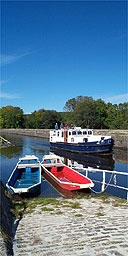
Maybe one day we'll start saving for the grand tour, but for the moment we're too entranced by what a fellow tourist rudely dismissed as our "floating soapdish". It's true that at first, as we saw the bright-painted longboats drifting past, we were inclined to underestimate the virtues of our little boat, Freja, which was white and tublike and made largely of plastic. But we changed our tune after watching a distraught German try to execute a three-point turn in one of those coveted longboats, and talking to another who complained that if he took his eye off the steering for a minute, it would lumber off course. After three days at the wheel, he was exhausted.
Freja, in contrast, danced nimbly into the locks; had no objections to being steered by children; and took the occasional bump against a lock wall with nothing more than a resigned hiccup. She was cosy at night, with enough bedspace even for a six-footer, and bright and airy by day. She was so gracious with her novice crew that by the end of the trip we were trusted to operate the locks ourselves by the eclusiers - employees of the highways department - who shuttle up and down the towpaths on mopeds to open and shut the gates, taking bearings of the nearest boats from mobile phones. We only once had to wait for a lock-keeper to arrive, and there were none of the queues that are the bane of the English canal holiday.
For all the apparent wildness of the countryside, the boats travel so slowly that you are seldom more than half- an-hour's rescue time away from base should anything go wrong, which is good to know when you're travelling with children. But despite the apparent hazards of letting families of landlubbers loose on the water, there appear to be few problems beyond the occasional dreamer who ignores the arrows directing canal traffic into locks and away from the hazards of shallow water and low-slung bridges. The children became so confident that by the end of the week, they were leaping on to the locks and racing the eclusiers .
After arriving back with no injuries bar a bumped head (low doorways) and two scraped knees (jumping on to locks) - not bad, shared among four - we exchanged notes in the local restaurant with a family of longboaters. Wasn't the countryside beautiful, we said. And what an amazing range of wildlife. Yes, they replied, but a shame the water was so dirty. "And did you see the size of those rats?"
Way to go
Getting there:
France Afloat (08700 110538, France Afloat ) can arrange channel crossings with Eurotunnel, Hoverspeed, P&O Stena or P&O Portsmouth for a car and passengers.
Cruising holidays:
France Afloat offers a week for a two-cabin four-berth boat in low season for £435, rising to £2,550 for a four-cabin eight-berth EuroClassic in high season. The Auxerre-based Chouette can be chartered complete with skipper and crew on a self-catering basis. The barge costs from £655pp (based on six sharing), excluding travel. Further information: Maison de la France, 178 Picca dilly, London W1V 0AL, (09068 244123, France Tourism, France Guide.
Time difference: +1hr.
Country code: 0033.
Drive time: Calais- Vermonton 4hrs.
£1 = 1.54 euros.
