
Barbuda is good for second marriages. That's straight from the tourist board, and it's a figurative as much as a literal statement: such is the demand for wedding packages in the Caribbean that islands can now characterise themselves according to the visitors who choose to marry on them. Barbuda, a flat, stunning island 30 miles north of Antigua, pitches itself against the monstrous wedding traffic of the bigger islands, where you can't walk down a beach without tripping over an English bride, her lobster-skinned groom and a steel band hammering out I Will Always Love You.
This, the Antiguan and Barbudan authorities note stiffly, is not an image they wish to promote. Neither is the term "laid-back", that catch-all for the Caribbean, which, with its connotations of indolence - probably dope-inspired - is eschewed by the prim Antiguans for the marginally more upscale "relaxed". Social indicators both: the three-island nation (the third, Redonda, is uninhabited) places itself at the top end of the market, with Barbuda at its summit. The only weddings you will find here, implies the tourist board, are between couples who in the period since their first marriage have developed some taste.
So it is that the three hotels on Barbuda are beyond the reach of most tour operators. The most prestigious, the K Club, regularly hosted Princess Diana and her two sons, but either of the other two, the Palmetto and Coco Point, could have served equally well as hideaways.
There tends to be one of each thing on Barbuda: one town, one school, one main road, a population of a little over 1,000 and, until recently, one way of getting there: a 20-minute flight on a nine-seater twin-engine plane that flew out of Antigua twice a week. Fishermen on its sister island, a relative Beijing of 65,000 people, still reminisce about Diana's vacations, those salad days when Wapping's finest swarmed on the quayside and offered them £2,000 a piece to row within long-lens range of the K Club beach.
These days, the island is more accessible to the general tourist, financially and logistically: the catamaran Excellence sails twice a week from Antigua's Heritage Quay, on a day trip including lunch and afternoon tea on board that costs $100 (£64) for adults, $80 for children; there are two flights a day from Antigua's VC Bird airport which, depending on demand, are in either a nine- or 19-seater plane. It is advisable to book a few days in advance.
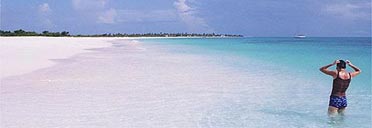
Twenty minutes after our nine-seater took off, we were descending over Barbuda, our first glimpse of the island justifying all the tourist board snobbery. The sea, swimming-pool blue in its outer reaches, is the colour of coconut milk at that shoreline. The vegetation is sparse - Barbuda suffers from a lack of rainfall and there is none of the exhilaration you get from flying over the lusher islands. But, in this age of ever-diminishing peace and quiet, it is achingly empty, concording with even the most extravagant dream of paradise as a place of space and light and amputation from other people.
Apart from its supernatural remoteness, the island has two major attractions: its green lagoon, a 15ft-deep nature reserve which is home to 2,500 frigate birds; and its beaches, not a unique selling point in the Caribbean, but justified in this case by their power to inspire a near-religious feeling of privilege and well being.
After landing at Codrington airport, a sort of outhouse at the side of the runway, it is possible to follow Barbuda's one main road by foot to the jetty. (Alternatively, for a couple of dollars, you can get the customs official to call you a taxi.) This road runs through the town of Codrington, a strip of single-storey homes with corrugated roofs and the occasional rum shack, with some smart-looking council buildings that testify to the island's recent growth in prosperity. Codrington is the name of the British slave-owning family who, in the 17th century, ran Antigua's sugar plantations and leased Barbuda from the crown for the rent of "one fat sheep" a year.
These days, the island's main exports are lobsters, grass and sand, which it ships to the balding beaches of more popular resorts. It defends its exclusivity in terms of eco-tourism, which it takes very seriously: the only reason you go to Barbuda is because nobody else does. Once you get to the jetty you can hire a speedboat to take you across the lagoon to the mangrove swamps, home of the frigates. The cost of the boat is $40, whether for one person or four. It is an eerie trip. Nowhere feels so end-of-the-world as this, a collection of twisted branches poking up through the water, acres of bright green foliage and screaming black birds (wingspan 6ft) circling above like pterodactyls. It is chillingly prehistoric.
After the mangroves, ask the speedboat driver to take you to Luis beach, a strip of sand some 100ft wide that was created when Hurricane Luis swept over the island six years ago, displacing some of the mangroves to uncover this formerly hidden outpost, the rim of civilisation. It is possible to be dropped here and collected several hours later, inviting all sorts of survivalist fantasies, although reassuringly you can just make out the coast of Barbuda several miles away. In the event of a no-show, you could probably swim for it. There are other, more accessible beaches, some with pink sand or the shallowest water. Perhaps the most perfect is the prosaic-sounding Access beach, which borders the private beach of the K Club.
Of the island's three hotels, the most down to earth is the Palmetto, owned by an Italian firm and an antidote to the sterile luxury that characterises a lot of expensive Caribbean resorts. There are tapestries on the walls, terracotta-tiled floors and sand is permitted to blow through the lobby without a battalion of cleaners materialising to deal with it. It gratifies a sense of superior taste in all those who stay there. The bedrooms are bungalows that open out on to a private terrace, and prices are based on full board. Just as well really, as beyond the most basic snacks at lunchtime, there isn't anywhere to eat out in Codrington.
Unless you have some serious unwinding in mind, then two weeks on Barbuda would probably be too long. Even the tourist board promotes it as a destination to visit in conjunction with Antigua. The latter is, itself, a fairly sedate island, much more British in flavour than some of its neighbours and, in comparison with Jamaica and Barbados, far less developed. We visited during the annual carnival (which takes place on the first week of this month). It is as jumping as it gets: the street procession reminded me of just how grossly overblown Notting Hill has become - on Antigua, you can carnival without fear of being crushed to death or fleeced by local vendors to the tune of £3 for a bottle of water.
The Palmetto Hotel's equivalent on Antigua is Coco Bay, on the south side of the island, which is a development of bungalows dotted across a hillside overlooking a bay of fluorescent blue sea. While the north is quite drab and under-vegetated, the south is as green as southeast Asia. The bungalows in Coco Bay are designed in local style: wooden floors, tile bathrooms with a door to a screened section of the balcony so you can effectively shower in the open air, and a hammock from which to view the bay. There are mosquito nets and an old-fashioned fan in place of air-conditioning.
Set in a chic expanse of decking, the pool is built on the rim of the hill, so that it looks as if the water runs over the edge and directly into the sea. It is a hard place to come home from. For the first few days, it feels as if someone has turned down the contrast on your vision.
Way to go
Getting there: Carib Aviation (001 268 4812403) flies Antigua to Barbuda from EC$193 open return.
Where to stay: The Palmetto Beach Hotel (Central European reservations: 0039 02 83311 1833, The Palmetto Beach Hotel ) costs from US$360 per night full board (two sharing) for a junior suite. Virgin Holidays (0870 2202784) offers seven nights' all-inclusive at Coco Bay including return flights from Gatwick to Antigua and transfers for £899. No children under 12.
Further information:
The Caribbean Tourism Organisation (020-7222 4335, caribbean.co.uk).
Country code: 001 268.
Time difference: -4hrs.
Flight time: London-Antigua 9hrs.
£1 = 4.12 East Caribbean dollars.
