
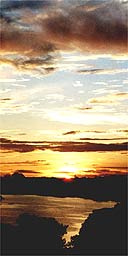
Eagles and parrots were circling; a family of monkeys came to investigate my arrival (and steal my biscuits). The view was breathtaking, the setting sun reflected by a mirror-like lake at the foot of the hill. Occasionally, pink river dolphins broke the calm water, and I decided there and then that I might never leave the home of Fraile José Rivera.
The moment my friend had mentioned the Alto de Aguila, or Eagle Heights, I was convinced it was worth a visit. "Its well up the Amazon," he said, "miles from anywhere. It's run by the fraile, a kind of monk. Not exactly the Ritz, but I promise you will not find a better base for exploring the jungle."
The first step was to fly to Leticia, deep in the Colombian rainforest in a region known as Tres Fronteras, perched on the borders of Brazil, Colombia and Peru. It's a self-styled gateway to the jungle, which is relatively accessible from all three countries, albeit by air or river only.
Leticia, and its Brazilian neighbour Tabatinga, are scruffy frontier towns filled with mud, humidity and the smell of the Amazon. With little to tempt anyone into staying for long, they are the base for a number of tour operators and independent guides who offer excursions, as do some of the hotels. However, resolutely independent, I headed for the passenger wharf, and my first look at the greatest river on earth.
Nothing can quite prepare you for the size of the Amazon in wet season. It's a vast swirl of turbid currents, concealing perilous, half-submerged logs. Once away from the town, its true extent is startlingly visible. In many places there are no banks, just the tops of trees and houses on stilts rearing out of the flood, with water stretching as far as you can see.
I realised shortly into the four-hour trip, once the novelty had worn off, that stuck in the middle of a river in a thunderstorm is not the best place to take one's mind off the need to go to the bathroom, but relief finally arrived in the form of Puerto Nariño, a small pueblo on a tributary on the Colombian side of the river. It is the last town in this direction penetrated by those of European descent. Further upstream the villages are inhabited by Ticuna Indians; we were nearing Eagle Heights.
Everyone knew the fraile, which was fortunate, because my friend's recommendation had not extended to directions. A sweaty hour's hike, aided by pointers from helpful passers-by and a friendly nun, brought me finally to Fraile José Rivera's cabanas, on a bluff high above the flooded forest.
The fraile was a unique host. As a monk, he was posted to the Amazon years ago. When asked to move, he missed the jungle so much that he returned to set up his home, working with the local communities and accepting travellers when they make it. In a clearing high up on the river bank, his cabanas consist of no more than a central wooden building - with dining area, the fraile's bedroom and a cold shower - and a few smaller wooden huts behind. It can cater for up to 12 visitors at a time, although rarely does it see such numbers. This rustic accommodation, with its verandas, hammocks and a fantastic viewing tower, are all you need to live very comfortably, given the limitations imposed by the jungle.
With genuine hospitality, he arranges boat trips and local guides, or simply provides a canoe for independent exploring. If it's peace you want, he will leave you be. One day saw me spend uninterrupted hours in the mirador, a high platform with a panoramic view, up among the myriad variety of birds, visited occasionally by the monkeys. Alternatively, he has a fund of stories, a concern for your comfort and a willingness to include you in local life if you choose to be more social.
I realised this when he took me to mass in San Francisco, the nearest Ticuna village upstream. Within minutes of arrival, I was made at home on someone's porch, with fruit juice and curious children ("Isn't he tall." "Aren't his eyes green.") The imposing padre arrived in pith helmet, cassock and wellies (Paddington Bear might not be found here on the edge of darkest Peru, but I was pleased to see someone wearing them) and shouted people to church in quick time.
Thinking I was being handed some sort of running-order to help the godless heathen through his first Catholic service, I discovered I had inadvertently agreed to give the reading. Before I had time to work out how to say "Chapter 6, Verses 3-11" in Spanish, I was sweating in front of a sea of polite faces. It was a little more involved than I would have liked, but the opportunity to interact with the community as a guest and participant in their daily lives, rather than solely as a tourist, was worth a little humiliation.
Further upstream is Tipisca, the last village on the tributary before you cross into Peru, remote enough to have changed little with the arrival of outsiders. In the company of a guide from the fraile, we had the opportunity to glimpse another world as the village elders welcomed us, although not without some suspicion as their ancient burial sites have in the past been cleaned out by thieves posing as tourists.
There was much excitement that night back at Alto de Aguila when high-power torch beams were spotted in the deep jungle, giving rise to the notion of grave-robbing gangs on the prowl. With the generator shut down for the night, the noise of the jungle, the darkness and the isolation were perfect for such romantic flights of fancy.
Over a cold beer, the fraile told me of the heady days of the first cocaine boom when the hacienda next door was a base for the local mafia, serpents in his little Eden. There was so much money in town that the indigenous population were drinking bottled water and eating chicken, instead of using the Amazon to survive. Small river planes would arrive at all hours, landing in front of the fraile's house, and boatfuls of beers and fast women were seen as this small corner of the jungle turned into a bawdy house. The fraile saw them come and go. Now Amazonas is known as the safest district in Colombia.
Other days saw me paddling amateurishly around the flooded forest, picking up fishing tips from passing locals, getting bitten by a parrot, eating piranha, tempting piranha to eat me, painting myself with dye from the huito fruit, watching vampire bats swoop up the river at dusk and dodging torrential rain. I drank hot chocolate made from hand-picked cocoa beans and sampled mysterious fruits; one which looked like Roald Dahl's snozzcumber, others which tasted like I imagined it.
Even the boat trip back to civilisation was an adventure. The fraile offered me a lift, but his small launch was scarcely up to the fierce storm we encountered. Perched in the bow, wrapped in bin liners, I was swamped by rain and river, honestly believing that my days were numbered, as swirling currents and riptides from tributaries threatened to capsize us. We finally made it, dripping and spluttering to the safety of Leticia, happy to have survived a fitting finale to the whole expedition.
If anyone has spent their life dreaming of the Amazon, it is all you have expected and more. Tranquil, romantic, beautiful, and wild, it simply has to be experienced. Latest figures suggest that half the world's rainforest will disappear in the next 20 years. So go, go now, but don't go all at once. The fraile needs his peace too.
Way to go
Getting there Fly to Leticia/Tabatinga from Colombia/Brazil/Peru. Internal flights cost $100-$200. Find a boat heading to Puerto Narino (four hours upstream from Leticia). The Expreso Tres Fronteras Company will charge around $10. Alternatively, fly to Iquitos in Peru and catch a ferry down river until you reach Puerto Narino. Then ask for the fraile.
What to take Deet mosquito repellent, mosquito net, lightweight waterproofs (although you'll get wet anyway), good boots and fast speed film (the forest is surprisingly gloomy). Check with your doctor for vaccinations (yellow fever is a requirement for many visitors) and anti-malarials.
Word of warning Not many people in Leticia speak English, and fewer still upriver. You should not be put off if you cannot speak Spanish, but the trip will be easier with a few basic phrases.
