
There is something eerie about Leptis. There are no tourists, no trinket sellers and no packs of moneychangers. It's quiet. The only sound is the breeze blowing off the Mediterranean. Walking through the old marketplace, with no one else in sight, you can almost hear the chatter of shopkeepers and customers from millennia ago. The stones of the cobbled roads are so worn you can see the tracks from the many thousands of carts that once plied the city's back streets.
But all this may soon change. Libya was once the enemy: a country vilified for its support of state-sponsored terrorism, whose leader, Muammar Gadafy, was portrayed as a puppet master callously controlling the strings of Islamic militancy. But things are different now, and since the conclusion of the Lockerbie trial in February of last year, Libya has begun to relax, however slightly, its traditionally stringent rules on tourism. Although visitors are still obliged to travel with recognised tour operators, the once-impossible visa process has been streamlined. Instead of a wait of up to three months, tourists can now get their visas in about two weeks. Libya is coming in from the cold.
Tripoli is the obvious place to start a tour. A coastal city with a pedigree that pre-dates the Phoenicians, it has always been an integral part of North African life and trade. Its chaotic history (Tripoli has changed hands time and again throughout the last two and a half millennia) has imposed a degree of cosmopolitanism upon the city, but in an ancient way. For the visitor, trying to sift through nearly 3,000 years of history is an almost impossible task.
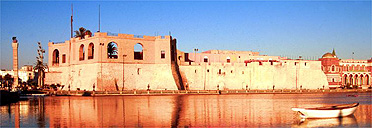
The only place that even comes close to offering any sort of overview is the Jamahiriya Museum housed in the Red Castle in the old Medina. With a collection of Roman marbles and mosaics that would make the British Museum salivate with envy, a two-hour stroll takes you from Tripoli's humble Iron Age beginnings through the tumult of the Carthaginians and Romans, past the second world war and up to the present day - all under the watchful eye of a 30ft Gadafy.
The massive Green Square, next to the museum, may be the parking lot of Tripoli's political life, but the real heart of the city lies in the old town - the Medina. Behind the high walls a variety of busy traditional markets, or souks, sell everything from women's clothing to stacks of dried vegetables to hand-made copper pots and Islamic crescents. Here among the beehive hustle and bustle, it's not difficult to imagine yourself a bit player in A Thousand and One Nights - it's as if the main gate is a time portal where the 21st century comes to an abrupt halt.
Once inside, the narrow streets spread out in a grid-like pattern in every direction, their high, white-washed walls helping to cut the heat of the Libyan sun. The air is heavy and pungent with the aroma of apple-flavoured tobacco, smoked in metre-high shisha pipes by men in flowing robes. Women hide behind traditional headgear, one eye peeking beyond the fabric like cotton Cyclops.
Outside the Medina the city is heavily influenced by the legacy of the Italian occupation of 1912 to 1945. If it wasn't for the Arabic signs and the way people dress it could be mistaken for any town on the Italian mainland. Ice cream-coloured buildings, in blues and pinks, line the city's byways, while old Christian churches and cathedrals are now home to the Islamic devout.
Seventy-five miles east of Tripoli lies the magnificent Roman City of Leptis Magna. Buried in the sand for the better part of the last 1500 years, it wasn't until the beginning of the 20th century that Italian archaeologists started to piece the city back together. Built originally by the Phoenicians and later occupied by the Carthaginians, Leptis Magna eventually became one of the most important cities in the Roman Empire, its coastal location making it key to keeping Rome's African trade routes intact. Today, it is empty, the gate guarded only by an old man and his equally decrepit dog.
The whole of Leptis Magna looks like a Hollywood set from an epic movie: the only things missing are the hundreds of extras basking in the Libyan heat. Fittingly, the city's centrepiece is the theatre which, standing three storeys high, glows a brilliant orange in the afternoon sun. The stage is still adorned with intricate marble sculptures depicting Hercules and Dionysus, the patron deities of the city, and through the forest of columns the waters of the Mediterranean lap at the boulder-strewn shore.
Close by lie the coliseum and the Circus Maximus. Walking out onto the coliseum's sandy floor, it's difficult not to have gladiatorial delusions. Looking up at the surrounding seats, enough to hold up to 35,000 bloodthirsty spectators, you get the feeling that armed with a shield and sword, you could wipe the floor with Russell Crowe. And at the Circus Maximus next door, Ben Hur would look a rank amateur against your own well-toned steeds and chariot.
But Libya is more than the coast. Inland lies the vast expanse of the Sahara, the largest sandbox on the planet. The biggest attraction here is the chance to traverse the huge dunes, either by four-wheel drive or by the more traditional method of camel caravan.
No matter how many times you've watched Lawrence of Arabia, nothing will fully prepare you for the desert, As clichéd as it may sound, crossing the dunes is truly like crossing a sea. The waves of sand undulate for as far as the eye can see in every direction. If it weren't for the expert knowledge of the Tuareg guides, you'd be lost out there in a matter of minutes. But it's not all sand: the desert is dotted with oases, islands of palm trees and water that made the caravans of years gone by possible, but today are more like dinner stops for long 4x4 desert journeys. The Dawada Lakes, in the Ubari Sand Sea, are as picturesque an oasis as you are going to get. A series of saline lakes, they are the perfect spot from which to watch the sun dip below the dunes.
Now is the time to visit Libya, despite the often fickle attitude of its government. Soon the tourist floodgates will open fully and the remoteness of this diverse country will be lost forever. With a population as yet untainted by mass commercial tourism, Libya's people still have that unique blend of curiosity and naivety that most countries have lost long ago. How long this will last is anybody's guess.
Getting there
Tourism to Libya is still restricted to groups. Cox and Kings (4th floor, Gordon House, 10 Greencoat Place, London SW1 1PH; tel: 020 7873 5000) do a 10-night Classical Libya tour for £1695, including flights, accommodation, transport, meals and taxes.
