To the tourist-climbers whose bags he carried up the mountain, and to most of his fellow porters, he was known only as "African". There was nothing unusual in that. Like manual workers everywhere, the porters and guides working on Kilimanjaro, Africa's highest mountain, have all manner of nicknames for each other.
On Kilimanjaro, there's "Bibi", or "Grandmother", so-named because he is said to be always fussing. There's "Ndege John", who got his name from his fondness for wearing especially short trousers, which reminded his co-workers of a particular kind of long-legged, or Ndege, bed.
And then there was African, a young man of 26 who one day in the middle of September borrowed his bus fare to the village of Marangu. There, on the slopes of Kilimanjaro, he joined the many hundreds of other hopefuls searching for employment as porters on one of the tourist treks to the mountain's summit.
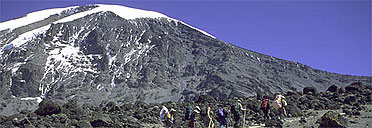
It would be African's misfortune that he was one of the few who got work that day. Less than 24 hours into his climb, African was caught in the sort of unexpected severe weather that can strike any mountain at any time - and that can strike a 5,896m monster like Kili with a severity all of its own. Inadequately clothed and hopelessly unprotected from the elements, African never made it back down again. A small pile of stones and two sticks arranged in a crude wooden cross mark the spot where he took his last breath.
Three porters from three different parties died on Kilimanjaro that day. Fred Mtui, climbing the six-day Machame route up the mountain, was in a group guided by Ndege John. Another porter, known only by his given name of Rashid, who had left his wife and two boys behind in Tanga to take up work on the mountain, was in a second group climbing the same route. African was a porter on the route up from Marangu - the so-called Coca-Cola route because of its popularity with tourists. The name belies the difficulty and danger attached to any climb up a mountain that rises out of the east African plain to a height 700m greater than that of the Everest base camp.
For the tourist-climbers on Kilimanjaro, no matter how greatly some may underestimate the severity of what they are attempting, there is usually a guarantee of proper clothing and equipment, accommodation and food. For porters such as African, desperate for the hard currency earnings and tips that massively exceed anything they could hope for elsewhere, it is a very different matter.
When African started his fateful ascent, he was dressed in just trainers, trousers and T-shirt. When he arrived at the huts where his party stopped for the night, the porters' accommodation was full and he had no option but to sleep out overnight. When, at around midnight it started to rain, he had neither waterproofs nor shelter to protect him. The rain - driving, cold, heavy - continued on through to the next day, and African's only thought was to continue with his load and try to keep moving to keep warm.
Halfway between the first huts and the next, soaked to the skin and shivering uncontrollably, he fell face down onto the ground. The first of his fellow porters to come across him thought he was praying. When he was helped to his feet, African was unable to stand unaided. Several times he staggered forwards a few paces; each time he fell face down again. Plaintively, he asked his colleagues: "What's happening to me? Am I dying?"
"There is nowhere to hide on Kili when you get above the forest," says Daniel Mblisi, one of the regular guides on the mountain who works for the same company as African. "The rain didn't stop that day, and he couldn't get warm again."
Realising now that their colleague was in serious distress, some of the other porters sent for help, but by now it was too late. Lacking even the most basic training in mountain survival techniques, emergency equipment such as survival bags or even the ability to recognise the onset of hypothermia, they were powerless to help. The porters who stayed with him, trying to warm him up by wrapping him in their own gear, didn't even know he was dead until a doctor, passing by as part of a tourist trek, examined him.
The two other porters who died on Kilimanjaro that day were better clothed than African, but they, too, lacked suitable waterproofs or cold weather gear - and they were higher up the mountain, at about 4,500m. At that altitude, it had been what locals call a "white night", with snow enveloping the mountain. The two men dumped their loads and tried to seek shelter under some rocks. It was no use: they froze to death.
Along with the game parks and the Indian Ocean coast, Kilimanjaro is one of Tanzania's biggest tourist attractions. Around 25,000 visitors attempt to reach the summit every year - and hundreds of young - and not so young - men flock to the mountain in search of a share of the money they bring.
You can see scores of these hopefuls hanging around outside the hotels and tour companies that organise Kilimanjaro climbs. Few of them are properly equipped for bad weather, and the cut-throat competition driving down costs means that only a handful of the climbing companies provide them with the gear they need.
One of the ones that does now make such an attempt is the long-established Marangu Hotel in Marangu village, from where most of the Kilimanjaro ascents commence. In association with the British-based travel company Guerba, the hotel has just started to provide waterproof jackets to porters employed on some of their climbs.
"Part of the problem is that when porters do get decent gear, the first thing that some of them do is to sell it," says Martin Crabb, managing director of Guerba. The Marangu Hotel and Guerba have their logos emblazoned on the jackets they have provided and require each one to be checked and accounted for after every climb.
It's a small step, but still not enough for many of those associated with the mountain. Unlike other trekking areas, there is no association or trade union to look after the interests of guides and porters on Kilimanjaro. There is no monitoring or regulation of the companies operating there. Competition for work is fierce, and the work is casual, insecure and, of course, lacking in sick pay or other protection. And although every visitor to the Kilimanjaro National Park pays $25 per day in park fees, none of this is spent on the welfare of those who work on the mountain.
Daniel Mblisi would like to see a cheap, local source of proper mountain gear for guides and porters, as well as the provision of emergency equipment on Kilimanjaro itself. Basic training and some element of regulation by the Tanzanian park authorities are also essential for this thriving tourist industry.
Ultimately, though, if more porters are not to die providing an adventure challenge for tourist-climbers, it will depend on those tourists themselves insisting upon proper protection and safety for the people who serve them on the mountain.
