
Rolling into Rajasthan across yellow-green seas of grass swaying in pre-monsoon winds. A whitewashed temple rises above the thatched roofs of a distant village. Kneeling women harvest rice in straw baskets, dark heads covered in saris of pastel purple, gold and saffron. The morning sun illuminates a hazy red mountain ridge. Nick laughs. A camel lopes beside our train, pulling a wooden cart beneath a fantastic bale of hay. Perched atop is a barefoot Rajasthani driver, looking like an outtake from a Bengal Lancers movie in red robes and periwinkle blue turban, his face weathered and mustaschioed.
'My first camel,' Nick whispers, to himself.
The Shatabdi Express rocks and tugs further westward, toward the Great Thar Desert and the pink city of Jaipur. We smile and fall silent in our shadowed train compartment, Nick and me. We are father-and-son fugitives from a life consumed by too much calculation of risk and death, by the yellow-orange-red terror charts of the Washington politicians.
We arrived the day before at Delhi's airport after a 24-hour trip on Aeroflot, the airline equivalent of a country bus. In Delhi we walked out of a dim-lit terminal at 6am and found an orange orb rising, white-faced monkeys swinging from banyan trees and a motorised rickshaw driver no older than Nick - which is to say 14. He popped a reggae and hip-hop-inflected Indian tape in his player, promised us he knew where we were going - he didn't - and set off on a careening trip down dusty boulevards edged by purple bougainvillea. Cows strolled down the middle lane, families of untouchables shook themselves awake in their dusty roadside tents, a barefoot father poking at the black ashes of last night's fire.
Twenty-three years before, a childhood friend and I had roamed across Asia after graduating from college, from the Indonesian archipelago to the tea plantations of Sri Lanka to the Himalayas. But no place so entranced us as India. I would return, I knew, in a year, perhaps two. Then I flew home and tumbled head-first into love and adulthood and jobs and a fine marriage. One child came and another followed. For years I spun tales of my adventure for Nick and promised we'd travel there together when he became a teenager. We'd dodge the comfort of western hotels, ride the rails and buses, plunge into a world not our own.
Now I was 45. My son was perched on the cliff wall of manhood. He sensed no less than I that it was time. Then came those three digits, 9/11. There was the shadow of terror, and communal violence in India, and fear of something so prosaic as boarding an airplane with my son. Yet I still wanted to find, for Nick and myself, the freedom and possibility the world once promised.
By winter 2001 a semblance of sanity had crept back to my life as a New York-based journalist. I no longer switched on the television every 15 minutes to scan the CNN scroll line. Or reached for a reporter's pad when the telephone rang. I still talked too much of terror, and terrible possibility, but I began to remember what it was to be a husband and father again. Nick just wanted to know: when are we going to India?
I lie awake in a Jaipur guesthouse at 3.15am, the air cool and soft and sweet with frangipani. So many worries pierce these hours before dawn as I cast backward through our first day in Jaipur. We'd arrived at midday and found our clean and friendly little guesthouse, the Hotel Aryas Niwas. In late afternoon we ventured inside the walls of the old city. I had recalled, in the fog of memory, a pink-washed city perched on the edge of a yellow desert. Camels languid in the heat, small streets leading to smaller streets leading to alleys, the muffled pounding of mallets on cloth-wrapped silver, men and boys sitting in tiny shops, smiling and imploring visitors to stop. A medieval guild of a city, a fantasia.
What we found now was impossible 20 years ago: rush hour. Once Jaipur had few motorbikes and fewer cars. Now the main boulevard is a cacophonous pollution-spewing parade of cars, cows, trucks, camels, motorcycles, rickshaws. There are men in long, flowing capes and women in saris with vast piles of mustard and betel leaves balanced atop their heads. There is the nostril-flaring smell of dung - camel, cow and human. And there is the incessant importuning of drivers, shopkeepers and peddlers:
'Excuse me, sir, where do you go?'
'I have a good deal for you, sir, good deal...'
'Excuse me! What is the precise country of your origin?'
'Hello, sir, HULLO!'
Nick and I hail a rickshaw and offer to double his fare if he pedals fast. We arrive back at the hotel covered in soot and taken aback by it all. We eat and head to bed. Nick falls asleep and I rehearse my worries. The weeks before leaving New York had been a blur of rushing about for passports and vaccinations, supplies and hotel reservations, the goal a perfect trip. I had weighed fears of terror but thought little about culture shock. Now I wonder: have I pushed Nick too deep too soon into a culture too foreign? Will this smell and press of people, the sweaty immediacy of life in India, prove too much? Is it too much for me? My assumption had been that I would slip, Peter Pan-like, into the skin of my younger self, and so serve as Nick's guide. My night reckoning reminds me that beneath the sturdy confidence of parental consciousness flickers the fear that you just might get everything wrong.
We rise with the sun - God knows what time-zone purgatory our bodies are floating in - and set off for the India Coffee Shop, which came recommended in some guidebook or other. I'm not sure what I expected to find: perhaps a smoke-glassed Starwallah-bucks. In fact it's a hole in the wall so obscure that we ride by it several times on the rickshaw before spotting the place. We walk through a cool, blue-white courtyard, stepping over a sleeping dog. Inside are elderly waiters in turbans and improbable black cummerbunds. And at a table in the back sits Mr Krishna, just finishing his morning coffee and doughnut and Hindustan Times. A roundish, white-haired old gentleman with a pleased-as-punch smile, he invites us to take a breakfast samosa and coffee while he plies us with questions.
He is charming and solicitous of Nick, and after a while this retired teacher and philologist taps the table with his hand and delivers his recommendation: we must scrap our plans to wander a Jaipur museum and go instead to visit the Amber Palace. It is perfectly splendid, he says. I look at Nick and Nick looks at me. We hop on a rattling junk-heap of a public bus - five rupees, or about 6p - and ride 10 miles to Amber. We pass a city palace where the local rajah stashed his wives, who were forced to watch life's parade from behind intricate mesh screens, and we travel through the faceless industrial belts that surround so many Indian cities. Then come two elephants with trunks and tusks and faces all painted blues and pinks. Nick points out a rajah's summer mansion sitting in a shallow and muddy lake, its white marble walls lustrous in the desert sun.
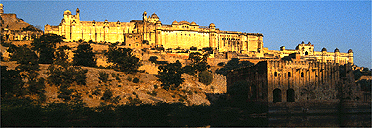
The bus rattles on through scrub desert hills. We hop off in a small village wedged into the brown folds of a canyon. We snake through the streets and take the long ride up to the mountaintop palace on the back of an elephant. Our driver, known as a mahout, sits snug on the elephant's neck, legs swallowed up behind massive elephant ears.
Nick and I wander a vast and deserted palace, through azalea gardens and dark passageways. We peer at ancient battlements running up distant hills turned wavy in the heat, where warrior scouts once hung their lanterns to warn of the approach of enemy hordes. We walk beneath delicate arches that seem to float in the desert air, and run our hands over marble ceilings inlaid with finely cut glass. We stand in a princely bedroom of pale marble and feel on our faces the cool touch of winds vectoring off distant peaks. Afterwards we sit in the shadow of an ancient arch as Nick talks of his hip-hop music and baseball, shoots photos and laughs at the mahouts waiting at their truck-stop of an elephant stand.
We return that evening to a different city, or we return different to the same city. The clamour is there, and the pollution, and poverty, but we see the kaleidoscopic colour, the pastel-painted doors, the beauty of a young woman caught in the rays of a setting sun, the mounds of red saffron and yellow cumin and sweet orange pumpkin balls. We hear a rickshaw driver spin a tale of his lovely wife and three children, and his determination to send them enough rupees to see them through drought. We see vast brown mountains of figs atop red wagons, and barefoot children playing tag. There are flowers everywhere. This recurs throughout our trip, the clangour and the press of so many people so persistent. And then the unexpected moment of transcendence. That night I awaken and resolve to let him go. Let Nick process the insistent rickshaw wallahs, the beggars, the scents and the muezzin's haunting morning call to prayer. I am travelling with my son and that is fine enough. I had a parent's hunger to find him the perfect experience; maybe imperfection is the point.
Our 50-year-old English taxi fishtails around one of those vertiginous bends in the road where all that stands between us and the great blue abyss is... nothing. Nothing, that is, except our elderly Hindu driver, who has an unsettling belief in reincarnation. A week has passed since we left Jaipur, and Nick and I are deep in the Himalayan foothills. Our car skirts 1,000-foot cliffs on what feels like a rollercoaster, except that a rollercoaster is about the illusion of danger. We are on our way to a distant Hindu temple, 9,000 feet up, with terrific views of the Himalayas, assuming the thick blanket of cloud finally lifts.
Cackling nervously, leaning into the centrifugal spin, we journey now in the company of my long-ago travelling companion, Peter Kurz, and his 14-year-old son, Amit. They arrived from Israel a few days back, escapees from a daily terror more encompassing than our own. A curious thing, to travel together again after so many years, as though in Peter's presence I can no longer pretend. I am grey and Peter is balding, even if his face is no less gentle for the passage of decades. We have the suspicion that creeps in with middle age that perhaps life is no longer about what we might become.
Yet the memory spin can be as deceptive as a film dissolve. We grew up together on Manhattan's Upper West Side, in adjoining apartment buildings, cementing our friendship as our mothers walked us to our first day of kindergarten. When we told our parents of our plans for travelling across Asia, they smiled and asked questions but did not flinch. It was a time in some ways even more uncertain than today; Iran and Afghanistan were torn by revolution, Vietnam invaded Cambodia, boat people washed ashore throughout South East Asia. They gave us the parental gift of swallowing their fears.
Peter and I agreed to travel with our sons, much as we did two decades ago. And so we are, after a fashion. We hop on public buses and trains, but take a few taxis too. We seek bargain hotels but forgo sleeping in hammocks on rooftops. And we've come to an agreement that guesthouses with sit- down toilets are a permissible bourgeois nicety.
I worried that the arrival of Peter and Amit might allow Nick and me to clamber back to our respective, distancing roles as father and son. But that has not happened. There is only the strange duality that occurs when fathers walk with their sons in the shadow of their younger selves. In Agra, a few days earlier, we rose before dawn to watch the sun crawl over the Taj Mahal. Nick and Amit gasped, teenage insouciance tossed aside. Two decades ago Peter and I sat in the vast gardens that surround the Taj and watched a full moon roll across the night sky, bathing its marble in ivory light. We had talked of books and girlfriends and the ripe swell of our futures. A quarter-century later we feel the exhilaration again - and mortality's ache.
From Agra we took the Dehra Dun Express, rocking to sleep as our train sliced through the bamboo forests that skirt the feet of the Himalayas. The next morning we made our way up to Mussoorie, a dowager of a British hill station, which sits at 6,000 feet. And that's how we've come to sit in this taxi bouncing along a shoulderless dirt road, fringed by the most appalling cliffs. We scramble up the last 2,500 feet from the road, our lungs heaving by the time we reach
the whitewashed temple. I set to ringing its dozens of bells, explaining this is a Hindu sign of good luck. As though on cue, Nick suggests that maybe I should be quiet and turn around. There, for hundreds of miles, stretch long and serrated ridges of impossibly high mountains; even at a distance of 50 miles, the 26,000-foot snow peaks glisten with a hallucinatory immediacy.
We return that evening to Mussoorie, and the boys are euphoric about our expedition. I feel only more restless. Days ago I spotted a British mansion at the tip of a distant ridge far above the town. I decide to walk up there alone. I find a broken beauty of a house, her white pillars peeling, her windows hollowed, her roof collapsed. An interior wall is painted a childlike blue. Exquisite Chinese tiles stretch like a necklace above the grand and ruined porch, each painted with scenes of periwinkle oceans , golden ships and dark mountains, offset with Chinese characters. The sense of time's erosions is overpowering. What dreams did this place once ignite? Who were the children who awoke here to the Himalayan sunrise? Did they chase the monkeys, and fight and laugh, and fancy themselves forever young? And what of the wandering Englishman who sat on this verandah and sipped his tea? Did he imagine himself home? I walk to the ridge's edge, cliffs falling away below. Overhead a trio of hawks floats motionless on the evening updrafts. Then one after the other, the raptors take a sideways roll and sail down into the dark green Doon Valley until they are dots against the approaching darkness.
The truth is that you can't hold on to it, not for ever. We return to the States, Nick and I, in that strange jetlagged state of grace. Our jaws loose, our voices soft, our desire not to forget intense. Slowly the cold wash of reality splashes over. The demands of work and homework and the fog of parental and teenage posturing come rolling back in.
In the weeks after our return, India and Pakistan bare their teeth in a nuclear confrontation; I wonder if I would so readily embark on our adventure now. In New York City, the Sunday newspaper mines the nightmare possibility of nuclear terrorism. From Israel is word of more bombings. Summer comes and Peter's mother dies and there is the rawness of loss as Peter returns to New York to bury her. And yet... as I sit here at night typing, my sense is of what lingers from our trip. Long train rides through a strange land, and time to see and think and breathe. Time to read and swap tales with Nick.
We ended our trip in Rishikesh, where the ice-blue Ganges pours from the Himalayas on to the northern plains, a laidback town of Hindu sadhus and hippies and screeching monkeys. On the last night I leave Nick in our room reading Tolkien. I feel joy that he is so relaxed. I head toward the Ganges. Soon enough, I am swept up in a sea of smartly dressed men and women in elegant saris, and children racing ahead. They are walking toward Swarg Ashram for evening songs and prayers. In daylight it is a faintly ridiculous place, the statues of Vishnu and Shiva looking like something out of a Hanna-Barbera colouring book. Night transforms it. Hundreds of saffron-robed children sit cross-legged on mats, singing by the edge of the Ganges. The sound is pure and hypnotic. I'm not sure what to make of the ecstatic impulse, save that my hunger for it surprises me; I feel unexpected tears.
A full peach moon climbs over the hills, and the children stand and place burning candles on banana leaves, and set them afloat in the Ganges. The candles dance and flicker and wobble, and after a long while the river swallows them up. Nick slides in beside me on the bank. He announces his presence by stretching an arm across my shoulders; I can feel it still.
©Michael Powell
· The author is The Washington Post's New York bureau chief
