
When I returned from the Costa Brava, I tried to recreate a taste of Spain - grilled sardines, tortillas and toasted peasant bread, smeared with fresh tomatoes and olive oil.
The last thing I wanted to eat when I came back from Cuba was Cuban food. Essentially, it consists of pork, pork and more pork. For variety, there are ham or ham and cheese sandwiches. I exaggerate, but only a little. In Cuba, the pig rules: the ultimate Cuban sandwich must be ham, pork and mortadella. Tough luck for vegheads.
You do not go to the Caribbean's largest island for its culinary variety or refinement. The ravioli I ate at the otherwise admirable Habana Libre hotel in Havana looked and tasted as if it had lingered at the bottom of a freezer for months, while the lobster I had in Santiago de Cuba was tougher than Charlie Chaplin's boot in the Gold Rush.
Our young guide Aristides, who had taken us to the restaurant, offered a sad explanation for the wretched state of my seafood. "We are poor people. How do you expect Cubans to know how to cook lobster when they can't afford to eat it themselves?" Cubans are allowed to open restaurants - usually a front room in their homes - in their desperate quest for dollars to supplement their rations.
But don't let the food put you off this fascinating place. The music, for one thing, is as scintillating as the food is execrable. I returned with a stack of CDs and spent weeks listening to upbeat Cuban tempos as if they could somehow dissipate the London winter blues. I bought CDs not just from those veteran Buena Vista Social Club crooners, Ibrahim Ferrer and Omara Portuondo, but from excellent, no-name bands that performed at cafes and local music halls.
Polo Montanez, singer, songwriter and guitarist, was a find. We happened to be watching TV at the bar of our hotel in Vinales, a scruffy little town about three hours by bus from Havana. The footage consisted of massed crowds at a funeral accompanied by a lovely, mournful number, quite different from the mostly cheerful stuff that you hear in Cuba. The barman told me it was Montanez's funeral and I made a mental note to look for his music back in Havana.
Listening to his Guarjiro Natural (Natural Peasant) CD, the record that made him a star three years ago, I was struck by his melancholy voice, the superb female backing vocals and the violins which give some of the songs almost a country feel - shades of Neil Young, in fact. Montanez, whose real name was Fernando Borrego, was a former coal miner who, unlike most Cuban musicians, never attended any formal music school or academy. I found out later that the 47-year-old had died from head injuries when his car hit a truck while he was driving home with relatives from a family party.
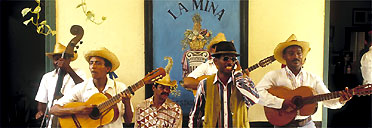
Cuba pulsates with music. It blasts out at you from dark doorways in decrepit buildings, it fills the air-conditioned Viazul tourist buses, and musicians serenade you everywhere, even at the airports. Every restaurant or bar has a band to keep the punters entertained. Yes, you will hear Guantanamera performed virtually every day, as well as Chan-Chan - one of the songs on the Buena Vista Social Club CD - but the variations are endless, so you rarely tire of hearing them. For the most part, the music is of a good standard and some of the best music is free.
In Havana, we heard some wonderful music from a band of 70-year-olds - including a toothless old man on lead vocals - who were performing across the road from the 18th century cathedral that once supposedly housed the bones of Christopher Columbus. More music awaited us at Sunday Mass. This time, the band featured a skinny drummer in tennis shirt and garish electric blue track suit. At one point, the choir and band abandoned the usual hymns and burst into a rendition of Bob Dylan's Blowin' in the Wind.
We found some of the best music in Santiago de Cuba, otherwise an unattractive industrial city. On our last day there, the combination of sun, heat and noxious fumes - those 1950s vintage Pontiacs, Cadillacs and Chryslers may be a treat for the eyes, but they are hard on the lungs - had made me queasy. We almost stayed in to catch yet another American movie on cable TV, but decided to drag ourselves to the Casa de la Trova.
Just as well we did. It was an intensely exhilarating evening, giving us a glimpse into the sometimes sexually-charged interaction between foreign tourists and Cubans. Hordes of young Cuban men lined the pavements outside the colonial building, gesticulating to the women tourists on the balcony in what appeared to be a demented parody of Romeo and Juliet. The local dudes could not afford the $3 entrance fee and wanted the foreign women to pay in exchange for cool moves on the dance floor. We stepped inside into a wonderfully bacchanalian scene.
The band consisted of the usual group of grizzled old men in white suits and Panamas, belting out salsa tunes. On the packed dance floor, Rastas with long dreadlocks - many Jamaicans came to Santiago - strutted their stuff and twirled their blonde partners. The most dazzling moves came from the Cuban Naomi Campbell lookalikes, who managed the neat trick of simultaneously wiggling their tiny bottoms upwards and sideways as they gyrated. My wife covered my eyes with her hands.
Age was no barrier to the fun and games. One European woman who must have been at least in her late 50s, busily snogged her Cuban dance partner - who could only have been half her age - before ditching him for someone else. Meanwhile, every time Claire, my wife, peered over the balcony, the young wolves below would holler for her to come down to take them in. To cap it all, the waitress, a veritable angel in this chamber of dissipation, sweetly congratulated us on our recent marriage and insisted we come back the next night. "I'll book a table for you," she yelled above the din. Unfortunately, we were moving on the next day.
Like music, debauchery never seems far away in Cuba, especially in the city - little seems to have changed from the days when Graham Greene wrote Our Man in Havana. On our last night in Havana, we went to the Dos Hermanos bar opposite the ferry terminal. The bar, once owned by the gangster Lucky Luciano and his brother (hence the name, which means two brothers), actually serves tasty snacks such as whitebait. A pimp hovered over a table, where two Brits were drinking beers. After a brief chat he returned with a pretty girl who could not have been much more than 15 and she sat down to chat uneasily in a mixture of English and Spanish.
Meanwhile, two Cuban women cased the joint. The prettier one accosted any male tourists, but each time returned empty-handed to her companion, sitting morosely at a table. It was a sad sight and a reminder that despite its vibrant music, exquisite coral beaches, turquoise water and Spanish colonial architecture, Cuba remains a very poor country indeed.
As a result, Cubans are always on the hunt for dollars to supplement their rations of rice, beans and soap. Tourists are natural targets: there are constant offers of Cohiba and Montecristo cigars, lobster dinners in private restaurants, and guided tours. However, it is not done aggressively and you can easily fend off the touts by saying you've already bought cigars or eaten. And unlike in countries such as Vietnam, Cuban schoolchildren, smartly turned out in while and yellow uniforms, never ask you for money. Those kids who do will usually draw your portrait on a plain card in return. They are generally awful, but you can hardly begrudge them a dollar.
People will invariably start chatting to you, providing a glimpse of everyday hardships. Several people told us that Castro had to stop professionals such as engineers and doctors from becoming waiters in the tourism industry because so many wanted to make decent money. In Trinidad, a charming colonial gem of a town with cobble-stoned streets and pastel-coloured houses, we were told that the government wanted to cap the number of casa particulars - private bed and breakfasts - because they were taking business away from the state-run hotels.
You could see why. About the only decent meals we had came from a paladar in Vinales, where we feasted on tuna, chicken in a tasty sauce, and yucca and malanga - delicious root vegetables - accompanied by rice and beans. Our hostess gave us so much food on our first evening that we had to ask for reduced portions the next night.
To what degree Cuba's poverty stems from outdated socialist dogma or the spiteful 40-year US economic embargo, it is impossible to tell from a three-week visit. But the lack of foreign investment gives the place, with its run-down houses and clattering, ancient US cars, a feel of a land that time forgot.
Despite its US-imposed isolation, we did not once hear any anti-American sentiment. Cubans directed their grumbling at their own government for reining in private initiative and you get the impression that people are just waiting for Castro to fade away. Cuba's mix of state heavy-handedness and the free-wheeling nature of its citizens make the island an intriguing cocktail far more interesting than any rum concoction you can buy in one of its bars.
