
"It means model yourself upon the bees and their way of life", explained our guide as I took a break - from a safe distance - and asked about the painted tableaux on the beehive cover. Having passed numerous beehives in the Slovenian countryside it was quite clear this is a land where bees live in style, a world away from their European counterparts who buzz around in dull, white apiaries.
The wooden roof on the multi-coloured beehive was adorned with rural folk art, depicting the importance of bee keeping in Slovenia. Many of the paintings denote the diligence, organisation and firmness of the matriarchal queen.
Sandwiched between the Alps and the Mediterranean, Slovenia has been one of the most successful countries to undertake the transition from socialism to a market economy. Spluttering, battered old Zastavas - aka ancient Yugos - of yesteryear have been nudged off the road by BMWs; hotels have been refurbished; and the boom in trade and industry has paved the way for the independent country to become one of the newest members of the EU. Despite many changes over the last decade, age-old farming methods and rural traditions continue to co-exist happily behind the new façade.
Tourists aren't the only ones making tracks across Slovenia. The indigenous brown bear population almost died out in 1848, but has steadily increased since being declared a protected species after the second world war. With around 60% of Slovenia covered with forests, it is an enticing homeland and bears are on the increase. The Balkan conflict boosted population levels further as bears began to cross borders to escape their disturbed habitat - refugee bears. Now wildlife experts estimate there are as many as 700 bears in Slovenia.
If you drive for more than two hours in any direction in Slovenia you'll trip over the border into Italy, Austria, Croatia, or Hungary. So you don't need to venture far off the beaten track to find wildlife. In fact, it is the only country in the world where bears live in forests barely 30km from the capital. These southerly populations near Ljubljana, at Rakitna and Dobrepolje, lead on to one of the most highly concentrated areas at Kocevje.
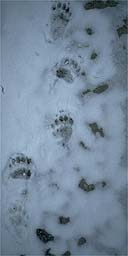
Here, in the cool morning air, we found paw prints leading to a rock that had been turned over by a bear foraging for insects. Nearby was a telltale sign on a tree, where a bear had rolled in mud before rubbing its back along the bark to mark its territory. Deeper in the trees we found one of the high forest hides, which local hunting organisations open to intrepid tourists for whom the sight of a nocturnal bear makes up for a cramped night in the cold. The best time to see bears is from March to June and during October and November.
After tracking Slovenia's largest wild animals we were initially amazed to hear game hunters have now turned their sights to something at the opposite end of the spectrum. Every September is the dormouse-hunting season. Seeing our horrified faces our guide was quick to point out these are not cuddly little Alice in Wonderland characters, but large edible rodents originally thought to be the devil's creatures and now deemed forest pests. He didn't convince us.
Whilst some areas are only accessible with knowledgeable guides, well-marked paths and trails criss-cross much of the countryside. Our next stop was Triglav national park and the Julian Alps in the north-west. Covering 85,805 hectares, it is one of Europe's largest national parks and it is rich in diverse landscapes. A few real or imaginary blisters led to the executive decision that we would stick to gentle terrain rather attempt the slog up 2,864-metre Mount Triglav, the country's highest peak.
This was my kind of walking. Deep, mossy woodland carpets through pines and beech trees interspersed with meadows and lush pastures. A total absence of "no trespassing" signs. We strolled along isolated forest paths, occasionally stopping to pick the tiniest and most delicious wild strawberries in the full knowledge that when greater sustenance was required the nearest farmhouse or gostilna village inn would never be more than two hours gentle walk away.
Many family farms offer accommodation that is ideal for walkers and a less stuffy option than hotels. If, like me, you get fed up relying on your own two legs then abandon Shank's pony in favour of the four-legged variety. The south-western Primorska area that stretches down the Italian border is near the Lipica stud, home of the famous white Lipizzaner horses. Nearby farms, like Diomed, breed their own Lipizzaners that are available for hire. Any aching limbs can be soothed in the farm's self-catering apartment, where rustic accommodation is elevated to new heights with the addition of a sauna.
Eating in Slovenia is a serious and sometimes inadvertently entertaining business. One night my soup arrived in a bowl, complete with lid, entirely made out of a hollowed out loaf. The trick here is to eat the lid first and refrain from nibbling too much of the sides, otherwise you end up with a nasty, hot mess in your lap. Maybe there is a national aversion to washing up, because pumpkin soup served in its hollowed out namesake is also a speciality.
Slow-food dinners, involving a seemingly never-ending succession of small, and sometimes rather pretentious and overly fussy courses, are still popular in Ljubljana and some of the more expensive restaurants. But country fare is, by its very nature, much more down to earth and just the job after a day outdoors.
One of the local wines Teran, which takes its dark colour from the red soil of the Vipava Valley vineyards, is promoted as something of a "cure all" and is renowned for its health giving properties. Served up from pitchers and poured into thick glass tumblers, some of the rougher vintages tasted as if they were more conducive to large hangovers. But perhaps that's the way it works, any initial medical complaint is totally eclipsed by the next day's headache.
In the early afternoon sun I snoozed in the shade of one of the kozolci hay drying racks that are peculiar to Slovenia and diligently planned and organised my next walk, making sure I'd be back in time for dinner.
Way to go
· Adria Airways (tel: 020 7734 4630) operates daily flights (summer timetable) from London Heathrow to Ljubljana from £121.90.
· Slovenija Pursuits (tel: 0870 2200 201) can organise tailor-made itineraries and has 7 nights bed and breakfast at Seruga Farmhouse, Dolenjska, with return flights from Gatwick and transfers from £374pp. Day long bear and wildlife trailing expeditions with a local expert cost £50pp when booked with the holiday. A wide range of hotel-based and self-catering holidays also available from Holiday Options (tel: 0870 0130 450).
· Zavod za Gozdove Slovenije (tel: 00 386 1895 0400; email: gl.medved@zgs.gov.si) organises guided wildlife watching tours in the Kocevje region for £46pp per day and overnight stays in hunting lodges for £26pp per night. The Slovenian Hunters Association rents out a hunting lodge, for a maximum of 6, for £100 per day, and can also put visitors in touch with wildlife guides on request (email: lzs@lovska-zveza.si).
· Further information: Slovenia Tourist Office (tel: 020 7287 7133). Country code: 00 386. Flight time from London to Ljubljana: 2hrs. Time difference: +1hr. £1 = 350 tolar.
