
It would be nice to pretend that food wasn't a crucial factor in choosing my holidays, but I like to eat, and a growling stomach can turn paradise sour very quickly. Where Greece was an interminable feta salad and Spain a vegetarian's nightmare, Italy looked a sure bet for a hearty meal for all tastes. Sometimes, though, you can push things a bit far.
When we headed out one balmy evening to drive south from our base, a converted farmhouse just outside Siena, we had little idea what was in store. In the oddly barren, almost lunar landscape on the road to Asciano - vastly different from the classic green Tuscan hills of Chianti - we stumbled on La Pievina, a homely roadside restaurant with chickens running in the grounds and chintzy dolls lining the walls.
The coming meal would inspire both delight and panic. When the hostess - a woman of a certain age for whom the term waitress wouldn't do justice - inquired whether we wanted "carne, pesce o vegetariano" it was the last decision we were given the chance to make.
In hindsight, eating the home-baked bread was a mistake. Wine was placed on the table without even needing to ask. Within minutes my first course, a fish-topped bruscetta, had arrived. It was followed by a mixed seafood salad; a plate of clams; next, grilled sardine; a bowl of winkles; dried cod with roe; homemade fishcakes; an anchovy and olive plate; a bowl of marinated mussels; a fish broth with egg and spinach; and then mussels with mozzarella.
By this point I was already futilely hiding food under my cutlery to ease my straining stomach. "Fine, gli antipasti! Starters over!" trilled our hostess. Now it was time, she informed me, to try her seafood risotto (what would pass for an excellent paella in Spain).
I was a beaten man. Ravioli came, relentless. And only then did we come to the main course. "Piccolo, just a little," I pleaded, before being served a whole grilled fish accompanied by potatoes and king prawns. "Piccolo?" I enquired, in my best Italian. "Si, piccolo," the waitress replied, pointing to another table where the diners' fish was accompanied by a branch hung with king prawns.
We only had a couple of desserts, although we were offered six. All this, with wine, water, grappa, limoncello, dessert wine, a herbal digestif and coffee and biscuits, came to just 75 euros for the two of us. My vegetarian girlfriend was admittedly catered for a little less splendidly, at a mere 11 courses, but strangely wasn't complaining.
I'd like to report that, aside from this feast, we led an ascetic lifestyle, but it wouldn't be strictly true. If meals out were too cheap to spurn, self-catering brought more temptation. One 50-euro supermarket expedition kept us pretty much sustained for the week with the sort of foods that would mean a pricey deli splurge at home: mozzarella, pecorino, parma ham, olive oil, bunches of fresh basil. Add a couple of cheap Chiantis and you can want little more than to head back to base and play at being Italian gourmets.
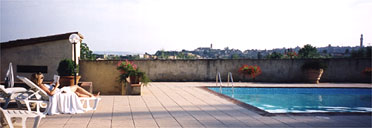
Our accommodation was the peaceful Poggio Ai Pini, a set of six semi-rustic apartments built around a 17th-century villa overlooking Siena. There was enough garden furniture to be able to eat outside - and though what was advertised as a private terrace was shared with another couple from New York, this turned out to be a pleasantly social experience rather than the bitter dogfight which might have resulted with less amenable neighbours.
The villa was just about walkable from town, at least on the way back down the steep hills, although the stretch of bleak roundabouts outside the city walls meant it wasn't an appealing stroll at night. With a hire car, it was a quick journey in and out, armed as we were with world's most illegible map from Poggio's resident manager.
For outings, your own car is really something of an essential unless you're planning on sticking to the cities, which might not be a great idea in summer (our New Yorkers from Poggio took a train to Florence one day and came back ashen). Driving means hills, views and villages become accessible on a whim; the downside is the minor heartbreak of not being able to get lashed on best cheap Chianti, especially when passing the numerous vineyards which sell direct and offer tastings.
Not all routes are as attractive as you might imagine. We drove from Pisa airport (a hell hole, incidentally, for departing passengers) to Siena via the country roads from Empoli onwards. On the map, passing many villages denoted of guidebook interest, this looked a winner, but it's a surprisingly industrial area in parts.
East from Siena, though, there are just too many beautiful towns and villages even within a short drive to see them all. The spectacularly skylined San Gimignano is perhaps best seen from a distance; a jutting, angular hilltop silhouette. Close up, this Renaissance Manhattan had the feel of a crowded tourist trap, all car parks and shops selling what our new neighbour Clem called tchotchke ("You know, those itsy little bits of little dinky crafty bullshit shit"). Even the gelateria in the main square had a letter from Signor Tony Blair, thanking the proprietor for his crate of ice cream (sent, apparently, in recognition of the prime minister's efforts to bring peace to Northern Ireland).
Even in early August, when the crowds are at their peak, it's not impossible to find a magical Tuscan village that feels like you're the first to stumble on it. Barely 12km from San Gimignano is Col Valle d'Elsa, another walled hilltop town with lovely views and medieval cobbled streets. Another evening's drive took us to Radda in Chianti, stuck on a precipice above misty green valleys, with dining rooms perched even higher on upper floors. Driving around Chianti you could barely go wrong for finding picturesque villages, castles and rolling verdant hills: each day we'd compare notes with our neighbours and come up with different destinations.
Siena itself, while never as oppressive as the likes of Florence, can still be extremely busy in August. That said, even a short walk from the main squares can lead you to quieter cafes, while pushing at the less advertised doors, such as that of the Enoteca I Terzi (Via dei Termini 7), can uncover oases of calm in the very centre.
Safely back at the villa, Siena would look unfeasibly tranquil. Having joined the ranks of gullible pizza-hunters on the Campo, we knew all too well that the city was no such thing; but we could soon let ourselves fall into the illusion, slumbering under the shade of the trees beside the terrace pool.
The scene was at its best in the late afternoon when the sun, setting orange, cast long shadows across the olive groves and burnished earth. It would be hard to feel more calm than now: sitting outside, bare feet on the warm tiles, with no noise other than the cicadas and bells ringing from the campanile in the distance.
Way to go
· Gwyn Topham travelled with Italian Journeys (020 7370 6002, email italy@italianjourneys.com. A week in a villa at Poggio Ai Pini costs from £519pp in May, based on two sharing, including car hire and flights from Gatwick to Pisa with Monarch airlines and car hire.
· He hired an Opel Corsa through Holiday Autos (Holiday Autos), 0870 400 4447. Seven days' car hire for a 5-door, air-conditioned vehicle from Pisa Airport in August currently costs from £204.
· La Pievina restaurant is two miles north of Asciano on the route no. 438 from Siena, tel: 0577 718 368.
