
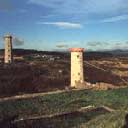
I've loved lighthouses since I was small. Well, I've loved stories about them - beacons for seafaring pioneers, brave men against the elements. So I jumped at the chance to stay in a restored lighthouse on Ireland's east coast. I expected steps - lots of them - plenty of fresh air and peerless views; I didn't expect to have the bejesus frightened out of me.
The Irish Landmark Trust is a not-for-profit charitable venture that aims to preserve small pieces of the island's heritage by giving them a future as self-catering holiday homes. It restores buildings as faithfully as possible, using local craftspeople and traditional methods. After a decade in operation it now has properties throughout Ireland, including one in the North, from lodges, lighthousekeepers' cottages and a castle sleeping 10 to an apartment sleeping seven above its offices in the heart of Dublin's Temple Bar.
Wicklow Head Lighthouse is its best-known property. About 25 miles south of Dublin, it is 95ft high, a stout-looking octagonal tower built in 1781, standing proud on the headland. It has not operated for more than 150 years since a lightning strike gutted the place. Now it is a triumph of restoration. Each of its six floors has one room, starting with a reception room, then up to two comfortable double bedrooms, a big bathroom and cosy living room to a fully appointed kitchen at the top.It's well furnished, with quirky sail-like blinds on the windows, which look out in all directions, and nautical touches throughout.
It sleeps up to six people, so when we booked it last autumn we knew there would be plenty of room for me, my wife Jane and baby Eddie. What we did not consider was that, by the time we went, baby Eddie would have transformed into toddler Eddie - a human dynamo programmed to clamber up stairs all day, then clamber/bump/tumble down again. Six floors, 109 steps...
In the event, the magnitude of the task he faced brought out an unusual caution in him, so while he still insisted on going up and down a lot, most of the way it was in our arms.
We arrived in the late afternoon in a howling gale and heavy drizzle so we did not linger long on the view. The trust's house manager, Miriam, showed us how things worked, told us a bit about the area, then left us to it.
We stretched our legs: carrying bags of groceries up to the kitchen at the top; down to the bottom again for the family-sized suitcase; up to the higher bedroom; down to the bottom bedroom to put up the cot; up to the living room again for a cup of tea. So far, so fit.
The wind howled and whined outside. Windows rattled. The clouds closed in. Dusk fell and, dimly through the gloom, we caught the flashing beam of the new lighthouse by the shore below: three times, count to five, three times again. At least, I think that was what it was doing. It was hard to see. I mean, I didn't expect to see all the way to Dublin or anything, or to enjoy cloudless, starry skies. After all, it was a lighthouse - they are put where they are generally because the weather is rough enough to wreck ships on the rocks below.
With Eddie bathed and put to bed we had supper then put our feet up. That was when, just before bed, Jane made the mistake of reading the visitors' book. Lots of delighted people on surprise birthday treats... Americans over to see the old country... cars nearly blown over by gales... moonlit walks to the new lighthouse (they'd be summer visitors, then)... a challenge to race to the top in the quickest time (23 seconds was the most believable)... birders claiming sights of fulmars and choughs... a sighting of the headless woman's ghost. Eh? There followed dozens of spooky entries: a party of six all swearing to have seen the ghost climbing the stairs; Siobhan, aged six, disappointed at not seeing the ghost; Ellen, nine, sleeping in with her mum so that the 'white woman' doesn't get her; the headless woman topless (nice body); the headless woman whistling at the window...
Jane and I looked at each other. Eddie started to wail. Guess whose turn it was to check on him? I padded down, peering round corners sheepishly, tucked him in and sprang back up sharpish. I returned in time to be informed that, according to one past visitor's granny and a Wicklow legend, the ghost was 150 years old and lost her head to a suitor armed with a scythe who took exception to her betrothal to another man. 'If you hear tapping in the night, don't look out of your window,' warned the visitor.
We went to bed... and lay awake listening to the place creak. The windows continued to rattle (until a neatly- placed Observer business card was folded into four and inserted in the frame on the windward side). Unable to put off a trip to the lavatory any longer, I generously took a detour to stick another card in Eddie's window, then raced back up to bed. I wondered: how can a headless woman whistle? Then it came to me: imagine blowing across the neck of a bottle. Elementary.
I must have dozed off because the next thing I knew I was lying there, my eyes staring feverishly at a veiled figure looming by the foot of the bed. 'Jane, Jane, I saw her,' I cried. Not daring to look, she pinned herself to me, saying (doubtless hoping): 'It's just a nightmare. You're imagining it.' We didn't get much sleep after that.
Day two. For once I was pleased Eddie woke up at six. After he had exhausted serial breakfast options we thought we would entertain him with a walk down to the new lighthouse. It sounded blowy outside, but we wrapped up warm. Out of the door, out of the lee of the building, and wham! We were walking backwards, such was the strength of the wind, with Eddie howling along in protest, trussed up in his backpack. The wind blew us towards the car so we set off down the coast, stopping first at Brittas Bay. I trundled through great dunes to discover a fabulous beach, at least three miles long. Through the haze of gale-blown spray and sand, an apparition appeared in the distance like Omar Sharif in Lawrence of Arabia (except it was freezing cold). As the shape acquired form it became a man exercising his horse on the sand, with a lurcher bounding along in tow. I'd left my camera behind in the car so all I could do was watch the great beast thunder up and say: 'How are ye?' The horse was pretty big too.
We headed on to Arklow, which - despite glowing references in our guidebook - was completely shut, it being Sunday morning, with hardly a soul in sight. Some Irish towns are pretty, some are terribly forlorn with their faded signs and gloomy pebbledash. This was the latter. We returned to Wicklow town, still in drizzle but miles more welcoming for all that.
It was then, at exactly 12.30, when empty streets started filling with people, that the miracle of the pub occurred. The Old Forge welcomed us with a roaring fire, hearty food - though we declined, unlike a neighbouring diner, to try the Tia Maria and Turkish delight cheesecake - and loads of space that everyone was happy for Eddie to career about in. When we emerged into the street again it was warm and sunny.
We went back to the lighthouse, donned our walking gear and headed along the coastal path between clumps of gorse and tweeting songbirds. The view was breathtaking, cormorants dived into the sea for fish, and to top it all we saw two seals. The place did not seem nearly so creepy in the sunshine. And if by nightfall the wind was picking up and starting to whine again, what matter? If we kept our bedroom door almost shut, I wouldn't have to lie in bed staring at the stairs, expecting headless company.
After two nights we headed south to another Irish Landmark Trust property: Salterbridge Gate Lodge at Cappoquin in Co Waterford. Open just over a year, it is a lovely little one-bedroom Victorian gatehouse, single storey, underfloor heating, no ghosts. Maro, who manages it, asked how we got on at Wicklow: 'Well, the wife got a bit scared...'
Cappoquin is halfway between Waterford and Cork, and beyond those two cities there are plenty of interesting walks and day trips in the area. We thought about Tipperary but it's a long way. Instead we visited Lismore; the harbour town of Youghal (try Aherne's for seafood), where we played in the sun on the beach; Cobh; colourful Kinsale; the Knockmealdown Mountains; and Cashel - where after a bitterly cold dash round the holy site of St Patrick's Rock we retreated to the warmth of O'Sullivan's pub.
Pubs are the place to head for lunch with a toddler. The Irish love kids (one lovely old lady thrust a €5 note into Eddie's hand) and you are guaranteed a tale or two. It was there we made friends with a man who said he had played rugby full-back for Ireland in the early Seventies when I was choosing my sporting heroes, and who told us of the time he painted the town red with Welsh legend Barry John.
After our daily trips we would settle down in the lodge's armchairs and listen to the radio, pour a glass of whiskey, and relive the day. Warm fires and warm welcomes, history, humour, fresh air, and tales to tell. Which is as it should be.
Factfile
Paul Simon and family stayed in two properties owned by the Irish Landmark Trust (00 353 1 670 4733).
Wicklow Head Lighthouse, Co Wicklow, sleeps up to six people and costs 700 euros (£485) per week to rent in low season (October-May), rising to (£770) in July/August. Outside high season it is also available for three-night weekend rentals, at £385-£395. Special Christmas and New Year rates apply.
Salterbridge Gate Lodge, Cappoquin, Co Waterford, sleeps two and costs £215 per week in low season, rising to £310 in the height of summer. Weekend rentals are available, starting at £165.
