When Lonely Planet commissioned me to write its new guide to Britain, it came as a surprise. Although I know this country pretty well, my travels have taken me all over the world, and most of my previous guidebooks are on various parts of Africa. But for Lonely Planet, this was my best qualification; they wanted the new Britain guidebook written for Brits holidaying at home and for visitors from overseas. The brief from the editor required me to use my local knowledge and at the same time look at my homeland through the eyes of an outsider.
So, for the first time, I set out to write a major guidebook on my native country. There were advantages to working in my own backyard (I got home at weekends, and didn't need to worry about malaria), but many parts of Britain were unknown to me, and I came to the job with a completely open mind.
I couldn't do it alone, of course, so a team was assembled: a mix of British, Aussie and Irish researchers and writers. Between us, we'd covered just about every corner of the world on previous guidebook assignments, but this time we spread out to cover every corner of Britain - from Cornwall to Shetland. All in all, researching and writing the Britain guide took the best part of a year.
And what we found - to the surprise of many - was a great and wonderful delight. So taken were we that in the introduction to the book, we stick our necks out and describe Britain as one of the most beautiful islands on earth. Of course, not every square inch is beautiful, but after seeing areas such as Devon, the Cotswolds, the Pembrokeshire coast, the north Pennines or the Outer Hebrides, we think Britain deserves more praise than it gets - especially from the Brits themselves.
But it wasn't just the scenic countryside that grabbed us. Without a doubt, Britain's cities are getting better, too. And not just the tourist classics such as Oxford and Bath. We describe Cardiff as "trendy", Glasgow as "alluring", Birmingham as "radiant", Manchester as "interesting and vibrant", Newcastle as a "great city with a fierce sense of pride", and Liverpool as "well on the way to reinventing itself", while Aberdeen is "pulsating" and Brighton "has everything for the visitor".
The researcher covering Nottingham might have planned a quick look around and a couple of lines on Robin Hood, but we lost track of him for about three days while he thoroughly investigated the local club scene. Needless to say, this city gets a good write-up: "the surprise package of the East Midlands, home to a fashion, music and sporting scene that competes with the best of Britain".
For Brits and foreigners, the key to enjoying travel in Britain is appreciating its astounding variety. In the space of a few hours, or at the most a few days, you can immerse yourself in history at ancient castles, go mystic at stone circles, marvel at grand cathedrals, drink in traditional pubs, eat in world-class restaurants or friendly local cafes, stroll through picture-postcard villages, hike over wild moors and mountains, or dance all night in world-class clubs where the music takes your breath away. And all in a country that takes about 12 hours to drive end-to-end.
But while Britain may appear compact, the more you explore, the bigger it becomes. Visitors from overseas are often unaware of this magical expansion, and in the guidebook we warn them against trying to do too much too quickly. JB Priestley once observed that England was "pretending to be small", and he's still right. Covering the whole country all in one trip is impossible - and that's before you start thinking of Scotland and Wales as well. It's not a place to be rushed. Instead, Britain should be slowly savoured.
So where are our own favourite places? London has to come near the top of the list. Even though it's jaw-droppingly expensive, and some "attractions" are distinctly underwhelming, it's still a city the world comes to, and a city the world revolves around - a cultural melting-pot that's exhilarating, irrepressible, intimidating and brimming with spectacle.
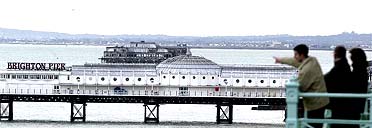
For sheer joie de vivre, Brighton scored high. Of all of Britain's seaside resorts, we call it "the artist among the artisans". Not only is it Britain's most popular coastal resort, but it is one of the best cities in the country. A city, mind you, as the artist formerly known as Brighton Town is now the City of Brighton & Hove, although it's a distinction that is lost on most Brightonians, who only hear its new name on train announcements. In this hip location, it seems, you can live pretty much anyway you want, and very comfortably, too: from the urban jetsetter who can't afford London prices to the organic crusty who yearns for a place to paint or play music. And there's the gays and lesbians who have turned Kemptown into the most vibrant and exciting gay neighbourhood in southern England.
We love Bristol, too, despite a hint of haughty grandeur that rubs off from nearby Bath. In size and vivacity, it's unmatched in south-west England, with excellent museums and galleries, magnificent architecture, exciting new developments and "a buzz after sundown which really kicks".
Just up the road, but years away in time, the Cotswolds are always wonderful - the quintessential chocolate-box England that every tourist expects, with honey-stone cottages and neatly manicured village greens. The marvellously named trio of Moreton-in-Marsh, Stow-on-the-Wold and Bourton-on-the-Water attract their fair share of crowds, so for a more peaceful view we also recommend the south Cotswolds - in the triangle between the M4 and M5. It's less cutesy, with a harder edge, but you are more likely to have the place to yourself.
In Wales, we enjoyed Pembrokeshire - a glorious peninsula of coves, cliffs and beaches, while just inland is a delightful rolling landscape, quiet villages and the massive "secret waterway" of the Daugleddau estuary. Parts of mid-Wales also feel surprisingly remote, and the lack of major roads slows everything down, for better or for worse. The winding A470 is the closest you'll get to a north-south highway, but it more than makes up in looks what it loses in speed.
Yorkshire scored high on the list, too. Partly because it's so big, but mostly because there's so much to enjoy: from the ancient city of York, with it's stunning fortified walls, the thriving medieval streets of the centre and the biscuit- coloured shock of the minster, to upstarts such as retail-centric Leeds ("the Knightsbridge of the North"), Harrogate ("urbanised and immaculate") and oft-forgotten Beverley, a time-warp market-town with a cathedral that even gives York a run for its money. Then there's the Yorkshire Dales, of course, where the grassy moors give an overwhelming impression of space and openness, and the glorious seaside resort of Whitby - a lively combination of a working harbour complete with colourful fishing boats, a maze of narrow medieval streets lined with restaurants and pubs, a vista of red-brick houses spilling down a headland and a cacophony of coaches, amusement arcades, chip shops and seaside paraphernalia, all topped by the imposing silhouette of the great ruined abbey.
North of the border, we highly recommend Edinburgh - a unique blend of culture, sophistication and architecture, fused together in a remarkable location; an extraordinary city and an architectural wonderland dispersed among the rocky crags of brooding volcanic hills. Edinburgh castle clings to one of these crags, and with its three sides dropping almost vertically, dominates the city centre. It's an irresistible sight, never failing to turn heads.
And finally, the timeless landscapes of north-west Scotland - the fabulous highlands and islands. We believe they're unrivalled in Britain, and the scenic gem that makes this island one of the most beautiful on the planet. Clearly impressed, our researcher wrote: "etched from the brutal forces of nature, this land will sear itself in your mind. It is the last of the great European wildernesses, dominated by soaring peaks, unforgiving terrain, a stunning coast and miles and miles of empty, exhilarating space."
So, Britain may appear small, but it's certainly never boring. Even given a decade or two (let alone a three-week holiday) you'd be very hard-pushed to "do" everything. And this is where Brits have the advantage - we can come back to places again and again, whether just up the road or at the other end of the country, and simply enjoy the wonderful diversity of it all.
· To order a copy of Lonely Planet: Britain for £13.99 plus p&p (rrp £15.99), call the Guardian book service on 0870 0667979.
