
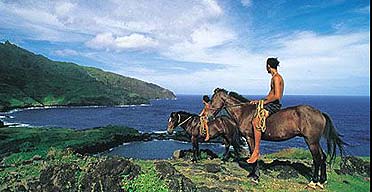
The Sunday collection piled up in a carved coconut shell. The drums beat out the rhythm of That God Is Great. Women and men, all bedecked in garlands, sang the popular hymn with full voice in the Marquesan language of French Polynesia. Words apart, this multicoloured service was still recognisable as a Catholic mass, even in this most isolated of places and with a female deacon distributing the sacrament in the absence of a priest.
In the village of Hapatoni, on Tahuata island (population 647; area 70 sq km), as everywhere in the Marquesas, we were greeted with open arms and the warmest smiles. We had come from the Aranui, not a cruise liner but a freighter with accommodation for up to 100 passengers. The vessel makes 13 runs a year around French Polynesia, each of 16 days' duration, starting from Tahiti, the largest of the islands. We felt like guests, not tourists - the ship makes only about four visits a year to this particular village, so such a call is a social event. Nearly all the crew come from the islands, so every day someone is greeting relatives, who, in their turn, are often welcomed on board.
The Aranui is the locals' lifeline. In the Tahitian capital, Papeete, three days' sailing to the south, it had been loaded up with consumer durables and huge pallets of concrete to extend the roads. The ship brings to Tahuata the only regular contact with the outside world and takes away copra (dried coconut), which is the only export. There is no air strip, and the only other way off the island is by a ferry that runs twice a week to the larger neighbouring island, Hiva Oa, where the French post-impressionist Paul Gauguin is buried.
The Marquesas, spread out just 8-10 degrees south of the equator, are the most northerly of the seven groups of islands comprising French Polynesia. Local tourist facilities scarcely exist: there is an infrequent air service to some of the six inhabited islands; and only the simplest accommodation; there are hardly any shops, only outlets for local handicrafts.
Joining the working cruise at Papeete, I was diverted from checking that my luggage had been delivered to the cabin by a welcoming cocktail party on deck.
I had paid for single occupancy of an A-grade cabin, which gave me more space than I needed. The cupboards were ample, the private shower and facilities adequate and spotless. On board the Aranui, the atmosphere is one of total informality. By day, the social centre is the small swimming pool, by night the restaurant, where there is no such concept as dressing for dinner. The dining room accommodates the passengers in two sittings. The French chef produces a set menu of top quality twice a day, or a cold feast for "picnics" on shore, but special dietary needs are well catered for. In addition, on some of the islands the local restaurants offer a Polynesian feast for lunch, which involves a massive variety of meats and vegetables all cooked for about four hours in an underground oven (ahimaa).
The first port of call out of Tahiti, a day and a half's sailing north, is the coral atoll of Takamoto, in the Tuamotu archipelago. Takamoto is the world capital of black pearl production, the secrets of which the locals are keen to initiate you in to. But here, as throughout the islands, the pressure to buy is non-existent. Local artisans are proud of their work, be it black pearls here or beautifully crafted wooden sculptures in the Marquesas, and to ask you to buy would be unbecoming for them. Nor do you sacrifice your dignity by trying to haggle over prices.
These islands are not the Seychelles or the Galapagos. There are few birds and no giant tortoises. The joy is in the people and the rediscovery of their ancient culture. You might, too, as I did, find your fellow-passengers good company. On my cruise, I was the only Brit, the rest of the passengers an almost 50:50 split of North Americans and French, but all united in a spirit of adventure.
The Marquesas, another day and a half's sail further north from the Tuamotus, are extinct but uneroded volcanoes, covered from shore to peak with the lushest tropical vegetation. Banyan trees are the symbols of a lost civilisation, having been planted to mark the sacred sites. There are palm trees, but in cultivated groves, mostly not along the shore, and grown for their precious copra. You might find the odd hour to sit under a flame-tree in a village, but so fascinating are the people and the mountains that they will take up the majority of your leisure time. Sailing is usually during the evenings and at night.
You need to be fairly fit to climb in and out of the whale-boats, which provide the link between the Aranui and the several villages that have no dock capable of accommodating a sizeable merchant ship. To derive the best from the islands, you need to be a little fitter still. To reach the marae (sacred sites) and view their tiki (massive stone statues), you have to negotiate a rough path through dense vegetation and in tropical temperatures. These paths were abandoned, though perhaps not forgotten, at the beginning of the 18th century, with the advent of the French missionaries. The first wave of priests waged a losing battle against paganism and cannibalism: it was only after smallpox reduced the local population from about a quarter of a million to less than 25,000 that Christianity prevailed. Since then, numbers have further dwindled to a mere 9,000, spread thinly over the six inhabited islands.
The young people tend to succumb to the temptations of "civilisation" beyond their shores and few immigrants have settled in the islands where Gauguin spent his last years. Those who are left have adapted ancient ceremonial sites to arrange welcoming parties: garlands, food and drink, dances, and school children singing the legends of the half-forgotten gods who created their islands, and enacting the story of the palm tree, one child dressed as the root, another the trunk, a third the leaves, and a fourth the flower.
In every place we were not so much visitors as honoured guests, and only the inexorable schedule prised us away. Not, though, before we had begun to penetrate the secrets of those concealed wonders. There were warnings against the heat and midges, but no passenger on this cruise would want to miss seeing these relics of a lost civilisation. In the event, the sea breezes were kind and the insects docile. The site of Iipona, on the island of Hiva Oa, is awe-inspiring. Its massive tiki are reputed to be the most impressive statues in the Pacific after Easter Island.
The Aranui picked up a local French archaeologist, Didier Benatur, who lives on the islands, and his explanations made the whole place come alive. There are relics of a similar civilisation on Tahiti and its smaller neighbour, Moorea, but they in no way compare to the Marquesas. New discoveries are still being reclaimed from the encroaching jungle and the vast numbers of undeciphered petroglyphs demand more detailed study. Compared with the mana (supernatural power) of these sites, European relics, such as the grave of Gauguin, also on Hiva Oa, seem trivial indeed. In reality, the artist left little behind on these islands which he loved so much - but every visitor will quickly understand what drew him here.
Way to go
Getting there: Strand Voyages (020-7836 6363) offers standard A cabins, all outside, and based on double occupancy, for £2,285 (de luxe £2,680, suites £3,100) for 15-day cruises on the new Aranui III. There is also basic air-conditioned dormitory accommodation, popular with the islanders and back-packers, at £1,290. Air France (0845 0820162, airfrance.com/uk) flies London-Papeete via Paris from £1,020. Air Tahiti (email: reservation@airtahiti.pf/airtahiti-vt.com) flies Papeete-Hiva Oa from £313 return.
Where to stay: On Hiva Oa, Pension Gauguin (+927 351, pensgauguin@mail.pf), has doubles for £80 per night. Transpacific Holidays (01293 567722) organises itineraries of Tahiti and the islands.
Further information: Peperu Heitaa (+927 004). Tahiti Tourisme (020-7222 7282, tahiti-tourisme.pf). Tahiti & French Polynesia (Lonely Planet, £11.99) is an excellent source of information on the Marquesas Islands, and has a separate section on the Aranui.
Country code: 00 689.
Flight time London-Papeete: 23 hrs, Papeete-Hiva Oa 3hrs.
Time difference: -10hrs.
£1 = 171.21 Pacific francs.
