
'I have seldom heard a train go by and not wished I was on it.' Thus Paul Theroux begins his 1975 travel classic The Great Railway Bazaar. 'Railways are irresistible bazaars,' he explains, 'snaking along perfectly level, no matter what the landscapes, improving your mood with speed, and never upsetting your drink.' Clearly, the writer had yet to experience the jolting joys of Connex South East. Yet his point is well made: rail has glamour and a sense of liberation; aircraft and automobiles have confinement, plush seats and little else.
Theroux, of course, is an American born within earshot of great Boston and Maine engines thundering to Syracuse and Buffalo. Trains were in his blood. By contrast, we Britons have had the screeching of the 7.32 at Kidderminster, the Northern Line rumbling under Tooting and little else to stimulate a thirst for rail romance until the opening of the Channel Tunnel.
Now continental expresses sweep hordes of British passengers to their foreign affairs and adventures. From my house in Brixton, I can hear Eurostar's seductive drone, and each time I wish, like Theroux, I was on board - for a trip to Paris, or Marseille, or beyond.
Indeed, such thoughts acquire an obsessive quality. Why stop in France, I wondered? Why not Spain, Italy, or another continent? I began perusing rail maps - a sure sign, like hairy ears, of middle-age - following twisting lines that headed to the Arctic Circle and the Middle East.
I could have picked Moscow or Athens, but chose Marrakesh. Perched below the High Atlas, it is the most southerly town that a London traveller could reach by train without leaving a station (if you ignore the inconvenience of the Straits of Gibraltar). All I needed to do was cross France and Spain, catch the Tangier ferry and board the train that snakes south to Casablanca and across the desert to Marrakesh. Simple.
For added piquancy Marrakesh and Brixton both have markets. The former has the spices and fabrics of its souk and crowds watching fire-eaters and fortune tellers in Djemma el Fna Square; the latter has eel sellers, fruit merchants, and night clubbers heading for the Fridge and the Academy. Even better, Brixton market is housed in the very archways over which Eurostar trains sweep every 15 minutes, rattling stalls and drowning the rap. And the place would even provide a travelling companion, my friend and neighbour Bryn 'the timetable' Davies, my pathfinder on so many other expeditions, who - with little persuasion - agreed to be Sancho Panza to my Don Quixote.
We worked out a schedule, bought InterRail passes and headed off through Brixton, past the shouting evangelists, the drug dealers and the shoppers. After posing for each other's cameras beside its station's life-sized platform statues - memorials, one presumes, to the unknown commuter - we boarded our Marrakesh Express: a series of ageing trains that shuddered through the March gloom towards Bromley, Sevenoaks, Tonbridge and, finally, Ashford. The windows were graffiti-scored; litter bins overflowed; and passengers bellowed into mobile phones.
On his journey through southeast England, Theroux described a network bustling with activity: country lanes jammed with cars at level crossings, and busy 'black train yards'. Bypasses have since replaced the rural byways while the yards now provide homes for whirlpool bath salesrooms and clutch repair specialists. However, the author did miss one treat: the rebirth of British coffee. In place of Travellers Fare granules, I had fresh filter in Brixton, a mocha from Bromley's platform kiosk, and a latte in Tonbridge. Bizarrely, they were the best coffees of our journey.
Eurostar was an antiseptic delight. It's not a great train - just a speedy, comfortable one that takes you straight into foreign cities. We scooted towards Paris, where Bryn's timetable permitted a blow-out at Brasserie Terminus du Nord. We scoffed crevettes and chateaubriand as the lunchtime theatre unfolded: waiters effortlessly accommodating growing bands of diners, including one lady of uncertain years and sobriety who could not get far enough from the two disreputable Brits. Unabashed, we swigged our chablis.
From the Gare du Nord, we took the Metro to the Gare de l'Est, and the TGV to Irun. The carriages had the comforting air-conditioned atmosphere of a supermarket, though this did not stop us sleeping off our wine. At Bordeaux, the train emptied and we spent the next two hours alone as we juddered over ancient, non-TGV track to Irun - a total flop as an international station: three platforms and a neon-lit cafe. We consumed beer, bread and serrano ham before boarding the Madrid sleeper: four carriages, and no buffet.
We rattled off into Spain, heads out of windows. At the first station, we passed two cancan girls; at the next, a respectable imitation of George Washington; and on the third, a woman dressed as the Statue of Liberty. Either Spanish people travel far for a good fancy dress party, or folie à deux had struck with a vengeance.
In Madrid - 24 hours after leaving Brixton - we had a breakfast of bitter espresso and fresh orange juice before blowing some euros on an upgrade on the Malaga Express: smoked glass windows, headphones, TVs, and hostesses bearing drinks and canapés. I lolled in the sunshine, watching the countryside, while Bryn fretted over his timetable.
Four hours later, our sybaritic pleasures ended at Bobadilla, where our 'irresistible bazaar' headed for Malaga while we awaited a connection to Algeciras. The place had the dusty desolation of a spaghetti western. We wandered around deserted, wind-swept streets before returning to the station cafe, expecting more beer and ham. Instead we got fried whitebait and chilled manzanilla sherry. Superb.
Then we rattled down the ravines of Andalucia, through twisting gorges and past tiny stations, each with a covering of mimosa, orange groves and single-tabled cafes with old men chatting. Next time, I would linger in this idyll, I promised myself.
At Algeciras, we sat on a ferry for hours, our trip's only major delay, while Bryn chewed the pages of his Baedeker. At nightfall we eventually set sail for Tangier. Next morning, we blew 120 dirhams (£8) on another upgrade, this time on a dingy old diesel with air-conditioning (of sorts) and unspeakable toilets. The landscape switched from the First to the Third World: half-built houses, hovels with bent TV aerials and travellers on donkeys - though it was surprisingly green.
By now our routine was well established. We dozed, read and chatted aimlessly, on this occasion debating the merits of each nation's rail network. France's had speed and soulless efficiency, we decided; Spain class and scenery; while Britain and Morocco had crap rolling stock, though the latter at least had a hint of Arabian mystery. At Rabat, we lunched on sandwiches and beer in the Hotel Terminus bar ready for our journey's final leg.
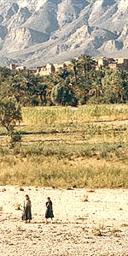
For the first time, we had to sit near other passengers, a group of American academics whose conversation broke our ritual reverie. The countryside altered from green to brown and finally to red. The trees were now palms, and the Atlas Mountains loomed on the horizon. At 5.30pm, we pulled into Marrakesh. It had taken 60 hours to link Brixton with Marrakesh, an oddly satisfying, but not exactly comfortable experience. Theroux had promised us that 'anything is possible on a train: a great meal, a binge, a visit from card players, an intrigue, a good night's sleep.' We got none of those, just a soporific feeling of transposition. Had we taken a week or a fortnight for our journey, we could have included stays in Paris and Madrid, tours of the Gironde and Andalucia, and a final exploration of medieval Marrakesh - all with a £239 rail pass. Next time.
We stretched our legs, first with a souvenir-buying expedition to the souk. Then Bryn consulted his guide-book and marched us down ever-darkening alleys towards the Palais Gharnata restaurant. Halfway there, I felt my wallet being pulled from my pocket. I grabbed the culprit, who squirmed from my grasp. Tenners, euros and dirhams spilled to the ground - to be grabbed by passers-by. That was my wad gone, I thought. Then, to my utter astonishment, my money was gathered and pressed back to me. 'Go back, bad people down there,' hissed a shopkeeper. We grabbed a passing taxi and hightailed it.
Only later did I feel ashamed at my surprise at this display of local honesty. This was Marrakesh, after all, not Brixton.
Factfile
A two-zone InterRail pass to travel through France, Spain and Morocco costs £275, or £195 for the under-27s, from Rail Europe (0870 584 8848). Pass holders also get a special discount price on Eurostar services.
