
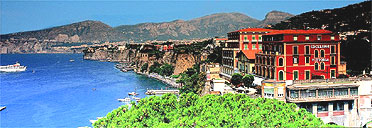
Late afternoon in the music room of the Excelsior Vittoria in Sorrento. The sound of leather soles on the hotel's marble floors occasionally breaks the heavy silence. All afternoons must be like this here, I think as I sip on a glass of pinot grigio and gaze out across the terrace. Beyond, the bay of Naples and the city are framed by the marble busts on the balustrade, balancing precariously in the light breeze.
Regal, it most certainly is. Which, presumably, is what over the past century or so has attracted the great, the good and Ronald Reagan to this little corner of Sorrento. The sepia pictures in the lobby attest to this, recording the visits, among others, of Gustav of Sweden, Fernando of Bulgaria, and our own Princess Margaret.
Enrico Caruso is also included in the photo call, the camera capturing the legendary tenor's visit of 1921, shortly before his death. As royalty goes, he's up there with the best from a local point of view, and certainly held in higher esteem than the Savoys, the remnants of the Italian royal family banished after the second world war. Vittorio Emmanuelle, his wife and son had flown in to Naples on the same morning as our arrival, only to receive a less than friendly welcome from certain elements of the local population.
We'd left the noisy protests and heavy police presence far behind and headed out of town and along the coast road that links the pockets of humanity dotted along the Costa Amalfitana.
So here I am in Sorrento. In the music room of the Excelsior Vittoria. With a bottle of charming white wine and my partner to keep me company. While I sit all smugness itself, she busies herself leafing through the leather-bound visitors' books that have found a home on the antique table opposite. I'm just wrestling with the shell of another pistachio nut when a sharp cackle breaks my concentration. "Listen to this," she cries. "'Wonderful hotel, great views. Pity Vesuvius didn't erupt.'" Of course, I'm not one for naming names, but suffice to say, Mr and Mrs X of Rhode Island, we know who you are. As holiday reflections go, this is more Rumsfeld than Rough Guide, an apocalyptic vision that became all too real for the poor souls of Pompeii and Herculaneum some 2,000 years before. As a constant reminder of the ensuing carnage, the brooding presence of the volcano puts any latter-day shows of machismo firmly in the shade. But this seems worlds away from the tranquility that currently reigns.
The onset of evening sees us make our way out of the hotel and down the path flanked by orange and lemon trees and into the bustle of Piazza Tasso. The statue of Sant' Antonio Abate, encircled only hours before by a succession of tourist buses, stands contemplating the square that is now ringed by restaurants and bars servicing the northern Europeans that are drawn to Sorrento in their thousands at this time of year. We head south into the old town, in search of a quiet meal. The area is a maze of shops offering both fresh and ceramic lemons of all shapes and sizes, attesting to the region's abundance of citrus fruit. A great deal of the annual crop goes in to the manufacture of limoncello liqueur, bottles of which can be yours for however many euros the individual shopkeeper believes he can safely draw from the sea of tourist bumbags populating the area at all times of the day. If you've never tasted limoncello, don't. Of course, some may believe it to be the height of Amalfitana sophistication, something to be savoured on nights at home with the neighbours as you regale them with stories of how you will soon be setting up home in southern Italy. To me, it tastes like nothing less than an over-enthusiastic reduction of a Bacardi Breezer. Believe me, it'll take more than one bottle of mineral water to remove its cloying consistency from your palate.
Of course, if the limoncello doesn't take your fancy, there are always the hundreds of varieties of tea towels, invariably adorned with lemons, invariably destined to inhabit the bottom drawer of whoever back home is unlucky enough to receive one in lieu of a postcard.
We investigate a succession of restaurants, their menus stuffed full of Italian cliches that reflect more of their author's views of how the British see Italian cuisine rather than the indisputable grace and simplicity of the indigenous dishes. Forty-five minutes later we're back in Piazza Tasso, looking up at Sant' Antonio for divine inspiration. He looks at us, we look at him, but after several minutes we come to the altogether less miraculous conclusion that we should just head off in the opposite direction. We turn left at the Excelsior and down Via Correale where, 100 metres later, we come across the Osteria Gatto Nero, the Black Cat. No mandolin players here, or rows of low-hung wine-bottle fiascos waiting to thud into the head of those not quick enough to evade their pendulum swing from the ceiling. No, aside from the contemporary fixtures and fittings, the Black Cat possesses that one element that in this country usually guarantees a good meal - it's full of Italians.
Of course, there is a handful of foreign interlopers, myself and my partner to name but two. We open, respectively, with a plate of tubettoni, mussels and fagioli beans, the liquor from the crustaceans clinging to the fat pasta shapes, and ravioli caprese, the fresh yellow rounds of pasta giving way to a milky centre of ricotta. Very nice, too. Veal is the choice of both of us for the main course: mine, thinly beaten slices in a red wine sauce, her's a cotoletta milanese whose crisp batter and succulent centre would put many chefs up north to shame. There is still room to spare, thanks to our recent hike, so the cheese is summoned; the selection includes pecorino sardo, strong, salty brigante, and pale yellow auricchio. Our only other companion for the evening is Fiano di Avellino Dei Feudi di San Gregorio 2001, several bottles of which make for a most illuminating couple of hours. Would sir and madam care to round off the meal with a glass of limoncello? Thankfully, this is never suggested. The Black Cat is far too street-wise a feline for that.
Not surprisingly, the Fiano is still making its presence felt the next morning as the blinds are drawn back to reveal bright sunshine and a few white tops upon which the ferry to Capri is bobbing up and down in the harbour below our terrace. It's already 10.30am, so settling for a coffee and pastry from the morning buffet, it is time to make our way to the car park, past the lines of Audi and Mercedes coupes, and Alfa Romeos, and, taking one last glance to ensure nobody is watching, fire up the Nissan Micra.
The coast road south out of Sorrento leads on to some of the other glittering cast of the Costa Amalfitana: Positano, Amalfi and Ravello. The swell of the waves visible from my partner's position in the passenger seat reflects the delicate state of our stomachs as the tiny hatchback negotiates the seemingly never-ending succession of bends that slow our progress. By half an hour after midday, we're still several kilometres from Positano, but the dome of Santa Maria dell' Assunta and the town's pastel-coloured houses, framed by the mountains and rising steeply away from the sea, are visible in the distance. Then, around 1pm, we're descending the narrow streets and in to the welcoming embrace of one of the numerous parking consortiums that do brisk business finding a temporary home for your four wheels.
We head on foot down yet more narrow streets, past yet more limoncello and tea-towel emporia from which emanates the essence of citrus-scented candles.
Finally, we're standing on the beach. Time for lunch, we both agree, and turn 180 degrees and in to the welcoming embrace of Le Tre Sorelle. The restaurant, complete with a huge black-and-white photograph of the three sisters in question, all smiles as they feed the pigeons in post-war Milan, does the job of supplying pizza and beer to road-weary tourists extremely well.
Back on the beach, we gaze out in to the Tyrrhenian, then look right and up to the coast road on which we arrived, and left towards Positano's bigger cousin, Amalfi. It looks invitingly close, but then so did Positano three hours earlier. We settle on a snooze before heading back towards Sorrento. If we time it right, we should be back in the music room of the Excelsior for an evening glass of pinot grigio.
Shadow of the volcano
Naples's daily paper Il Mattino reported earlier this month that the local authority was planning to offer residents living around Vesuvius, in the so-called "red zone", €25,000 each to relocate. If any further incentive were needed not to risk incurring the wrath of the volcano, then a trip down the A3 autostrada to Pompeii would probably do the trick.
The site, covering 66 hectares, 45 of which have been excavated, is a testament to the natural forces that rained down on the town's citizens in AD79. The full horror of the event is reflected in the casts of several victims caught in their death throes as the deluge of ash and rock descended on them. It will be of no comfort to those unfortunate souls that this blanket helped to preserve a wealth of sculptures, paintings and mosaics, offering latter-day visitors an insight into the cultural, spiritual and commercial life of the Pompeian citizen.
Because of the size of the site, even on a day when the tourists arrive in droves, you can still find yourself alone on one of the streets, or in the sauna, theatre or brothel, with only the eerie silence for company.
Vesuvius is not expected to awake from its slumbers in the near future, but if I counted myself among those currently residing in its shadow, I would think it advisable to take the money and run.
Getting there: Pompeii, 2 Via Villa dei Misteri, pompeiisites.org. Daily tickets cost €10 per day (€5 for European Union students and teachers). The site is open 8.30am-7.30pm (last ticket 6pm).
Way to go
Getting there: easyJet (easyjet.com) flies daily Stansted-Naples from £54.48. Holiday Autos (0870 4000010, holidayautos.co.uk) has car hire for three days from £74.
Where to stay: Until October 31, two nights B&B in a garden-view room at the five-star Grand Hotel Excelsior Vittoria (0800 969765, exvitt.it) costs €312pp (two sharing).
Further information: Italian Tourist Board (09065 508925, enit.it).
Country code: 00 39.
Flight time London-Naples: 2hrs, 50mins.
Time difference: +1hr.
£1 = 1.37 euros.
