
As the storm raged, our hydrofoil nudged gingerly towards the jetty and the crew in their yellow sou'westers tried to lower the gangplank.
But it was futile; the waves and the rain were too strong. The captain announced that we would proceed to the next stop, the island of Stromboli, and come back to Panarea once the storm had abated.
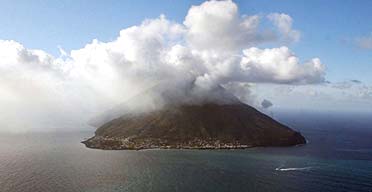
Even some of the more irate passengers were soon entranced as our boat approached the still-active volcano. The storm had cleared by now, the light was extra sharp, yet tempered by the softness of the sunset. The slopes of Stromboli were surprisingly green, but the volcano was belching vigorously, sending a thick column of smoke into the pale blue sky.
Finally, the boat disgorged its passengers onto the island and headed back out, giving us a glimpse of Stromboli's sciara del fuoco, or trail of fire, a grey slope where the lava trickles into the intense blue sea, sending up puffs of steam. The sciara looked as smooth as a ski slope and I wondered how long before some daredevil in an asbestos suit slid down on a heat-proof toboggan.
It was hard to take our eyes off Stromboli as we returned to the more pampered confines of Panarea. Back in our favourite bar over a prosecco and a bacardi and tonic, we just sat and contemplated the volcano puffing away in the distance as the sun set.
It was a soothing and peaceful scene, quite at odds with the description of Sicily in the Leopard, a masterpiece of world-weariness by Giuseppe Tomasi di Lampedusa (if nothing else our trip to Sicily was an excuse to re-read this poetic novel about the Sicilian aristocracy coopting the nouveau riche peasantry).
"This violence of landscape, this cruelty of climate, this continual tension in everything, and even those monuments of the past, magnificent yet incomprehensible because not built by us and yet standing round us like ghosts; all those rulers who landed by main force from all directions."
It is true that the landscape is violently beautiful - the bougainvillaea stridently colourful in their pinks, reds or blues. The giant elephant-ear cactus topped by delicate little yellow flowers, like some afterthought, look as if they belong in Monument Valley, not in the Mediterranean.
The heat was certainly cruel, even more pitiless than usual because of a heat wave. It was the kind of heat that frays spirits after just minutes of walking, tempers rising along with the din of the cicadas.
Getting to the water was hard work, wherever we stayed, usually entailing a hike up some steep path before descending to a beach full of melon-size ankle-twisting stones.
But the startlingly blue water - as if painted by Matisse or Dufy - was the reward. Blue, yet so clear that you could see at least 20 metres into the deep, picking out clearly the little black fish below. Sicily's crystalline waters are heavenly. Snorkelling in Sicily was like wrapping yourself in a warm blue cocoon pierced by golden threads of light.
As for Lampedusa's incomprehensible moments, Sicily is awash with the magnificent detritus of past empires; Greek, Roman, Moorish, Norman and Spanish. Segesta, in western Sicily, features an unfinished Greek temple, unadorned by engravings or carvings, all the more compelling in its austerity.
At the other end of the site, on the crest of a hill, lies an amphitheatre; its views of mountains, valleys and sea are so wondrous that the scenery must have been the despair of playwrights. Unless their plays were absolutely captivating, audiences would surely have just let their gaze drift to the beguiling panorama beyond.
From Segesta, we switched to the Norman time zone by visiting Erice, a hilltop folly reached by a serpentine road that took us beyond the clouds. The 12th-century Castle of Venus is perched so precariously on the edge of a cliff that my wife, Claire, wondered whether its builders were mad or paranoid - or both - to have chosen such an impractical location.
The poor Sicilians may have resented successive waves of intruders, but their presence has turned the island into an archaeological treasure trove for today's invaders. The combination of ruins, old churches, intimate pebbly coves, good food and pretty little islands makes Sicily irresistible.
Our pretty little island was Panarea, which as Claire observed was a bit of a con, although a beautiful con nevertheless. Only 3km wide by 2km long, with a population of just over 300, Panarea (it sounds and looks Greek with its white, flat-roofed villas) boasts no Greek or Roman ruins, just some clumps of stone from a Bronze Age village.
Yet despite its minuscule size - the streets are only wide enough for golf carts and three-wheelers - Panarea seduced us immediately with its compact seafront of cafes, shops, and small boys touting boats for hire. Our hotel, the Cincotta, complete with trellis of dangling grapes, a garden with lemon trees and a salt-water pool overlooking the sea completed the sense of enchantment. We decided immediately to extend our stay.
Panarea has an upmarket reputation and the clientele at Cincotta seemed to have stepped from the set of La Dolce Vita. The women swam in the pool still wearing pearl earrings, while their husbands muttered into their mobile phones. Even our cleaning maid looked as glamorous as the guests. Delectable in itself, the island was a convenient base for visiting Stromboli, Salina and other Aeolian islands.
Scopello, where we also stayed, was small, too, but completely different in character. On the western end of Sicily, Scopello is little more than a bend in the road, but it packs a lot in; a small square, a water fountain, a cafe, a terrific sandwich shop, and a handful of restaurants and bed and breakfasts.
The hamlet overlooks an old tuna-processing plant, where rusting anchors lie neatly in a row. It's now a beach with rock towers (faraglioni) topped by cactus jutting out of the sea. No wonder the writer and naturalist Gavin Maxwell chose to hang out in Scopello, it's a bewitchingly restful place - at least out of high season.
Upon our return to London, I rang an Italian friend to gush about Scopello and Panarea, chuffed at our discoveries.
"Oh, why didn't you tell me you were going, there are much nicer places," she said breezily. My sense of deflation was only tempered by the thought of a return visit.
Way to go
· Mark and Claire flew to Palermo with Ryanair, £110 return per person return.
· They stayed at the Hotel Cincotta on Panarea for £148 a night.
· In Scopello, they stayed at La Tranchina for £76 a night.
