
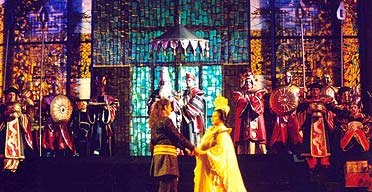
The greatest set designer in the world could not conjure up such a scene. A vast lake forms the stage, giving way to a backdrop of mountains, veiled in a haze of heat.
This is the magnificent spectacle that would have struck Giacomo Puccini as he looked out from his villa at Torre del Lago on the banks of Lake Massaciuccoli, where he was inspired to write many of his best-known operas.
"This is paradise," he declared when he first visited the lakeside village on a shooting trip with friends. Shortly before he died in 1924, the composer wrote to a friend: "I always come out here and take a boat to go and shoot snipes ... but once I would like to come here and listen to one of my operas in the open air."
A few years later his dream was realised and in 1930 La Boheme was performed on a stage built on piles in the lake. Today the Festival Puccini has become a Tuscan tradition. In 1966 an open-air theatre with seating for some 3,000 opened a short stroll from Puccini's villa and since then Luciano Pavarotti, Placido Domingo and Andrea Bocelli have been among the famous names to sing at the festival.
I arrive a couple of hours before the performance of La Boheme begins, but there is plenty to look at. Everyone is dressed up for this "Italianissimo" event, from grandmothers in their Sunday best to tanned babes in little backless numbers, fresh from the beach at the nearby resort of Viareggio.
The leafy road to the lake is lined with stalls selling postcards, gifts and reproductions of the posters that advertised the original productions of Puccini's operas. Local restaurants are open both before and after the opera, serving simple but fresh and flavoursome food. At Ristorante Da Cecco I eat "fileta d'orata" (translated as fillet of gilthead fish) with a salad - "squisito" as the Italians say.
Puccini's villa, painted a warm peach and surrounded by a garden filled with hydrangeas, sits at the top of the road looking out onto Lake Massaciuccoli, while a statue of the maestro keeps a watchful eye on the square in front of his home.
During the day, minus the opera crowds, this is a tranquil spot. Puccini's villa, known as Villa Mausoleum because the composer is buried there, is open to the public and gives a unique insight into the composer's life.
Walls and cabinets are crammed with paintings and photographs of friends and family, letters from admirers, including Princess Alexandra and Thomas Edison, and birds and small animals shot by Puccini, a keen game hunter. However, only the ground floor is on show until funds can be raised to open the rest of the house.
Puccini settled in Torre del Lago in 1891 and rented various houses in the village until the success of his operas meant he could afford to buy his own home.
He left in 1921 and moved to a villa in Viareggio, where he lived until his death. When he died, his son Antonio had a chapel constructed inside the Torre del Lago villa on the site of the former dining room, where his father's remains were interred.
You can also take a boat trip out on to the lake where Puccini loved to hunt - much of which is covered with tall marsh reeds and lined with tumbledown fishermen's huts.
On opera nights Torre del Lago comes alive. Shortly after 9pm hordes of opera-goers start to file across a wooden walkway over the lake to the open-air amphitheatre. As people take their seats the sun sets behind the lake and glittering stars appear overhead.
Each of the four operas showing this year - Manon Lescaut, La Boheme, Madama Butterfly and Turandot - continue the festival's strong tradition of combining music and the visual arts.
The main feature of La Boheme's set - designed by Belgian painter and sculptor Jean-Michel Folon - is a giant artist's palette, upon which the singers perform. Behind them, cartoon-like images of Paris rotate on an enormous easel. Creative touches abound - the fire where the Bohemians burn books for heat is a pool of paint on the palette, while as Mimi expires, a picture of a heart sinks on the canvas like a setting sun.
The set of Madama Butterfly, designed by Kan Yasuda, reflects both Japanese minimalism and the local landscape - making use of huge boulders that look as thought they have been carved from white marble quarried from the Apuan Alps - the mountains that rise beyond the lake.
Igor Mitoraj's designs for Manon Lescaut are exhibited at Pisa airport - demonstrating just how important the festival is to the region (Torre del Lago is in the Versilia region which is, in turn, part of the province of Lucca).
Turandot is a sumptuous production with a gorgeous art nouveau set that brings to mind the interior of Puccini's villa - Italians call the style Liberty.
The acoustics vary from opera to opera - La Boheme sounds rather faint in the open air, while Turandot, which has a powerful chorus, rings out loud and clear. Sounds of children's laughter drifts into the stadium from the village and one night a car stereo system blasts out at full volume nearby. In the next row a party of elderly women chatter away and sing along to the music. But somehow these noises add to, rather than detract from, the ambience - making the performance feel like a living, pulsing event.
A word of warning - the proximity to the lake combined with the summer heat makes the theatre a haven for mosquitoes, so a strong repellent is a must.
The artists who work on the Puccini festival all enjoy close links with the nearby town of Pietrasanta - a centre for artists and marble and bronze sculptors. Michelangelo worked in Pietrasanta, using the "statuario" marble quarried from the Apuan Alps, before he moved to Carrera. Even in the height of summer some of the mountains appear to be tipped in snow, but this is in fact the remains of marble quarries.
Marble sculptors still work in the town today, and I visit the Barsanti workshop - a huge yard filled with statues of gorgeous nymphs and proud Davids and carpeted with a thick white dust. Owned by a team of son and father (who, of course, inherited it from his father), the workshop employs around 24 highly skilled craftsmen. It takes three to four years to learn how to sculpt marble and bronze, and around six years to become adept at another Barsanti speciality - mosaics crafted from thousands of tiny fragments of Venetian coloured glass. The Barsanti's main clients used to be churches, but now they are just as likely to be private clients and companies.
Fernando Botero, the Colombian sculptor and painter, lives and works in Pietrasanta for part of the year and one of his sculptures - an enormous squat bronze warrior - greets you as you approach the town from the coastal road. Botero's trademark plump figures also feature in two vivid frescoes depicting the gates of heaven and hell in the tiny church of Saint Antonio Abate, a short walk from the main cathedral square,.
Nestling in the centre of town the Albergo Pietrasanta, a seventeeth century palazzo converted into an unassumingly luxurious hotel, displays contemporary art on staircases and salons, tracing the development of Italian art from the middle of the twentieth century until the present. Although the hotel has no restaurant, it can provide meals for opera goers either before or after a performance.
Quite a different holiday experience is on offer in Viareggio - a bustling seaside resort on the Versilian coast, a short drive from Torre del Lago. At first it is difficult to fathom the system of "bagni", private bathing establishments, where you must pay a generous sum in euros to hire sun loungers and umbrellas on the beach. Placing your towel on the sand without paying is simply not allowed, although no one can prevent you swimming in the sea. For those who categorically refuse to pay, there is a small free beach.
Viareggio literally means "royal road" and aptly the town's main coastal thoroughfare is lined with elegant shops selling shoes, clothes, jewellery and gifts. There is a local expression "chic, cheque, shock" used to describe the typical Viareggio shopping experience. A little way back from the coast sits a large pinewood - Versilia is known for its woods of cluster pine, introduced to Italy in Roman times - which offers respite from the ceaseless heat of summer.
In the hills behind Viareggio and its three neighbouring Versilian beach resorts - Lido di Camaiore, Marina di Santa and the most exclusive of the four, Forte dei Marmi - can be found agriturismi. These are establishments producing olives, wine and other local produce, which take paying guests and offer a peaceful alternative to bustling beaches.
Way to go
· Special events organiser Liaisons Abroad can arrange inclusive holidays with tickets to the Puccini Festival and a choice of accommodation - ranging from countryside agriturismos, villas in the foothills of Viareggio, the four-star Pietrasanta Hotel or seaside hotels such as the four-star Astor in Viareggio.
· Prices from £465 per person for three nights' accommodation sharing twin/double room on a half-board basis at the Astor or B&B at the Pietrasanta, including tickets for two festival performances.
· Flights (not included) from £90 with Ryanair (ryanair.com).
· Call 020 7376 4020 or visit liaisonsabroad.com
· NB There is still availability for this years Puccini Festival which ends on August 23. Book in advance for the 2004 festival.
