
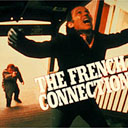
Marseille has a somewhat insalubrious reputation enhanced by its depiction in film, most famously the 1970s Gene Hackman flicks The French Connection parts I and II, and in writing, as in the melancholic detective novels by the native Marseillais Jean-Claude Izzo. I couldn't afford anything else anyway but it seemed fitting, therefore, that I check into a potentially demimonde establishment: the slightly scruffy, but clean, Hôtel Montgrand (50 Rue Montgrand, 04 91 00 35 20), a one-star joint just a few streets up from the old port.
I wrestled open the window in my room to be greeted from the street by the shout of car horns and the sight of striding summer Marseillais. On the air, wafts of that evocative French-city smell, potent and earthy: raw sewage. Graffiti rapped silently from the wall opposite. I felt I had found the right milieu (the name for the French mafia, as it happens, who are headquartered in Marseille). I caught myself becoming "Popeye" Doyle, Hackman's seen-it-all American detective abroad.
I needed a blonde and a once-sharp suit, but I had neither. I headed to the Vieux Port anyway, in shorts. The weather was so perfect - a warmth obviating clothes, tempered by the slightest breeze - that I almost feared retribution. The slyly groovy looking bars lining Rue Breteuil beckoned me for a pre-lunch pastis, but I told them I hadn't even had breakfast. The older men on the streets, typically grizzled and short, all wore their shirts unbuttoned to their navels to aid ventilation. Most of the younger ones were built like brick pissoirs and comprehensively tattooed. Neither type remotely resembled a Parisian intellectual.
"The yellow-studded maw of a seal with salt water running out between the teeth" is how the German philosopher Walter Benjamin described Marseille's old port in his travel piece about the city in the 1930s. This was the city's gullet for much of its 2,600-year history, swallowing up the supplies of a burgeoning metropolis and wave upon wave of immigrants. It forms a U-shape: the Quai du Port and Quai de Rive Neuve making the uprights and the Quai des Belges the base, the whole enclosing what is now a giant marina for yachts and other craft good for smuggling.
The entire "U" is barnacle-thick with brasseries and restaurants, but I decided to start with the one that opens The French Connection, La Samaritaine, which also affords the best view over the port. This brasserie, on the corner of the Quais du Port and des Belges, is a Marseille institution and obviously has not felt the need to modernise. It looks quite the same as in the film of 30 years ago, and the waiters' superciliousness is so impressive they should be on display in a museum.
The mystery man in the opening shot of The French Connection heads from La Samaritaine to the quarter called Le Panier (The Breadbasket), which climbs northwards up the hill from the Quai du Port. I decided to follow in his footsteps. The last we see of him is when he is shot in a doorway and his killer, in a fabulously French gesture, breaks off the end of his baguette to chew as he makes his get-away. Me, I decided to explore.
Le Panier is one of the oldest parts of the city but it represents only a fraction of what used to exist. During the second world war, Hitler realised that thousands of Jews and others sought by the Nazis had taken refuge in the unmapped streets of the medieval old quarter. In a bid to flush them out, collaborating with local property speculators - a familiar story - he had the whole district set with dynamite and gave the inhabitants 24 hours to leave before blowing it up. Indeed, Hitler didn't like Marseille at all. He wanted to make an example of it as a representative of decadent cosmopolitanism. For me, that is a glowing commendation. He should have written the guide book.
Le Panier has long had a salty reputation. Up until the 1970s it was the centre for the purification of the heroin that Marseille exported to the United States, as its main supplier in the period - hence "the French connection". Interestingly enough, the trade flourished with the CIA's backing of le milieu as a bulwark against the Communist party, which was very powerful in the city after leading the resistance during the war.
The quarter retains a strong air of cobbled back-streets mystery. I finished my peregrinations at the bar Les Treize Coins (corner of Rue St Françoise and Rue du Panier), with its sawdust-strewn bar floor, funky murals, cheap Moroccan salads and hearty tajine. This is one of the real-life haunts of Montale, the detective hero of Izzo's novels, who soothes his sorrow at the violence and cruelty he sees every day with his beloved Marseillais food and wine.
The next day my feet were tired of tramping. The sea was lapping languorously and seemed to whisper: enter me. I took the half-hour boat trip (€9 return), rough but fun in a heavy swell, from the Quai des Belges to the Isles de Friouls.
These craggy little islands have a stark aridity that will appeal to the crushed romantic in you, if there is one. You can make your way along the shoreline, dotted with clumps of hardy, aromatic herbs, and find an inlet of your own to swim from.
In the 19th century one of the isles, Ratonneau, had a quarantine station at its highest point, for the supposedly healthful effect upon its patients of the strong winds. I climbed the steep path to look at its ruins, surprising the colony of seagulls that had taken over there and which, enraged, it being nesting season, tried persuasively to dive-bomb me back down.
I don't think Montale, Popeye Doyle and Walter Benjamin were bathing types, and I felt they rejoined me only when I arrived back at the port. All that seawater had made me want to eat some of its denizens. I sloped from the port up La Canebière ("Can o' Beer" to English sailors; once a grand promenade, now fallen on litter-strewn times) to Rue de Rome. There, just to the right, was a shellfish establishment I had been recommended. You can't miss it: it has "Coquillage" pulsing in neon over the front. I ordered the tasting menu at an unpainful €18. It arrived looking like a wedding cake, the winkles, cockles, oysters, prawns, scallops and clams nestled in little piles on ice in a three-tiered metal frame.
On my last day I ventured further into dry land. I got a strong taste of Marseille's pervasive north African flavour in the Marché des Capucins, along La Canebière again and right at little Rue des Feuillants. Cous-cous and herb stalls abound, the air is heady with the smell of spices and fezzes bob above the crowd. Watch your wallet, because someone else might too.
Go east from the market, along Cours Julien, and you will find a colony of artistic types around the Rue des Trois Mages and its offshoots. Cafes and restaurants specialising in ambiences from the grungy to the edgily hip have sprung up here and you get the feeling that more will proliferate. L'Epicerie, on Rue des Trois Rois, is a gallery-cum-theatre-cum-everything that seems a good barometer of the city's arts scene. Its proprietor, Fred, befriended me five minutes into our conversation with the offer of a place to stay and the Marseillais equivalent of a Camberwell carrot.
I politely declined both, but Fred's informality and promise of intoxication were a perfect parting summary of Marseille.
Way to go
Eurostar (020 7922 6180) has tickets to Marseille, changing to the TGV in Paris or Lille, from £109 standard and £159 first class. TGV tickets can also be booked from TGV's website (tgv.com, English site available) if travelling to Marseille within France.
British Airways (0870 850 9850) flies from Gatwick; return tickets start at £60.
