
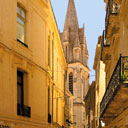
If Montpellier had a British twin, it would have to be Brighton. It may not have a beach, and it may not offer quite the same blend of sleaze and seediness as the Sussex resort. But if you thrive on graffitied grandeur, student-sized restaurant bills and places where history is not really the point, you may well adore it.
The town doesn't come packaged. It has no colossal gastronomic reputation, though it does have a three-starred Michelin restaurant in the Jardin des Sens, where a starter of artichoke salad with basil vinaigrette, local oysters and pig's trotter carpaccio will set you back an eye-watering €50.
Like every other French city, Montpellier has Sofitels, Best Westerns and Comfort Inns, but it remains largely untroubled by tour groups. There are no English-language guidebooks to speak of. The only substantial museum is the admittedly absorbing Musée Fabre, where the curator will be happy to expound on the 19th-century French obsession with the Orient and its women.
Now you will probably have to visit Montpellier under your own steam, which is easy enough; Ryanair and BA both fly to the Frejorgues airport eight kilometres away. Trains run there from almost everywhere: Paris, Nice, Toulouse, Carcassonne, Marseille and France's most popular naturist resort, Cap d'Agde - made infamous by the cynical, debauched novels of Michel Houellebecq, who is just as fascinated by eastern sexual mores as Ingres was.
Many of the big hotels are in Antigone, an extraordinary, postmodern suburb. It lies just to the east of what Montpellier inhabitants sometimes call the oeuf or ecusson - the shield-shaped perimeter of boulevards which encloses the oldest part of the city. Try, if you can, to book a hotel in the centre. Some of the 19th-century mansions are very dilapidated, but a view over the red-tiled roofs and into courtyards hung with laundry is worth seeking out. Antigone sits just beyond an uninspiring shopping centre called the Polygone. Gleaming blue trams slide noiselessly from the railway station to the Place de la Comédie, where most Montpellier nights begin and end.
One of the most delightful things about the city is the number of places where an impoverished visitor can loiter cheaply and admire the beautiful creatures prowling the streets. The cafes on the Comédie are an excellent place to begin. Baudelaire wrote about the Parisian flâneur, the stroller who mingles with the crowd and observes it; Montpellier, by contrast, is a city to sit and sprawl in.
The relative cool of the early morning is the best time to appreciate the Comédie. When the heat starts to become oppressive, there are a number of other possible retreats:
· Watch the red-eared terrapins swimming up and down the pool, or picnic under the big, shady trees at the Jardin des Plantes. It was opened in 1593 for the benefit of the university, and is the oldest botanical garden in France.
· The crêpe outlet opposite the St-Pierre cathedral. The crêpe, the croque-monsieur and the galette (waffle) are all excellent substitutes for a full-blown €20 lunch. What's more, the play of light and shadow on the stone of the cathedral is best appreciated from this particular angle.
· The Olympic-sized swimming pool in Antigone. Built by Montpellier's socialist town hall, and an inexpensive refuge from the late afternoon heat. It closes at 6.45pm at weekends but stays open until much later on weekdays.
· The Place de Peyrou. Possibly the most beautiful spot of all - especially at sunset, when solitary musicians bring along their instruments and skateboarders practise their tricks. The neo-classical arch overlooks an aqueduct which stretches away from the city.
Like Brighton, the city can be a little rough around the edges. As we were ringing the bell at a friend's flat, a teenager came up to us and pulled out a flick-knife. "Do you know what this is?" he asked. It turned out the gesture was part bravado and part curiosity: he wanted to know the English words for different types of knife. We were happy to oblige.
On summer weekends, Montpellier students head to the arid scrublands half an hour north of the city, known as the garrigue, to picnic and play pétanque. The area around the 658 metre-high Pic St-Loup and its smaller counterpart, l'Hortus, is particularly popular: buy a local map and follow one of the streams, which are warm enough to bathe in. Rosemary and olive trees grow among the ruins of cottages and farmhouses.
Oui, one student told me, means peut-être (maybe) in Montpellier; "tomorrow morning" means "in a couple of days' time". Few places can induce the same happy indifference to mortgages, promotions and deadlines - and certainly not so cheaply.
