
Even a journey to Tokyo starts with a first step. The trip conjures up images of frozen forests, mighty rivers and teeming cities but for me the first step started at 6:30am at Stansted Airport - or rather it didn't. As I rushed into the terminal, struggling under the weight of my excessive luggage, the word "closed" flicked up next to my flight to Oslo. Around me people were frantically relaying desperate stories of varying plausibility involving motorway diversions, weddings and unforeseen acts of God. The airline staff were unmoved. I decided to quietly join the queue of people trying to get on the next flight.
I wondered if I should just lie low and not mention this early stumble to anyone. I decided to call my sister. "How do you expect to get to Japan if you can't catch a flight from Stansted?" I wish I'd kept my mouth shut. I waited nervously in the airport with my stand-by ticket and a cup of undrinkable coffee. At last by lunchtime I was on my way to Norway, the happy beneficiary of someone else's motorway diversions, faulty directions or lost taxi drivers.
By the time we landed at 4pm it was already pitch dark. Rather than the wintry wonderland I had hoped for, the rain was lashing down under the orange airport lights. It was three degrees. The airport bus deposited me, tired, hungry and disorientated in the centre of Oslo two hours later. I struggled to shoulder my heavy luggage again and set off towards a hotel.
I had a hotel in mind but hadn't made a reservation, thinking it totally unnecessary in November. After several wrong turns and having nearly dislocated my shoulders with the weight of my pack, I finally stumbled into reception. I was greeted by a beautiful blonde Norwegian woman with a beaming smile. I smiled back enthusiastically. "Sorry we're full. Didn't you know there's a Robbie Williams concert tonight and everywhere is fully booked?" Her smile beamed away. I was crushed. Not since Joseph and Mary has anyone felt so disheartened and at least they had a donkey to carry their luggage.
A guy called Ben, who I'd spoken to on the flight, had mentioned another hotel. It was my only chance and the receptionist told me to go to the end of the tramline and look for the signs. The tram finally stopped in the suburbs. I stood in the rain but could see nothing except the odd house and some waterlogged fields. I cursed Robbie Williams to the night sky and vowed never to buy one of his albums.
Suddenly I caught sight of a hotel sign. I hauled my pack along a dark and muddy path, at the end of which I found the shining lights of the reception. I was greeted by another beautiful blonde woman with a beaming smile but this time they had a room. It's a cliche but sometimes it's true - I was asleep before my head hit the pillow.
I woke early the next morning with no real idea of where I was, the night before largely forgotten except for my aching shoulders. I opened the curtains and was amazed by the spectacular view I had missed in the dark. In the clear morning light the rooftops of Oslo sloped gently down towards the harbour below and the Oslo fjord ran like a silvery grey ribbon into the invisible sea beyond the hills and islands in the distance. Low, rounded mountains covered with black forest surrounded the city on every side and seemed to hold up the blanket of clouds that had rained so persistently the previous evening. I celebrated with an apparently standard Norwegian breakfast of pickled herring with raw onions.
It was Sunday morning and Oslo was quiet. In fact it was pretty quiet for the duration of my stay. No car horns, no jostling crowds, simply a pleasant, well-ordered and compact city. A guidebook had described my original hotel as being located in a rough neighbourhood. The Norwegians I spoke to insisted this is true. It may have been by Norwegian standards but then those are the highest living standards in the world. It takes more than a faulty streetlight and a small pothole to make a war zone.
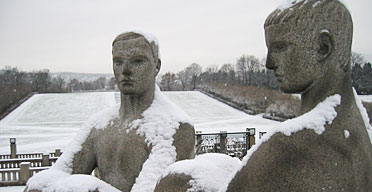
I walked out to Vigeland Park, world famous for its sculptures. It was busy with cheerful Norwegians wandering among the stern faced monumental statues or skating on the open-air ice rink. As the sun came out I was happy to sit and consider what the literature describes as the "human message" of the sculptures. I'm still considering what the exact message the statue of a man being attacked by an eight-foot centipede might be. I'd appreciate it if you could email me suggestions.
I headed for Akershus Fortress at the head of the fjord overlooking the quiet harbour. I climbed up the ramparts, passed the guards marching back and forth and made for the information centre. I was greeted by another beautiful blonde and considered if this wasn't a deliberate policy on the part of the ministry of tourism. I must admit that I took in very little of the history of Swedish and Danish sieges she carefully explained to me. I just smiled as endearingly as possible and she smiled back. I promised to come back after having a look around the fortress then strode manfully to the door and walked straight into an electrical wiring cupboard. She kept on smiling. I decided to keep on walking.
By the time I'd reached the Royal Palace I'd regained some of my composure. The palace guard smiled, pulled faces for the children and subtly dispensed tourist advice. Worryingly, they were all the security there seemed to be. You could literally walk up to the front door and ask to speak to King Harald and Queen Sonja. I decided against this on the assumption that neither had voted as part of the Netjetters competition. The palace is often given as an example of Norway's open and well ordered society; the kind of people who would designate a specific area to throw clean and ironed underwear at a Robbie Williams concert.
What surprised me about the National Gallery was the subject of the paintings. Most famous is Edvard Munch's The Scream, no doubt inspired by the artists failure to reserve a hotel room. Other cheerful subjects included Sick Child, Burial at Sea and Self Portrait with Spanish Influenza.
How did such an apparently calm and content society with a scandalous oversupply of smiling six-foot blonde beauties produce such ideas? In one massive painting, After a Fight at a Country Wedding a dragon's head emerges into the smoky room like the prow of a Viking longboat; and then it struck me that I'd seen no trace of that Viking spirit that carried the Norwegians, raping and pillaging, all the way to Newfoundland.
The Viking Museum contained a fascinating array of longboats, weapons, treasure and everyday items from burial mounds in the Oslo area but, apart from the dubious assertion that Vikings were farmers and traders as well as axe wielding psychopaths, there seemed little to link them to present day Norway.
I turned to the neighbouring Folk Museum for an answer. To my untrained eye two themes seem to dominate, painting roses on everything and drinking. The traditional farmers' ale bowl managed to combine both these elements. A love of roses might not explain a desire to invade Northumberland but a love of alcohol might.
Norway's high standard of living comes at even higher prices. I reckon it would now cost not much short of £100 to fill one of those farmers' ale bowls. The Alcohol Monopoly strictly controls sales and I watched as the locals carefully sipped their precious beer. If you spilt someone's beer in Oslo you'd expect a lawsuit rather than a fight.
Perhaps it's the dark winter nights that make them want to drink. As I walked towards the station and my train to Sweden it started to snow. This was what I had been looking for and I was ecstatic. The locals, however, looked glum and resigned to the long cold months ahead. I thought of trying my luck one last time with the beautiful blonde Norwegian women and inviting one to come for a drink but then I thought of my budget - and wiring cupboards - and thought better of it.
Email Jim at jim_netjetters@hotmail.com
