According to various accounts, Peter the Great apparently had a disproportionately small head with an equally disproportionate number of big ideas crammed inside. He wasn't the kind of person to tolerate having his ideas questioned either (very few Russian monarchs ever did). He had his sister Sofia locked up in a nunnery for the rest of her life for challenging him. When part of the army rebelled and tried to free her, he personally executed many of them and then had their bodies hung outside her window all winter.
So when, in 1703, the idea of moving the capital from Moscow to a desolate, disease-ridden swamp near the Baltic Sea emerged from Peter's tiny cranium, no one argued with him. Just in case some people didn't get the message he made it illegal to build in stone anywhere else in the empire until his new capital was complete.
The resulting city of St Petersburg, with its magnificent cathedrals, palaces, churches and museums was, therefore, all part of a deliberate plan by Peter to drag Russia (kicking and screaming if necessary) away from a medieval, superstitious and backward Moscow towards a bright, modern and cultured European future.
So it was with some degree of surprise that I found myself at the very heart of Peter's great city, drinking absinthe in a Russian rock mosh pit at two in the morning. The locals flung themselves around and I have no idea how no one was injured in the cramped space. The band selected the most drunk person from the audience and got them to sing. Although it sounded like the previous song in slow motion, it knocked spots off the live music in Tallinn.
Fish Fabrique had been suggested to me by Nastia, a Netjetters reader, to whom I'm eternally grateful. I'm sure all this fantastic mayhem was not exactly what Peter the Great had in mind, but while the club is located in some sort of underground bunker the sign above the heavy iron door does say "Art Centre". My highly unreliable guidebook confidently describes the club as the centre of the "avant garde art scene" full of "radical artsies" but then I suppose it depends if you regard moshing as contemporary dance.
As if to atone for a highly uncultured evening, I decided to visit the Hermitage Museum in the Winter Palace the next day. The opulence and splendour is so overwhelming that it's easy to go into a trance. By the time you get to the Pavilion Hall and discover a clock in the shape of an eight-foot tree with a life-size, clockwork peacock and a jewel encrusted owl in a cage hanging from the trunk - all in solid gold - it all seems quite normal. Perhaps the effects of the absinthe hadn't quite worn off.
It was the Bolsheviks who decided to turn the former imperial residence into a museum and they did so on a truly Soviet industrial scale. By the end of the day I found myself jogging through rooms filled with masterpieces by Picasso, Monet and Matisse feeling very similar to 3am the previous night. Clearly it was also all too much for the guards, many of whom were gently dozing in the corners of the galleries. I assume the only reason none of the treasures have been stolen is that no one could find the exit fast enough to escape.
The next few days were spent visiting an endless supply of spectacular sights that frustratingly only scratched the surface of what St Petersburg has to offer. I got to grips with the Cyrillic alphabet and learned several useful phrases in Russian, such as: "Please direct me to the nearest Van Gogh", "Is that pillar really made out of solid malachite?" and "Another absinth please." In fact the massive blast of the noon day gun at the Peter and Paul Fortress seems specifically designed to bring tourists back to their senses after a morning staring awestruck at the golden mosaics in St Isaac's Cathedral or the mansions stretching along the Neva River. Fish Fabrique regulars simply got woken up.
Not all of St Petersburg, however, fitted so neatly into Peter the Great's grand scheme. Some of the neighbourhoods could have made even a mosh pit look "artsy". It was perhaps because all this excessive opulence has been historically set against a backdrop of poverty that St Petersburg was the birthplace of the Russian revolution.
Deciding to bypass the cheap alcohol route via Tallinn, Lenin arrived direct from Helsinki and made a famous speech from the top of an armoured car outside Finland station. He headed back to Helsinki for a while, when the revolution looked in doubt, but the massive statue of him in the station square did not appear to be clutching a season ticket.
With the exception of the odd hammer and sickle in the metro stations, the statue was one of the few obvious signs of Russia's recent Soviet history. Most importantly for me, despite the wild array of uniforms in the streets, no one asked to see my passport and so my dodgy visa with its invitation from the Moo organisation was never scrutinised.
Without a convenient armoured car to hand for speeches, my departure for Moscow on the night train was a decidedly quiet affair. As I left a blizzard was billowing down Nevsky Prospekt so I was glad to get into a warm train. I found it a very comfortable experience, although you may find me less enthusiastic after several days in the same compartment across Siberia.
Being woken at 5.30am by the sour-faced carriage attendant, a full hour before we arrived in Moscow, at least gave me the chance to master some new Russian phrases such as: "Please direct me to the Kremlin", "Is that really Lenin in the tomb or just a waxwork?" and "Do you have an avant garde radical artsy absinth bar in town?" My first mission however, in the city that Peter the Great had despised, was to locate Moo HQ.
I had been supplied with an address at the foot of one of the seven enormous Gotham city-style skyscrapers that ring the city and rise above the onion domes of the cathedrals. Stalin had them built in an attempt to compete with the US, at the same time as he ripped many of the cathedrals down so he could get his tanks into Red Square for military parades.
History will probably judge Peter the Great as a better city planner, although it's a shame that Stalin's plan for a skyscraper with a massive statue of Lenin on the top with red searchlights for eyes was never built.
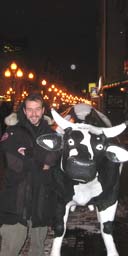
After a journey through ornate metro stations, back streets, hotel lobbies and endless corridors, I found the address. My few Russian sentences from the train were of little use but it was clear that they were a travel agency and that they weren't Moo. I left certain that I would never find out the mystery of my visa application. I wandered dejected up the street and came face to face with a statue of a cow with mad staring eyes. Could this be my host? Was I supposed to be some British expert on Mad Cow Disease? Could I really have bypassed Russian bureaucracy by being invited by the Moo Moo Cafe round the corner from the travel agents? Moo knows?
Despite Uncle Stalin's best efforts, Moscow remains a beautiful city; an informal, mysterious clutter in contrast to the well-ordered boulevards of St Petersburg. At the centre lies Red Square and the brooding mass of the Kremlin Fortress, whose mountainous red walls enclose a forest of gilded spires and soaring towers. I desperately wanted to get inside but the fortress was inexplicably closed.
It wasn't always this difficult to get into the Kremlin. In tsarist times, commoners were allowed into the courtyard so long as they prostrated themselves if the tsar appeared. The ticket office was unimpressed by my offer to do the same if Putin showed up. Nevertheless, I could visit the Kremlin Armoury full of royal sleighs, Fabergé eggs and the crown that sat on the top of Peter the Great's small idea-crammed head. It was certainly awe-inspiring but on a slightly more manageable scale than the Hermitage.
No one knows if the Kremlin will be open during my stay here in Moscow. I and my stupid suggestions are becoming a regular occurrence at the ticket office. In the meantime there are countless cathedrals, churches and museums to visit and perhaps a chance to explore Moscow's avant garde moshing art scene.
I may even get to visit Lenin's tomb in Red Square and find out if it contains the body of the world's most famous revolutionary or an elaborate wax candle with a goatee. By the look of the guards on duty that's probably not the best thought that's ever formed in my normally proportioned but disproportionately empty head.
