
As they say, you should be careful what you wish for as you might just get it. I've had plenty of opportunity to consider that fateful email I sent from an office in Camden to the Netjetters competition. At the time the idea of travelling to Siberia in the depths of winter seemed like a good idea. Camden Town can have that effect on people.
I now found myself travelling platskartny (that's 53 Siberian farmers, two scary provodnitsas and me in a dormitory on wheels), in the middle of the night, rumbling through the frozen Siberian wilderness in the direction of Tobolsk. Despite the din of snoring and the overpowering smell of socks, I was thrilled to be following in the footsteps of countless criminals, adventurers, dreamers and madmen into the unknown.
As we approached Tobolsk I was roughly shaken awake by one of the provodnitsas; a frightening apparition wearing a floral nightie and a fur hat which matched her moustache. I was instantly awake and still in shock as the train ground to a halt. I stood in the doorway looking out into the darkness, momentarily caught between the worlds of the snug, snoring carriage and the -16C degree snowdrift outside. "Where's the station?" I asked the provodnitsa. "This IS the station," she replied and indicated that her nightie was not made for sub-zero temperatures (or daylight I'd imagine) by shoving me down the steps. I fell into two feet of snow and waded along the train until my boot found the edge of the platform.
Tobolsk lies on the Irtysh River, the first of the mighty Siberian rivers which were used for transport in the years before the railway. The river rises in China and makes its way slowly to the Arctic Ocean but, despite its exotic location and its 20% Tartar population, the city still feels European. This is helped, perhaps, by the fact that the city buses are second-hand from Western Europe.
I climbed on a bus surreally claiming that its destination was Oslo and wondered if those beautiful Norwegian women I'd met at the very beginning of my trip knew that some wild-eyed Rasputin lookalike in a massive fur hat was now sitting in their old place.
A Netjetters reader named Alex had told me of how he once asked a Russian farmer what his hat was made out of. "Dog!" was the disturbing reply. As I looked round the bus it was clear he wasn't joking. The nervous looks of the few poor mutts in town seemed to confirm the whole sorry fashion tale. Fortunately this particular qualifying round of Crufts came to an end as I reached my hotel. The receptionist spilt her pickled cabbage at the shock of seeing a tourist.
With no tourist industry to cater for, the hotel seemed to make a living hosting noisy parties. Every night the lobby would be filled with the potentially explosive combination of local men chain-smoking and local women applying clouds of hairspray to architecturally impressive hairstyles. I suppose a little global warming would be welcomed in Tobolsk.
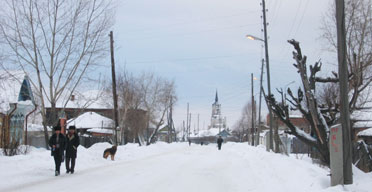
In its favour, the hotel was also next to Tobolsk's other impressive architecture, namely the cathedral and kremlin which sit on top of the cliffs looking out over the old town of ornate, multicoloured wooden houses; the river; and the vast empty expanses beyond.
The old town is located on the swampy ground on the river bank and is infested with mosquitos in the summer. With the ground frozen solid under several feet of snow and the nearest mosquito probably somewhere south of the Himalayas, I found it difficult to picture this. Eventually, with the completion of the direct railway to Omsk in the 1820s, Tobolsk was allowed to slowly sink into obscurity, and the mud, visited only by myself in the winter and, of course, clouds of mosquitos on summer holiday.
As a result Tobolsk has changed very little since 1849 when Dostoevsky passed through on his way to exile (an extreme form of research for his masterpiece Crime and Punishment) or 1917 when the last tsar and his family were held here before their execution. Perhaps, like me, they sat on the walls of the kremlin up on the cliffs and looked in the direction of the fading sun, Moscow, Europe (and Camden) and contemplated the approaching night from the forbidding Siberian east. Dostoevsky would have been attacked by mosquitos; I froze; the unfortunate tsar stayed long enough to experience both.
I got on a German bus supposedly going to Essen but arrived at Tobolsk station to catch the train further east to Omsk. I was sharing a compartment with a grandmother and her grandson and the usual game of charades revealed that the grandmother was originally from Dortmund in Germany but her family had settled in Siberia when she was a child. Perhaps they'd arrived on one of the buses. With the glittering, sunlit domes of the cathedral still in sight, the train stopped briefly by the river and the grandson ran out to one of the ice fishermen, returning with six frozen fish to the sweltering carriage. With 12 hours ahead of us, and seeing the look of horror on my face, he rushed out again and returned with half a pine tree to mask the smell of the rapidly defrosting six new passengers. By the time we reached Omsk pine needles had invaded my clothes and only my extreme distance from the sea prevented me being followed by a flock of seagulls.
After wandering through the city and nervously strolling across the ice to seen the frozen barges on the Irtysh River several hundred miles upstream from Tobolsk, I found myself back at the train station. I'd considered stopping in Novosibirsk further east, but a friend had forwarded an email from someone they knew in the city who had advised not to visit because there was nothing to see, nothing to do, no one ever went there and other places were much more interesting. I was initially intrigued. "What does your friend do in Novosibirsk?" I'd asked. "He works for the tourist board." Deciding against a one man attempt to kick-start Novosibirsk's tourist industry in the face of such opposition, I bought a ticket straight through to Irkutsk some 42 hours away.
I sat in the waiting room at Omsk and tried to get the pine needles out of my clothes. Perhaps the lack of sleep or my increasingly unkempt beard gave me a disreputable air, but I think it was probably the faint fishy smell. A terrifyingly stern provodnitsa marched up to me and started shouting. I meekly offered my ticket which she grudgingly accepted before summoning a truly enormous security guard and jabbing a fat little finger in the direction of the dozing drunk who had been snoring a few chairs away. The guard knocked the drunk's dog fur hat across the waiting room before lifting him by the scruff of his neck and dragging him away. The poor unfortunate was desperately trying to register what was going on while also attempting to recover his hat and vodka bottle. I looked at the provodnitsa quizzically but the way she wrinkled her nose suggested that, yes, I really did look and smell that bad.
Perhaps the train had been warned because, fortunately for everybody, I had a four-bed compartment to myself. By the time the train crossed the River Ob at Novosibirsk I was back to looking and smelling quite respectable. From the train the view of the city at night, with its neon lights and tall buildings in the middle of the Siberian plain, looked very inviting. I reckoned the city's tourist board simply needed to come up with a decent logo like "Novosibirsk - You don't have to be mad to come here but it helps". I thought the graffiti at the station which read "Welcome to our hell' was at least a start.
The train rolled relentlessly on across the time zones and the open spaces. Dawn found the train passing north of the Khakassian Republic and we reached the giant, and still unfrozen, Yenisey River at Krasnoyarsk by midnight. By the following morning the train reached its final destination of Irkutsk. After making myself at home I was sad to be leaving my compartment and reluctantly said goodbye to the carriage provodnitsa. She seemed relieved to be rid of me and the lingering smell of fish.
Irkutsk is closer to Beijing than it is to Moscow and for the first time I had a sense of being in Asia. The faces along Karl Marx Street ranged from blonde Baltic Russians to the local Buryatia Mongols as well as a few Chinese and Korean traders. I seemed to be attracting stares as the only person with a beard. I soon realised why as my top lip began to ice over in the intense cold. Before I could check into the hotel, several painful minutes had to be spent removing the icicles hanging from each nostril. The beard had to go, not least because I now no longer resembled my passport photo, and so the Siberian bandito look was consigned to the fashion dustbin.
Losing the beard didn't make it feel any warmer walking among the old wooden mansions and bright stone churches. Although only just above freezing itself, huge clouds of steam were rising from the Angara River into the bitterly cold air. Short walks to hear the beautiful singing at the cathedral or to visit the former mansion of Prince Volkonsky, exiled here in the 1840s, took on the epic quality of polar expeditions. The locals simply milled around eating ice cream and complained that -22C degrees was unusually warm.
"It was -10 here last week," said one, as if they'd just suffered a heat wave. "Don't worry," said another reassuringly, "It's much colder at Lake Baikal and in the Buryatia Republic on the far side." Great! I thought, that's exactly where I'm heading. So it looks like I'll escape the threat of heat stroke after all.
