
From lakes to the desert via Santiago my speedy voyage through Chile continues. I got my city fix from a few days in Santiago. I had been warned that after Buenos Aires, Santiago might be a little disappointing and the advice was about right. Although pleasant enough, I didn't find anything really compelling about Chile's capital city.
Sue and I were staying in Providencia (the posh part of town) and we walked the streets and squares of Santiago. The highlight for me was the Museo Chileno de Arte Precolombino, which displays fascinating artefacts from 4500 years of pre-Colombian civilisation. A recurring theme throughout the exhibition was hallucinogenics with all sorts of ancient drug paraphernalia on display. I wondered whether future global exhibitions would feature mirrors, credit cards and £20 notes.
The Atacama desert is the driest place on earth and covers 600 miles. I was expecting something out of Lawrence of Arabia with miles of sand dunes. Instead I found that the Atacama has an impressive series of landscapes and natural sights from salt flats, lakes and volcanoes to canyons, geysers and thermal springs. Enough to keep two keen travellers busy for a few days. But can a girl get a drink in the driest desert in the world?
Arriving in San Pedro de Atacama, my initial reaction was that I had well and truly left civilisation behind - wrong. Reminiscent of a hippy traveller hangout, San Pedro has a decidedly chilled feel to it despite the scorching heat.
The main street is a narrow, dirt road lined with small adobe buildings housing restaurants, bars and countless tour agencies. The bars and restaurants are relaxed with candlelit, caramel interiors, some have outside fires and all have compulsory ambient lounge music. Forgotten travellers with long hair, beads and beards wander the streets and the occasional package holidaymaker looks decidedly conspicuous.
Our first expedition was to the Salaar de Atacama and the Altiplanic lakes. We stopped en route at the small village of Toconao which has an irrigation system left by the Incas and an 18th century church. As we were leaving, two llamas chased a sheep across the village square (and I was missing the action on Albert Square?)
On then to the salt flats, home to three species of flamingo. Around a hundred of them were pecking the ground searching for supper in the extreme heat, occasionally giving us a spectacular view of their deep pink wings as they flew. We were treated to a close up of an 11-month-old flamingo baby who definitely had the ugly duckling thing going on, sporting more of a mucky grey than the striking pink of his relatives.
The Altiplanic lakes are stunning, a salt lake with a perfect reflection of its mountain backdrop and another, a deep blue lake struck an impressive contrast against the yellows and browns of the desert colour palette.
Later that night Leonardo, our guide and later my new "friend", drove me and a bottle of Pisco Sour out into the desert to look at the stars. It's a brilliant spot to star gaze as the light pollution is limited and the nights are clear. He showed me Orion's belt (whilst I was telling him to keep his buckled) and I taught him how to say "a-may-zing" as I saw the Milky Way clearer than ever before.
On an evening tour the following day we walked through the cheerily named Valley of Death and successfully made it out alive. The views were all the more enjoyable when we realised that the 2km walk was entirely downhill. To compensate for the easy descent, we arrived at Valle de Luna where we had to climb a steep sand dune to a ridge for a view of the valley at sunset. The colours must have changed on the mountains and eroded rock at least a hundred times during the course of an hour. It was a tranquil moment spoilt only by a loud American voice: "Oh Harvey, isn't this just the most peaceful place?" Why in this age of advanced science can someone not invent volume control for tourists?
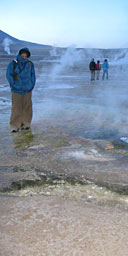
The real test of endurance came the following day. We had foolishly agreed to get up at 3.30am to visit the geysers at El Tatio. We left San Pedro at 4am, on a bus full of grumpy and sleepy tourists. The journey was to take us to an altitude of 4300m above sea level. Having been warned about the dangers of altitude sickness, Sue and I had abstained from alcohol and red meat the previous day; unfortunately the woman at the back, who was violently sick for most of the journey, hadn't. We were relieved to get off the bus until we realised that it was -3C outside.
We staggered into the darkness (actually Sue ran cross-legged behind a hill to answer a call of nature) and saw giant towers of steam rising up from bubbling craters in the ground. There were loads of them, varying in size and ferocity, and sounding like tea break at a kettle convention. Apparently early morning is the best time to see the geysers, as the weather is cold enough to make the emissions more dramatic.
Now a pause for a traveller's truth: ask me whether the geysers were worth the money, the freezing cold and the middle of the night wake up call and I would answer no. You could probably recreate the effect on some wasteland in a British inner city with a camper stove and a couple of pots of boiling water. At least then you'd get a cup of tea out of it.
Our next stop, however, made up for all the inconvenience of the geyser trip. We were dropped off close to Puritama, the site of a series of natural thermal pools. The pools are an average temperature of 30C and are connected by mini waterfalls. Paths lead off to the seven small pools and we found our very own spot of heated heaven with a small sundeck to boot. As we stripped off, layer upon layer, down to our swimmers (thankfully the sun had come out bringing the temperature up to around 25C) we swapped our thermals for the warm, crystal clear water of our private pool. Our mini waterfall provided invigorating neck and back massages and a bubbling Jacuzzi experience.
As I floated in that incredible natural bath, looking up at the cloudless blue sky and bright sun, I thanked each and every person, whoever you were, for voting for me to become a Netjetter. This was truly an oasis in the desert.
