
There are traditionally three maxims for holidaying in Corsica: learn French, expect to spend more than you would on mainland France and bring your international driving licence.
Travellers seeking more than a week lying by a hotel pool or lazing in a rustic gite often find that escaping the crowds requires running the gauntlet of the most dramatic - and unkempt - switchback roads in Europe. Indeed, Corsica's dramatic topography of hairpin bends, sheer drops and white-knuckle intersections encourage comparisons with Tibet rather than Nice.
With Corsica slowly opening up to international tourism, the first two maxims still apply. In recent years, the latter has become less pertinent; as the number of tourists from outside the traditional markets of Italy and France rises, Corsica's notoriously ramshackle train system is being updated. Tourists to the renegade Mediterranean island are discovering a whole new way to explore its rural heartland: Corsica par le train.
Le Micheline, the island's uniquely low-tech boneshaker, cuts a 157km swathe through the Corsican countryside connecting the northern ferry port, Bastia, with the capital, Ajaccio. En route it takes in the walker's hub of Corte and extends, via a gloriously dinky 73km toy-train shuttle, along the northwest Balagne coastline to Calvi.
The network was built in the halcyon days of railroad design and its feats of engineering remain impressive: 32 tunnels, 83 level crossings and 76 viaducts (one of them, the Pont de Vecchio to the south of Venaco, is a Gustave Eiffel masterpiece). Exploring the Corsican rails, therefore, is the kind of rustic experience that appeals to more than just Euro trainspotters.
Despite the ancient rolling stock and narrow-gauge tracks, the Micheline has kept on going like a living, wheezing museum piece. It stops frequently for cows on the track and breaks down quite randomly, but always does so with a certain hard-to-hate, frozen-in-time charm.
Now plans are afoot to breathe life into the network with new tracks, improved rolling stock and more trains a day by May 2004, the start of next year's peak season. The network's baby sister, the Tramways de Balagne, which runs between the resorts of Calvi and Ile Rousse stopping at various hidden coves and tiny beaches en route, is also due for a facelift.
It was at one of these stops that I found Corsica's best kept secret, Algajola. With ochre facades, sun-kissed squares and an old citadel peeking out over the ocean, this charming little coastal town retains the sense of unspoilt tranquillity that sets Corsica apart from other Mediterranean destinations. Better still, it has all the facilities you will ever need with some decent hotels, colourful little eateries and villas for hire from UK operators.
Algajola may be untouched by mass tourism, but Cap Corse is so unknown it even lacks an organised public transport system beyond its visitor's hub. This maquis-covered peninsula, 40km long and 10km wide, stands out from the rest of Corsica, giving a giant geographical finger to the French Riviera. The first stretch, running north from Bastia, is well served by good roads and regular bus services. But once past Macinaggio, and with the rocky ascent of the peninsula ahead of you, you have to resort to the oldest form of transport known to man: hitchhiking.
Thankfully France has a well developed hitching network and Corsica, in particular, stands at the vanguard of France's hitching movement. There is a strong tradition of giving rides to stranded foreigners. As a first-timer, I became a convert to the dying art and found it was a great way to meet fellow travellers.
My first lift was from a friendly Parisian couple who were bowled over by the scenery and recent fans of the Corsican landscape. From Barcaggio, a rather taciturn local family took me a short way with the father smoking heavily and the mother reminiscing about her wild days as an au pair in Putney.
After an overnight stop in Centuri, I was back on the road with a young Italian couple, who had a penchant for national parks and driving at breakneck speeds along implausibly narrow roads - as only the Italians do.
After several long, hot hours of standing by the roadside with a small cardboard sign, I finally rolled into Nonza with a lift from a friendly local. He was delivering a fridge to his cousin, who insisted we all stopped for a celebratory coffee before saying our goodbyes.
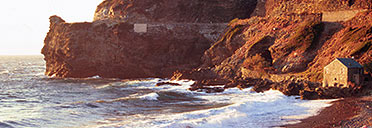
Nonza is a charming little village standing 150m above a blackened shingle beach. With a population of 70, it is the largest community on the western cape. The journey there had been fascinating, with tiny fishing harbours carved from rocky bays, historic Genoese watchtowers clinging frantically to sheer cliff faces and some of the most dramatic switchbacks in Europe.
Sitting in Café de la Tour, the focal point of Nonza's village life, with my Perrier à la menthe and a dramatic ocean backdrop, I had reached my final destination. I had tamed the iron horse, thundering through the countryside and juddering in my seat with every thrash and turn of the rolling stock. And my introduction to hitching had provided me with a slew of travelling companions eager to swap tales with a lone Brit in the middle of the Corsican countryside.
Next time, I vowed, I'd be brushing up my French and stocking up on travellers cheques, but leaving the driving licence at home.
· David Atkinson is a co-author of the new edition of Lonely Planet Corsica (Lonely Planet, £9.99), out in April 2004.
Way to go
Getting there: If you are travelling independently, the cheapest option is to pick up a flight online with EasyJet to Nice. From there, take the ferry to either Bastia or Calvi. The two main operators are SNCM (00 33-4 95 54 66 90; www.sncm.fr) and Corsica Ferries (00 33-4 95 32 95 95; www.corsicaferries.com). The latter has a better reputation for service and efficiency.
Corsica by rail: For train travel in France and Corsica, Rail Europe (08705 848848, www.raileurope.co.uk) offers a one-zone Inter-Rail pass available for 12 days (£182) or 22 days (£219), with reductions for those under 26. Pass users qualify for a 100% discount in mainland France, a 50% discount in Corsica.
Corsica 'en stop': For more information about hitching and car-sharing schemes in France, contact Allostop-Provoya (00 33-1 53 20 42 42; www.allostop.net) or Allostop France Covoiturage (00 33-6 73 88 35 54; www.ecotrajet.com).
Corsica operators: From 2004 Holiday Options (08700 13045, www.holidayoptions.co.uk) will be flying direct charters to Calvi from Gatwick, Heathrow, Stansted, Manchester, Birmingham, Edinburgh and introducing a new flight from Bristol. They are offering a lead-in price for next summer of £499 per person based on return flights from Gatwick to Calvi, transfers and two weeks at the Hotel Saint Christophe (www.hotel-saint-christophe.com).
Explore Worldwide (01252 760000; www.exploreworldwide.com) has a 15-day Corsican Villages walking holiday for £765-795 (plus £115 payable locally), including accommodation & some meals in hotels and gites, international flights and taxes. The walks are graded moderate with some strenuous sections (usually optional).
Corsican Places (08701 607503; www.corsicanplaces.co.uk) has seven nights staying inn a four-bedroom villa with a private pool for £410 per person, including flights from Gatwick to Calvi or Figari, taxes and car hire.
