
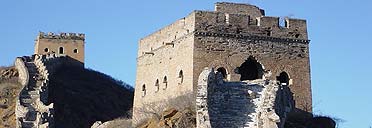
When I'd first arrived in Beijing a few weeks ago, some of the locals had advised me to go to the TV tower for a stunning view of the city. I'd replied that I would go once the weather cleared up, which they thought was a strange thing to say. Now back in Beijing I could see what they meant. The sun was a dull red ball peering through a thick blanket of smog. Frankly you could probably see further under water. These were hardly ideal conditions to visit the Great Wall, but then going to Beijing and not visiting the wall is, well, unthinkable.
Like many other wonders of the ancient world, the Great Wall was of dubious effectiveness. The Mongols and Manchus to the north weren't going to be deterred from mayhem and plunder by a wall; in fact you probably wouldn't stop the Mongols even if you mined and electrified the thing. Eventually China's Manchu rulers refused to waste money repairing it seeing as it hadn't stopped them invading the country themselves. For something that doesn't work, however, it makes a spectacular sight.
When President Nixon first saw the Great Wall he remarked "It sure is a great wall," thus confirming that he was a far better president than he was a comedian (not that that's saying much). My first reaction was disappointment because, as the wall snaked up and across the steep slopes, it was quickly lost in the smog blanket that had followed us from Beijing.
Not to be put off, we started to climb along the wall, up near vertical steps, past crumbling watchtowers and even crumblier old women selling postcards.
The wall at Simatai is remarkably unspoilt, the Chinese authorities currently lacking the inclination or (more likely) the time to install the blaring music, multi-coloured lights and plastic statues they seem so keen on elsewhere. I suppose if anything was going to keep out the Mongols then that might have done the trick, but it's too late to find out now.
We climbed for some time until we were stopped by a guard! I didn't realise the wall still needed them. Clearly the Chinese are taking no chances on being taken by surprise by the next delegation from Mongolia. The guard spends most of his time stopping those tourists who try to climb on the most treacherous parts of the wall in order to escape the postcard sellers.
The views from the mountain top were impressive but the poor visibility was frustrating. I decided to come back on a clearer day despite the obvious reluctance of my weary legs that had transported me up the holy mountain of Tai Shan and along the Great Wall in only a few days.
In preparation for the next climb I travelled from bar to bar in Beijing, guided by Lisa and Michael. Finally the next day started clear and bright (unlike myself) and the three of us hurtled along an empty expressway, totally deserted on Sunday morning, to a remote part of the wall near Miyun. There are ticket booths next to sand dunes in the Gobi Desert in China so we were hardly likely to escape them here but at least there were no guards to stop us taking our lives in our hands on the tumbling masonry.
The views were wonderful, with the wall randomly climbing up and plunging down the mountainsides into the far distance. Focusing on this and trying not to fall off the edge of the parapet, we completely lost track of time. A few hours later, after a high-speed dash back to the capital, my aching legs were propelling me and my luggage across Waiting Room Number Two in Beijing train station only to find I'd missed my train by a mere 90 seconds. Beijing can be a very difficult place to leave.
The delay gave me a chance to track down an electrical, psychedelic, rotating musical buddha for Lisa to thank her for her hospitality. They have to be seen to be believed and, well, I thought I'd get her something practical. The next day, and before Lisa could tell me that some wine glasses would have been a better idea, I'd actually succeeded in catching a train out of Beijing. I was heading for Qingdao, a fascinating former German treaty port and the jumping-off point for the ferry to Korea.
Colonialism in China left a bitter legacy. The German capture of Qingdao in 1898 after the Boxer Rebellion was no exception but there was one positive outcome. The British left post offices, the French left patisseries and the Germans left breweries. Qingdao is home to the massive brewery that produces the ubiquitous Tsingtao beer. Hardly by coincidence it's also a major holiday destination for the Chinese. As the train pulled into the station the tannoy was playing a martial version of Roll out the Barrel.
Tsingtao beer is actually very good stuff. A fact varyingly attributed to its German heritage, its use of local Lao Shan mineral waters, or its price of 20p per litre. I settled down on the waterfront with a cold bottle of the local brew and some delicious barbecued squid and looked out across the bay filled with battleships towards the lighthouse. I promised my legs that there'd be no more mountains or walls to climb for some time.
The local people of Qingdao are perhaps some of the friendliest in China, which is understandable seeing as they live next to a massive brewery. The streets are quite and tidy and the drivers have discovered that car horns have an optional silent state. Robert, a Netjetters reader, had emailed me to tell me to expect this but I'll admit that I hadn't quite believed him. Now I was wandering through the pleasant lanes winding up the hills from the beach admiring the old Bavarian villas, germanic gables and teutonic towers among the new glass skyscrapers.
The former German governor's residence was so expensive to build that the Kaiser immediately sacked the governor when he got the bill. It was built in 1903 and was modeled on a palace in Germany. Why it was felt the planet needed two such buildings is a mystery because the residence is perhaps the ugliest building in China (alright then, after that coal mine in Datong).
Part trifle, part rockery, it's the only structure in the country that would actually benefit from the obsession of many Chinese town planners with covering everything in white tiles. Why Mao chose the governor's residence as a holiday home is anyone's guess. Chang Kai Shek chose a far more stylish villa along the coast from which he fled to Taiwan after losing the civil war to Mao.
I've had a fantastic time in China. No country could be more fascinating than this one. No country could be more baffling or surprising for that matter. One day you could be climbing the Great Wall, the next you drinking a cold beer in a mock Bavarian castle. When I return I expect to find the authorities have put a Bavarian castle on top of the Great Wall for added convenience.
The South Koreans have a wall of their own but, unlike China's, it's still very much in use against potential northern invaders. Unfortunately the US army may require me to get a haircut before I can see it. I'll find out soon enough when I get there after my trip across the Yellow Sea.
