The slow trains from Kyoto ambled through Japan's mountainous scenery, along sea cliffs, past rural village stations and bustling cities and deposited me in Tokyo station at the height of the evening rush hour. My luggage and I were swept along by the tide of office workers into the maze of tunnels and 30 minutes, a sprained wrist and a good trampling later I managed to find the right subway line for my hotel. The six commuters left on the platform who'd planned to squeeze into the tiny space on the train, now occupied by my rucksack, didn't look too pleased and I would have apologised if I could breath. Little did I realise, pinned against the wall of the carriage, that the morning rush hour is much worse.
Unlike the place in Kyoto, my hotel did possess such luxuries as chairs and showers but I knew enough by now to realise that the "Japanese-style" room I'd booked meant it had no bed. Once I'd put my luggage down there was almost no room to sleep. You could almost touch all four walls at once. I was relieved that I had booked one of the "medium' rooms and assume that in the "small" rooms you have to sleep standing up. Waking up in the morning on the floor next to your luggage is normally reserved for those travel disasters when you miss the last plane and have to sleep in the airport. In Tokyo it was an everyday experience.
I was impatient to explore the vast metropolis and headed for the subway station only to get swallowed up, this time, by the morning rush hour. A line of uniformed conductors with white gloves was on hand to shove the commuters into the already crammed carriages. Rather than face the crush, I decided to wait until 9am and headed over to one of Japan's 4.5m vending machines for a can of hot coffee.
If Kyoto symbolises the ancient history and culture of Japan then Tokyo represents the equally fascinating ultra-modern side of the country. Not that the transition from one to the other has been easy. Tokyo has its temples and palaces, just as Kyoto has its vending machines, but many were rebuilt after much of the city was bombed in the second world war. The Imperial Palace didn't escape the destruction and actually dates from 1968. Having had his palace flattened it seems surprising that former emperor Hirohito's reign is now remembered as the "showa" period meaning "bright peace". However, this rewriting of history is nothing compared to the neighbouring Yasukuni Shrine which commemorates Japan's war dead.
The peaceful shrine still causes enormous controversy and the papers were full of angry protests from China about the visits the Japanese prime minister has made there. Fortunately the neighbouring museum has no Chinese (or Korean) translations or we'd have a real situation on our hands. The few English translations present recent Japanese military history with wild inaccuracy and by the end my jaw hurt from falling open in disbelief. I left unconvinced by the argument that the suicide guided rocket, the suicide torpedo and the suicide kamikaze plane in the exhibition were the tools with which the "peace-loving" Japanese governments of the early 20th century tried to liberate Asia from colonial oppression.
Perhaps no one knows how difficult Japan's transition has been better than Omura Masujiro whose statue stands in the shrine. As vice-minister for war in 1869 he tried to modernise the Japanese military after its humiliation at the hands of western powers. He was attacked by a group of disgruntled samurai (not the kind of people you want to offend) and "died of his wound". How you can be attacked by a group of samurai and only get wounded once (albeit fatally) is a mystery to me. The museum also contains a fantastic collection of samurai weapons and armour, minus their disgruntled owners.
In between the frantic rush hours, Tokyo still maintains a break-neck speed. Among the skyscrapers and the neon signs, 12 million people surge to and fro apparently permanently attached to their mobile phones. Mostly in complete bewilderment, I wandered from district to district totally lost and tried to understand the various machines from which you can buy your meal or hotel room or train ticket or anything else for that matter. Sometimes it seems that the machines actually run the city and I shudder to think what would happen in a power cut. The evening rush hour swept me back to the hotel.
As I tried to relax I thought I was trembling from the shock of it all only to realise it was actually an earthquake. As if my first experience of the sheer energy and dynamism of Tokyo hadn't been traumatic enough! Not even the ground stays still in Tokyo. The locals paid absolutely no attention to the fact that the building was gently wobbling although I continued shaking long after the building stopped.
With the stress of the hyperactive city enough to reduce a visitor to a gibbering wreck, blowing off steam is serious business for Tokyo inhabitants. Fortunately they show a great deal more originality than the westerners hanging around the Rappongi District trying to pick up local talent. It's surprising to see such innovation from the multitude of suits and school uniforms, but maybe that's the point. With such pressure to stick to the system in their working lives, the inhabitants of Tokyo really know how to be unconventional when it comes to entertainment.
Sure they have conventional leisure pursuits like playing golf or walking the dog; except that in Tokyo you go to one of the many multi-storey driving ranges to blast the golf balls at a target and the dog will be dressed in the latest fashion from one of the many dog clothes boutiques.
A walk in the park at this time of year is turned into a frenzied opportunity to look at cherry blossom. Everyone in Japan is totally fascinated by it. This is a contagious condition and I found myself taking photos and making repeated visits to the park, just in case more trees had blossomed that morning, just like the locals. I'd get into long conversations about where the best cherry trees were. It's all highly disturbing.
The sheer surreal escapism of Japanese leisure time was staggering. Convenience stores contain shelves of Manga comics filled with fantasy figures in bizarre and strange adventures. I joined the school kids and businessmen flicking through the magazines in the shop. I chose a comic at random and tried to understand the plot from the pictures. It was extremely violent and appeared to centre on some kind of armoured duck character. Unsurprisingly it made absolutely no sense until I realised that the Japanese read from back to front. I tried this and it made even less sense.
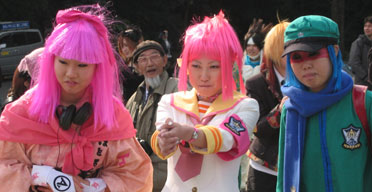
Perhaps strangest of all were the girls that hang out on Sundays near Harajuku station. They were like living Manga characters and their appearance is quite indescribable. Gangs of girls with pink hair and space age clothes mixed with Clockwork Orange Goths, punk shepherdesses and lizard ninjas. Even the earthquake-ignoring locals heading to the beautiful Meiji temple found it noteworthy. The shepherdesses started playing volleyball with the cyber rockabillies while the Goths sat in the corner looking miserable.
For my last night in Japan I decided to move out of my tiny hotel room and into a capsule hotel near the Senso-ji temple. There really wasn't much difference in the amount of space but I'd always wanted to try one of these things out. Since I paid a machine for the room, the receptionist's only job seemed to be to show the odd tourist how everything worked. My capsule was not much bigger than a fibreglass coffin. If I were killed in an earthquake at least they'd know what to bury me in. The capsules were stacked on two levels. Climbing up and down the ladder to get in was a bit difficult in the dressing gown the hotel had given me but, all in all, it was a very comfortable experience.
On the top floor of the capsule hotel was a sento, or public bath, which unfortunately lacked my favourite - the electric bath - which, surprisingly considering their love of electricity, aren't popular in Tokyo. I soaked in the hot tub trying to make sense of everything I'd seen in this amazing city but quickly gave up. The huge windows gave a fantastic view over the city down the river towards the Rainbow Bridge and Tokyo's own Statue of Liberty (Yes they have one and an Eiffel Tower too!) As the sun set the vast acres of neon buzzed into action lighting up the city in every direction. I stood there for a while, awestruck, until I realised that all the commuters heading home on the northbound Shuto Expressway number six could see me and I decided to put some clothes on.
