
At the point where the desert turns a deep copper, our driver, Gul, in an unannounced, matter of fact way, swings the car across the highway in the wrong direction. He drives off into the red sands, before stopping, he says, to relieve the pressure. In the tyres, he means. Job done, he returns to the driving seat and pronounces calmly: "Now I am going to show you a rock that looks like a camel. Fasten your seatbelts."
And with that we're embarking on a terrifying, exhilarating, lurching ride across the dunes. I try the odd "yee-har" to demonstrate my uncertain enthusiasm while my girlfriend grips the door handles and stares at her feet, which for the next few minutes are rarely in the expected position in relation to her head. The car races up hills, swoops, slithers and slips in the sand, before coming to a halt in front of a rock that looks less like a camel than I do. Gul, the architect of this momentary insanity, shows all the emotion of a cabbie sitting at a taxi rank.
Ours are not, as Gul observes glumly, the first tracks in the sand. Dune buggying is a popular pursuit now, one of the few things to pull many visitors beyond the huge seaside shopping emporium that is Dubai. Having landed several times in the Gulf without ever making it beyond the airport duty-free, I was now on a quest to discover what else, if anything, the Emirates held.
Two days earlier, we awoke in the back of the 4WD that collected us from a night-time flight to find ourselves in Dibba, several hours east on the Gulf of Oman, watching as a man with a rich baritone voice auctioned off a large catch of kingfish on the dockside. It felt like a good start. We were heading up into the mountains, which looked unforgiving, grey and bare. Goats and acacias are all that dot the landscape here. Somehow, people live in this wild, barren region, where no rain has fallen in five years. The homes are little more than tiny stone huts, sometimes with terraced strips of land that look as if they have long stopped responding to cultivation. As we drove, a helicopter passed us, airlifting sacks of food to the mountain hamlets.
Small roads, in some places little more than rock, wind through the ravines and wadis. Today's driver, who (unlike Gul) was not the chattiest of men, stopped where several caves dotted the cliff face. "Bin Laden in his cave," he said. I was pleased he had made the joke first; at least I thought he had, although he continued, staring into the middle distance, "No, George Bush could not find him..."
My girlfriend spotted a man carrying a sack up the rock face, and waved. He waved back, beaming ecstatically. Clearly they don't get many visitors in these parts. A little later, a small truck passed by, carrying a group of keffiyah-clad boys sitting in the back, one of whom gave us the finger. We continued to the highest point in the road, ate an unappealing, cold burger-based picnic, and drove back all the way down to the coast where, astonishingly, there was a five-star hotel.
The Meridien Al Aqah is a bold venture - a throwback, perhaps, to how Dubai might have seemed when the first coastal resort was built, or possibly how the first space rocket looked when it landed on the moon. In a long stretch of bare, empty coastline, in front of the bleak mountains, there's a sudden 21-floor eruption of hotel. One day, possibly, the Al Aqah will jostle with many other hotels for the beach space. Right now, the walls surrounding the resort seem fairly redundant, except perhaps to clearly signal to bemused motorists that a resort really has sprung up where the road apparently used to be. From the inside, it's only the sight of the occasional burka on the beach beyond the Baywatch bar that gives the exotic location away.
In a place so far from anywhere, you need to provide your own entertainment; the mainstays here were house band Ultimate, with support from the Al Aqah dancing girls and a belly dancer whose name I forget. We never saw the resident keyboardist, Natalya, but it seems that whether you require a word-perfect English covers act, a Parisian-style chorus line or an exotic midriff-wiggler, Russia is now the place to look. The Al Aqah should be commended for boldly providing the kind of highly enjoyable cheese that too many posh European hotels eschew.
We reluctantly forsook beach volleyball and aqua aerobics for a boat trip the next day, although it turned out to be a fabulous excursion, and considerably more fun than the mountains. At Dibba harbour, a group of French parents and children and ourselves took some convincing to get aboard as our guide, Shami, led us to a speedboat that looked little able to house our numbers and even less like an authentic wooden dhow. You felt we weren't the first to voice reservations; but Shami promised that we'd be happy in the end, and, in fairness, we were.
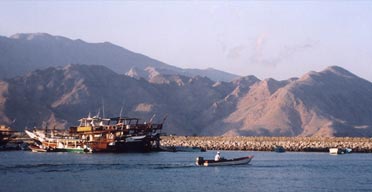
The cruise meanders along the coast of the Musandam peninsula, part of the neighbouring sultanate of Oman. Tiny settlements perch on small plots of land at the base of the rocky mountains that rise steeply out of the sea. Several can only be reached on the water, away from roads or electricity.
Lunchtime saw us pulling into a small bay, one where the beach proved to be more of a work than sunbathing place for any locals; after pioneering their way through some oily debris, our French co-passengers soon made their way back to the boat. Snorkelling was more successful: the chance to see some fabulous coral and large tropical fish, albeit contending with enormous flotillas of jellyfish. These were, we were told, non-stinging varieties, but there's still something a little disconcerting about putting your face into such gelatinous waters.
Shami - who had been constantly feeding us grapes, dates, nuts and drinks all morning - then astonished us further by producing a fabulous Arabian spread from another hatch. In the afternoon, we headed further north, to where dolphins apparently like to swim along with the boats - although, alas, not ours today - and to a huge rock that juts from the sea and, they say, marks the best diving in the Gulf. We turned back after reaching the tiny town of Lima, seemingly cut off from the world, though not enough to stop the kids wearing Manchester United shirts.
Back on land in Gul's 4WD the following day, the final leg of our tour took us through the desert back to Dubai. Little of the Emirates is blessed with startling beauty, but there are moments. The Hajar mountains form the backdrop. Hajar is Arabic for stone, and there can't have been many other contenders if they were looking for a literal name, bar perhaps the claims of the occasional goat. At one point Gul veers off into a wadi, driving along this dry river bed until we come to a cluster of trees and a pool of water, where two young men are furtively drinking spirits instead of attending Friday prayers.
Along the road, we pass occasional sights and curiosities: what looks like a huge metallic sheet but turns out to be men drying sardines in the sand; an oasis of century-old date palms; the tiny, 400-year-old Bediyah mosque; the Masafi mountain market of fruit sellers and carpet vendors; and the remains of a 17th-century fort in Fujairah, whose old town was largely destroyed by British invaders.
With the latest British invasion, that of the tourists, the rest of the Emirates has perhaps chosen to keep its head down. In a country where the majority of the population are migrant workers drawn to the cities, or the oil and port industry, with no permanent residency or citizenship here, there's an obvious path of separation and coexistence. A two-tier system sees hotels serving alcohol - illicit outside their doors - and offering carefully cordoned "pork corners" in their breakfast buffets. No one we meet in the tourist industry is an Emirates citizen; perhaps the locals aren't really that keen on trippers poking around their villages or ancient mosques, and prefer to have them doing their sunbathing and shopping in Dubai.
Way to go
Emirates (emirates.com, tel: 0870 243 2222) operate direct flights to Dubai from Manchester, Gatwick and Heathrow.
The Musandam tours (with an English-speaking guide/driver and some meals), with four nights at the Royal Mirage, Dubai and two at Le Meridien Al Aqah Fujairah, costs £1,259pp with Arabian Odyssey, including Emirates flights from Heathrow and taxes and transfers. Alternatively, spend all six nights at Le Meridien Al Aqah Fujairah from £927pp.
Call 01242 224482 or visit arabianodyssey.co.uk for more information.
