
Majorca has changed considerably since George Sand, her two children and a sickly Frederic Chopin in tow, spent four winter months on the island in 1838.
The writer formed a poor opinion of the inhabitants. She found them inhospitable, thought the peasants lazy and, when they did work the fields, observed they did so without even the most rudimentary technology to make the most of their labour.
Most shocking to Sand, the islanders shunned the sick and would not lift a hand to help those in need such as her beloved Chopin, whom Sand called "our invalid" in her book, A Winter in Majorca. Even on the mundane matter of accommodation, she found Palma woefully short of lodgings; tenants even had to bring their own windows if they did not want to freeze.
Sand's book is widely available in Majorca in English, French, German and Spanish. Perhaps, the Majorcans are playing a posthumous joke on the author, because the book shows what a long way the island has come since she besmirched their good name.
So inhospitable in Sand's time, Majorca has since become a byword for mass tourism. The northern coast is dotted with resorts such as Port de Pollenca, Port d'Alcudia and Cala Sant Vincenc and the island is so popular that hoteliers last year imposed a new green tourist tax. Even in February, tourists abounded.
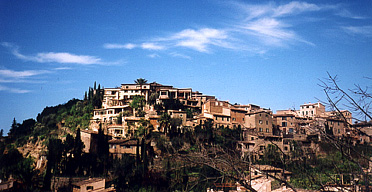
For a week we based ourselves in the tiny town on Fornalutx, at the head of a valley in the Serra Tramuntana mountains, in the north-west. Fornalutx's size was part of its charm; it has just one bar, a cafe and a grocery off the church square (little larger than a blotting paper) a pharmacy, a souvenir shop and four restaurants, one of which was for sale and one closed. And an estate agent.
Fornalutx has become so beloved by foreigners - especially Germans - that they own half of the town's 300 houses. In fact, Fornalutx is just the kind of place for property programmes such as A Place in the Sun.
We stayed at the Petit Hotel, one of two small hotels standing next to each other. Our first room, looking out on to the street, was rather dark. The manager kindly moved us to the back where we had a much more inspiring view. This time we looked out upon neat rows of orange trees and steep mountainside, laced with terraces of olive trees. The prettiness of the scene was tempered only by the fact that the terraces were initially built using slave labour.
Fornalutx has a plaque claiming that it is the loveliest village not just in Majorca, but also in all of Spain. The boast is not entirely absurd. It has a bewitching location, nestled in the mountains, and the stone houses with their characteristic amber-coloured stones and green wooden shutters glow like gold ingots in the winter sun.
Every day, we would march to the nearest big town, Soller, walking past streams, orchards of orange and lemon trees as if we had entered a Cezanne painting. Even when it was overcast, the grey clouds obscured the mountain peaks and filled the landscape with drama.
We would often pass groups of middle-aged or elderly Germans on our walks. Many wore the latest kit - the same red as Swiss army knives - full of zips and pockets. A good number used hi-tech walking sticks like ski poles. A bit over the top for walking down country lanes, we thought, until we started hiking up and down wet, uneven, rocky mountain paths. We then cast covetous glances at these pensioners propelling themselves along with their walking sticks.
Hiking is a big draw in these parts because of the many picturesque mountain trails that wind past the ubiquitous terraces of olive trees, isolated fincas (farmhouses) in lush green mountain meadows, and the occasional herd of sheep with their tinkling bells.
We made two hikes. One turned out to be more than we bargained for. We thought we were going up 1,000 feet, but it was in fact 1,000 metres. We also committed the rookie mistake of not bringing food with us, so that four hours into the hike, I craved a granola bar or a piece of chocolate for a sugar rush. As the trail kept rising into the clouds, I had visions of having to drag myself to safety like in the film Touching the Void.
Back in the hotel room, after a hot bath, our impromptu picnic of meat pies, Emmental cheese, bread and Rioja tasted as delicious as anything in a Nigel Slater cookbook.
We also hiked along a gentler trail along the coast to Deia, the small hilltop town where Robert Graves, the poet and novelist, spent his last years. Deia sits on an almost perfect cone ringed by terraces of olive trees. Graves, who wrote Goodbye to All That and the I Claudius novels, is buried in a tiny churchyard at one of Deia's highest points, overlooking the valleys and the sea - a grave with a view, you might say.
After having read Sand's book, we had to visit Valldemossa, the monastery town, where she stayed after fleeing Palma. Sand and Chopin rented a couple of cells that were anything but small. They were spacious and bright with pretty gardens overlooking the valleys. Inevitably, Chopin's music tinkles in the background as visitors browse sheet music annotated by the composer himself and original letters by Sand, but the overall effect is tasteful rather than tacky.
Sand may have been withering about the inhabitants, but she waxed lyrical about Majorca's physical beauty, especially the landscape at Valldemossa.
She wrote: "It is one of those rare views that overwhelm one, because they leave nothing to wish for, nothing to imagine. Everything that the poet or painter could dream of, has been created by nature in this space. An immense assembly, infinite details, inexhaustible variety, hazy forms, sharp outlines, vague depths, is all there, and art can add nothing to it."
So in some respects, Majorca has hardly changed at all.
Way to go
Mark stayed at the Petit Hotel in Fornalutx. Prices start at €77.65 for a single room and €129.40 for a double.
EasyJet flies to Palma from a number of UK airports.
